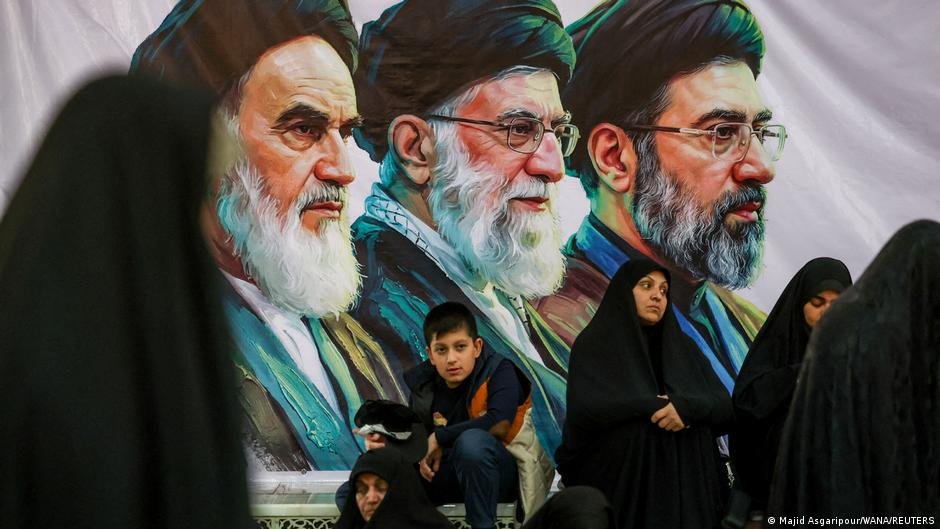
The Islamic Republic of Iran is entering a new political era as Iranians on Thursday prepared to bury their slain Supreme Leader Ayatollah Ali Khamenei in his hometown of Mashhad in northeastern Iran.
His son and successor Mojtaba Khamenei still remains hidden from public view after being disfigured in the US air strike that killed his father when the Iran war began on February 28.
The younger Khamenei — the Islamic Republic’s third supreme leader since the 1979 Revolution — was conspicuously absent from even the official mourning ceremonies for his father.
This leadership transition in Iran represents far more than a simple change at the top of the state.
It is the culmination of a profound institutional transformation that unfolded during Ali Khamenei’s nearly four decades in power.
To view this video please enable JavaScript, and consider upgrading to a web browser that supports HTML5 video
Reza Talebi, a political analyst, said Khamenei gradually reshaped the power structures of the Islamic Republic.
“Unlike Ayatollah Ruhollah Khomeini, who established a system after the revolution that rested on revolutionary legitimacy and his personal authority, Ali Khamenei began systematically restructuring that system,” Talebi told DW.
Over the past 37 years, the influence of senior clerics and Shiite semnaries over key political decisions has steadily diminished, he pointed out. In their place, security institutions, the Office of the Supreme Leader, and the political and military networks associated with it have become increasingly dominant, the expert added.
Former presidents appear sidelined by the regime
This transformation has also altered the role of Iran’s elected institutions. In Talebi’s view, presidential elections have increasingly evolved into contests conducted within a pre-defined political framework.
Although presidents from different political factions were able to pursue their own domestic priorities, they had limited room for maneuver in strategic areas such as foreign policy, the nuclear program, and regional affairs, Talebi said.
Notably, during the six-day state mourning ceremonies for Ali Khamenei, none of the Islamic Republic’s three former living presidents — Hassan Rouhani, Mahmoud Ahmadinejad, and Mohammad Khatami —appeared alongside other leading figures of the political establishment.
Instead, official images focused on representatives of the security apparatus, particularly commanders of the Islamic Revolutionary Guard Corps (IRGC), as well as incumbent President Masoud Pezeshkian.
Pezeshkian is widely believed to have maintained a close working relationship with Mojtaba Khamenei. He played a central role in negotiations aimed at ending the Iran war.
To view this video please enable JavaScript, and consider upgrading to a web browser that supports HTML5 video
The conflict, which began on February 28 with US and Israeli attacks on Iran and ended nearly six weeks later in a fragile ceasefire, gave way to a diplomatic process that Mojtaba Khamenei eventually approved.
Prior to that, according to a statement attributed to him and circulated by state media, he had “in principle” held a different position.
The statement said that he agreed to the negotiations after President Pezeshkian, acting as chairman of the Supreme National Security Council, assured him that he would “safeguard the rights of the Iranian people and the interests of the Axis of Resistance.”
A more confident IRGC
Alongside Pezeshkian, Mohammad Bagher Qalibaf — a former IRGC commander and current parliament speaker — also played a key role in talks with the United States.
On June 14, 2026, the United States and Iran agreed on a draft Memorandum of Understanding (MoU) designed to serve as the basis for negotiations on a broader agreement.
However, following the latest escalation in the Strait of Hormuz, US President Donald Trump cast doubt on the future of the talks with Tehran, while leaving his next steps unclear.
“Iran interprets Article 5 of the Memorandum of Understanding to mean that the phrase ‘the Islamic Republic of Iran will make arrangements’ gives Iran the sole authority to establish the necessary conditions for reopening the passage [Strait of Hormuz],” wrote Hamidreza Azizi, a political scientist specializing in Iranian foreign and security policy, on the platform X.
Iran regards control of the Strait of Hormuz as one of its most important strategic bargaining chips. Tehran therefore wants to prevent the establishment of alternative shipping routes — such as those passing through Omani waters and involving the United States or international organizations — without Iranian approval.
The IRGC has played a decisive role in the escalating confrontation with Washington.
According to Mojtaba Najafi, a France-based researcher specializing in emerging political and social movements, the war involving the United States, Israel, and Iran has significantly strengthened the IRGC’s confidence as a political and social force.
To view this video please enable JavaScript, and consider upgrading to a web browser that supports HTML5 video
An internal power struggle?
The crisis has not translated into greater influence for moderate factions, including supporters of former President Rouhani, who signed the 2015 nuclear agreement.
“We are likely to witness an internal power struggle within the Revolutionary Guards, and Iran’s future direction will revolve around this axis,” Najafi told DW.
In her assessment, the core power centers in Iran currently see little reason to make significant concessions to moderate political forces outside their network.
Whether the Islamic Republic’s entrenched power elite will rally behind Mojtaba Khamenei and allow him to redefine its direction — or whether he himself, reportedly having suffered serious injuries, will become an instrument of those same power centers — remains to be seen.
Edited by: Srinivas Mazumdaru
About The Author