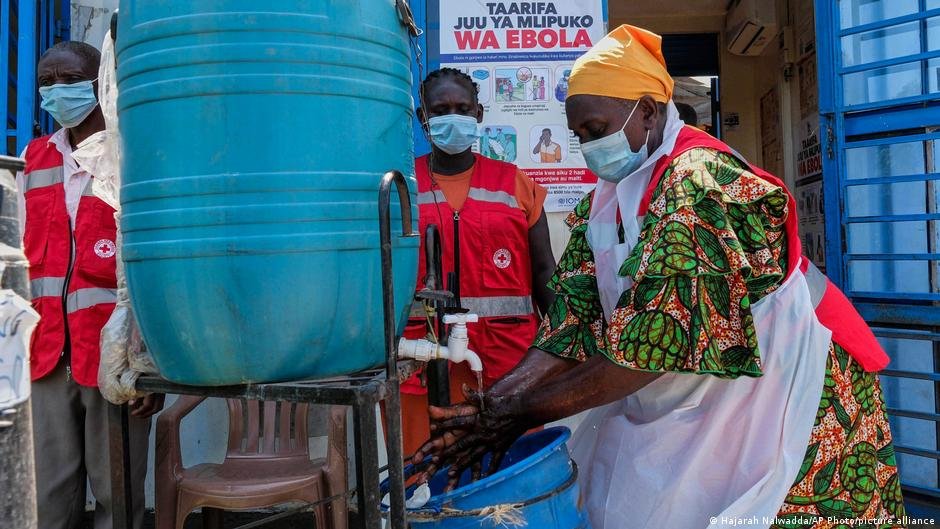
Countries bordering the Democratic Republic of Congo have stepped up screening at border crossings, trained front-line health workers and activated emergency plans to reduce the risk of imported cases as the DRC battles a growing Ebola outbreak.
On Monday, the DRC’s Health Ministry reported that at least 930 people have died due to the illness. The DRC has recorded 2,344 cases of Bundibugyo, the virus behind the current outbreak, which the government declared on May 15. The World Health Organization (WHO) recently warned that the number of cases could be up to four times higher than what is known.
In Zambia, authorities have stepped up screening at points of entry despite recording no confirmed Ebola cases. Dr. Naeem Dalal, assistant director for preparedness and response at the Zambia National Public Health Institute (ZNPHI), told DW that prevention measures had been reinforced nationwide.
To view this video please enable JavaScript, and consider upgrading to a web browser that supports HTML5 video
“Infection prevention and control is currently being activated, where a lot of disinfection will be taking place, and face masks and washing of hands with soap and water will become mandatory,” Dalal said.
He said provincial public health emergency response centers had been activated to coordinate a rapid response should suspected cases be detected.
Uganda, which has successfully contained previous Ebola outbreaks, has also increased surveillance along its border with the DRC. Speaking on Uganda National Television, Dr. Beda Senkware, of Kabale Referral Hospital, said three western districts of the country remained particularly vulnerable.
“The risk of getting this disease, Ebola, is very high. We have three districts that border the DRC — Kisoro, Kanungu and Rukungiri. These three districts have been put at the highest risk of getting Ebola,” Senkware said.
Rwanda has likewise strengthened health screening at border crossings, expanded disease surveillance and prepared rapid response teams to investigate suspected cases.
East African Community’s response to Ebola
Regional cooperation is also increasing. The East African Community (EAC) has agreed on a coordinated response to improve preparedness and reduce the risk of cross-border transmission.
EAC Secretary General Stephen Mbundi said partner states were working with the Africa Centres for Disease Control and Prevention (Africa CDC), the WHO and other partners to expand surveillance, laboratory testing and emergency response capacity.
“We are mobilizing regional mechanisms and working closely with Partner States, Africa CDC, WHO and development partners to strengthen surveillance, laboratory diagnosis, infection prevention and control, risk communication and rapid response capacities,” Mbundi said.
The heightened preparedness follows a warning from the WHO that the outbreak may be significantly larger than official figures indicate because many infections are going undetected in conflict-affected areas of eastern DRC.
Speaking during a virtual news conference in Geneva, WHO Director-General Tedros Adhanom Ghebreyesus said the outbreak had become “the third-largest Ebola outbreak on record” and had “expanded faster than any previous outbreak” over the past month.
Tedros also called on international donors to help close a funding gap of more than $400 million (€344 million) for the joint WHO-Africa CDC preparedness-and-response plan.
The outbreak is centered in eastern DRC, where conflict, insecurity and population displacement have complicated efforts to identify cases, trace contacts and contain the virus. The DRC has experienced several Ebola outbreaks since the virus was first identified there in 1976, but health experts say insecurity has made the current outbreak especially difficult to contain. There is currently no known vaccine for Bundibugyo.
Africa CDC urges early Ebola detection
Africa CDC Director-General Jean Kaseya urged neighboring countries to strengthen surveillance and laboratory capacity to improve early detection.
“This outbreak started in Ituri. Now it’s moved to Uganda and to other parts of the DRC. That is putting countries neighboring the DRC at risk,” Kaseya said, adding that timely detection remains critical to preventing wider transmission.
To view this video please enable JavaScript, and consider upgrading to a web browser that supports HTML5 video
“If countries do not increase capacity to detect, they are really at risk,” Kaseya said. “This is the message we are giving to countries: If you are near the DRC, please increase your capacity to detect.”
Professor Aileen Marty, an infectious disease specialist at Florida International University, said the ongoing violence continues to undermine containment efforts.
“The cases have continued to rise because it’s a highly inflamed area where there has been ongoing conflict for over a decade,” Marty said.
“A few of our treatment centers have been burnt down,” she said. “That discourages health workers from going there to manage patients and increases the number of people who travel elsewhere while infected. That is also making it extraordinarily challenging.”
Marty said the situation underscored the importance of preparedness in neighboring countries, where surveillance, rapid diagnosis and coordinated public health responses remain the best defense against regional spread.
Apart from Uganda, no neighboring country has confirmed a case linked to the outbreak, but health officials say vigilance remains essential until transmission in the DRC is brought under control. They warn that sustained investment in surveillance, laboratory capacity and regional cooperation will be critical to preventing the virus from further spreading across borders.
Edited by: Chrispin Mwakideu