8 minutes agoShareSaveAdd as preferred on GoogleDingindaba BuyoyaBBC Focus on Africa, Lusaka

 AFP via Getty Images
A spectre is hanging over the Zambian election campaign in the shape of former President Edgar Lungu.
Despite having died more than a year ago in South Africa, his body remains unburied amid a bitter dispute between President Hakainde Hichilema and the Lungu family that has sharpened political divisions.
This has had a role in energising support for the opposition National Reconciliation Party for Unity and Prosperity (NRPUP), particularly in the northern half of the country, traditional strongholds of Lungu’s Patriotic Front (PF), as people see it as offering the best chance to unseat the incumbent.
Meanwhile, it has complicated the second-term bid of Hichilema and his United Party for National Development (UPND), which draws its core support from the south, west and north-west while seeking to expand its reach nationwide.
The political battle is playing out on the streets of the capital, Lusaka.
As the afternoon heat blazes across the city, the familiar hum of commerce hanging over the busy markets is overlayed with the sound of campaign songs and jingles.
Election posters are everywhere: from lamp posts and shop fronts to massive billboards, with faces of presidential and parliamentary candidates looming over passers-by.
All this as Zambia prepares for one of its most unpredictable elections in years.
On 13 August, more than eight million registered voters will get the chance to choose a president and a new parliament. Hichilema wants five more years after his 2021 landslide win over Lungu on a platform of change.
Yet what many expected to be a relatively straightforward contest this time has been reshaped by Lungu’s death, the late surge of opposition challenger Brian Mundubile, persistent cost of living pressures and questions about electoral credibility.
This is all against the backdrop of recent constitutional reforms aimed at boosting the voice of youth and women.
The dominant conversation on street corners and in minibus taxis is the cost of living.
Zambia has not been spared from the worldwide pressures of high food and energy prices that followed the pandemic and subsequent geopolitical shocks.
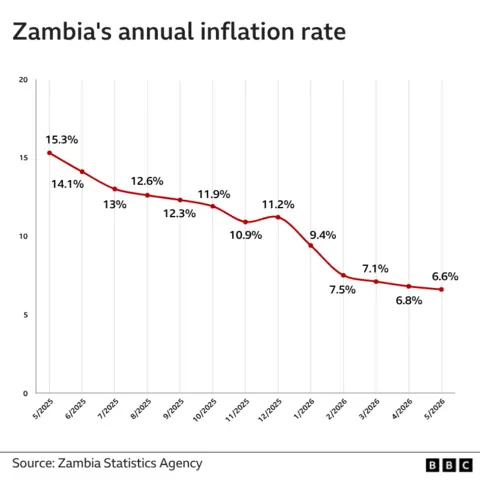
Annual inflation has cooled to around 6.6%, its lowest in eight years, and the currency, the kwacha, has strengthened, but for many households the relief remains theoretical.
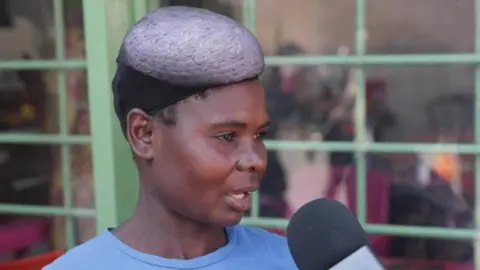
“The cost of living, I cannot say is okay,” says Given Kangwa, a 27-year-old flour-mill worker standing in Lusaka City Market.
“Where I work, for example, the money we are getting paid is not enough and we cannot sustain our lives.”
Kangwa explains that he was paid about 3,000 kwacha ($157; £117) a month, which is barely enough to cover food, rent and other expenses.
Theresa Zulu, a street-food seller, puts it more starkly. “Money has become so hard to come by. We are trying to stay strong to survive, but things have become really hard for us.”
Voters, as ever, are unforgiving.
Macroeconomic gains matter less than the cost of cooking oil, for example, which has risen by more than 70% over the past five years. Zambians have also been battling with an unreliable power supply.
A severe drought in 2024-2025 slashed hydropower generation, creating power outages of up to 20 hours a day in parts of the country.
The government has since ramped up costly electricity imports and accelerated solar projects, easing the blackouts in recent months.
Yet the memory of darkened homes and food spoiling in fridges lingers.
But Hichilema defends his record, saying that when he came to office things were a mess and he has laid the foundations for success.
“We inherited a broken-down country… the economy was declining,” Hichilema told the BBC in Lusaka.
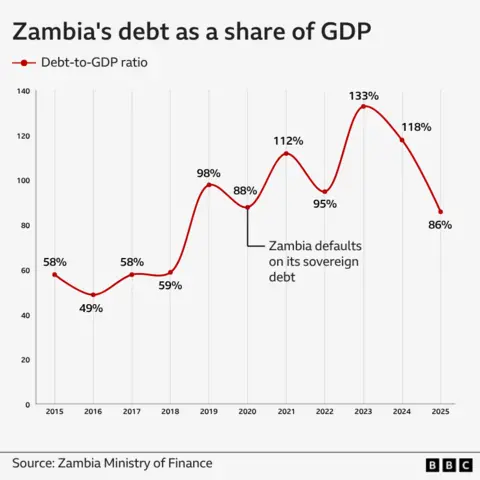
When he took office in 2021, Zambia was in debt distress and had been failing to make its payments.
The subsequent restructuring of more than $13bn (£9.7bn) in external debt has, according to the president, produced annual savings of roughly $1.9bn.
“That’s the money we’re putting in the economy… into investment expenditure such as free education.”
The free education policy – covering primary and secondary levels – has brought millions of children back into classrooms.
Thousands of teachers and health workers have been hired. Constituency development funds have been sharply increased.
Copper production, the backbone of the economy, has recovered strongly, foreign reserves have climbed to record levels and investor confidence has returned.
Supporters point to tangible openings.
“I think opportunities have been increased, looking at the number of people who have been employed – it has increased amongst civil servants. And, opportunities have just increased,” one young woman, who is hoping to become a teacher, said.
The unemployment rate as measured by the statistics agency has registered a slight fall from 13% to 11% over the last four years.
Critics counter that the benefits have yet to reach enough families.
There are also concerns from civil society groups that despite Hichilema’s promises of running a more open democracy, some opposition figures have been silenced after being convicted of hate speech.
The political landscape shifted dramatically with Lungu’s death on 5 June last year.
The courts had ruled that he could not run again, after having won two elections, but his passing removed the opposition’s most recognisable figure and initially appeared to create a smoother path to victory for the incumbent.
Lungu’s PF party fractured, with some politicians and supporters shifting to other opposition groups.
This accelerated the consolidation of a split opposition around Mundubile, a 55-year-old lawyer, accountant and former government chief whip under Lungu.
In a matter of weeks from filing his nomination papers in May, Mundubile’s popularity grew as the presidential candidate of an opposition grouping, the Tonse-Pamodzi Alliance, running under the previously unknown NRPUP banner.
Makebi Zulu – a lawyer closely associated with the Lungu family – is his running mate.
The alliance has capitalised on lingering loyalty in former PF strongholds and on public frustration with the cost of living.
Mundubile’s central pitch is generational and inclusive.
“We are moving the women and the youth from the margins to the centre of policy and economic transformation,” he told the BBC.
“We believe the youths have solutions to most of their challenges. What they don’t have is a big brother, what they don’t have is a caring government to be able to assist them achieve their objectives and goals. So I’m positioning myself as president as big brother to the youth.”
The Lungu legacy still hangs over the race in unexpected ways.
The row over the former president’s burial – still unresolved as the family do not want Hichilema to have anything to do with it – has become a potent political symbol.
Mundubile has publicly pledged that he and Zulu would ensure a dignified burial if they win the election.
Second-hand clothes seller Enock Mabenga said he was backing Mundubile “because we want to improve our lives”.
But not everyone is persuaded by the opposition’s return.
“I wouldn’t love to see them come back in the first place because we gave them a chance to rule the country and we saw what they did,” Edith Muntanga, in her late 30s said, referring to the previous government’s record on corruption and governance.
This election is the first under significant constitutional changes enacted in late 2025.
The amendments introduced a mixed-member system for the National Assembly with most seats given on a constituency basis but some reflecting the proportion of votes each party gets.
The number of constituency seats has expanded from 156 to 226, and 40 additional seats will be awarded through proportional representation: 20 for women, 15 for youth (counted as under 35) and five for persons with disabilities.
The reforms aim to boost representation in a parliament where women have long been under-represented. Whether they will translate into meaningful influence remains to be seen.
On the presidential ballot itself, gender representivity is limited: of the 14 candidates cleared by the electoral commission, only one is a woman – independent Given Katuta.
To win in the first round, a presidential candidate needs to have more than 50% of the votes cast. A second round is triggered within 37 days if no-one reaches this threshold, which could happen with such a fragmented field.
Civil society voices have raised concerns about the integrity of the process.
Linda Kasonde, human rights activist and former president of the Law Association of Zambia, has questioned the composition of the electoral commission.
“In terms of the constitution of the electoral commission itself, a number of the members of the commission are actually politically aligned to the incumbent ruling party and are not seen to be independent,” she said.
“And so we’re yet to see how they’ll manage the actual election, but in the run-up to the election, there is some disquiet as to whether or not they’re acting in the interest of all Zambians.”
The commission has consistently rejected accusations of political bias saying it operates strictly “within a constitutional mandate [and] adheres to principles of transparency and independence”.
Zambia has a proud record of peaceful elections and democratic transfers of power.
That history is frequently invoked by all sides. Yet trust in institutions, the cost of living and the unfinished story of a former president’s final resting place have combined to make this contest harder to predict.
As campaign rallies fill football grounds, Zambians are weighing the tangible gains of the past five years against the daily struggles that still define their lives.
On 13 August, they will deliver their verdict.
More BBC stories about Zambia:

Go to BBCAfrica.com for more news from the African continent.
Follow us on Twitter @BBCAfrica, on Facebook at BBC Africa or on Instagram at bbcafrica