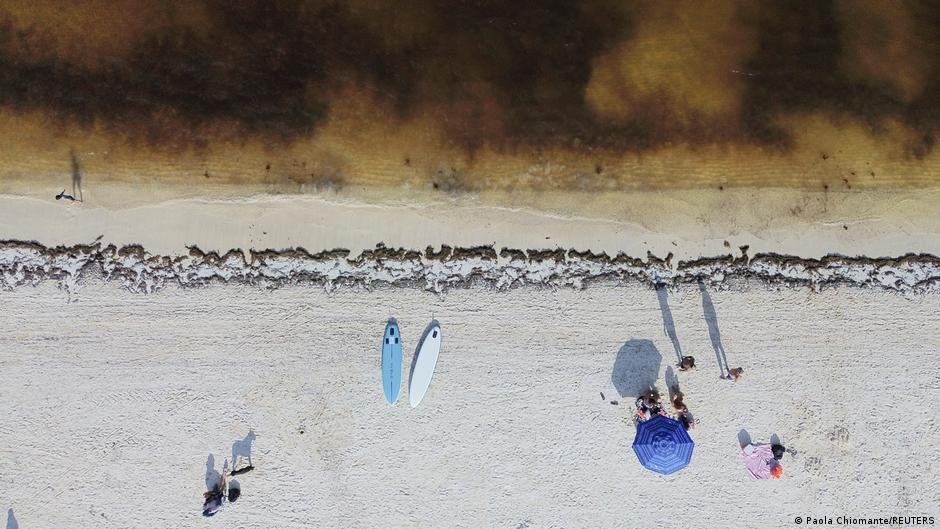
Large quantities of brown sargassum algae are washing up on Mexico’s Caribbean coast, polluting beaches, clouding the water, causing strong odors ― and harming tourism.
Image: Paola Chiomante/REUTERS
Mexico’s tourism industry in the Caribbean is suffering from an unprecedented algae bloom. On the beach at Playa del Carmen in the Mexican state of Quintana Roo, the usually turquoise water is brown and cloudy. Washed-up brown algae dominate the scene — and it smells. As they rot the algae give off the odor of rotten eggs, driving tourists away.
Image: Alfredo Estrella/AFP
The Mexican navy is attempting to intercept the algae while still on the open sea. To do so, it has deployed 27 specialized ships, as well as smaller boats, barriers, amphibious vehicles and cleanup crews. The ships use conveyor belts to remove the algae from the water, collect it in nets and then bring it ashore.
Image: Alfredo Estrella/AFP
The government has said that so far this year, 96,150 metric tons of sargassum have been collected — more than the 92,783 metric tons collected in all of 2025. Most of the algae is not removed until after it has turned up on the beaches. Despite countermeasures, large quantities continue to wash ashore — and heavy cleanup vehicles are probably not what tourists pictured for their beach vacation.
Image: Alfredo Estrella/AFP
Scientists have cited several possible causes for the growing amounts of sargassum algae: warmer oceans, more nutrients in the water and changes in ocean currents. Climate change could be contributing to this trend.
Image: Alfredo Estrella/AFP
Restaurants and hotels are feeling the impact acutely. A restaurant in Playa del Carmen, which normally serves about 400 guests a day, is currently seating fewer than 50. Hotels are also reporting massive losses: According to an employee at one 24-room hotel, at times not a single room is occupied because of the stench.
Image: Alfredo Estrella/AFP
So far, the Mexican government has tended to downplay the economic impact, pointing to the continued high number of foreign visitors. President Claudia Sheinbaum, however, has acknowledged a slight decline. Together with the hotel industry, the government has launched measures to combat the sargassum invasion and is investing approximately $115 million (€99.6 million) in prevention efforts.
Image: Paola Chiomante/REUTERS6 images1 | 66 imageshttps://p.dw.com/p/5IYxK