As Europe’s rivers recede during periods of drought, long-hidden traces of the past have resurfaced.
Alongside Nazi-era shipwrecks, unexploded World War II bombs and prehistoric mammoth remains, some rivers reveal history literally written in stone.
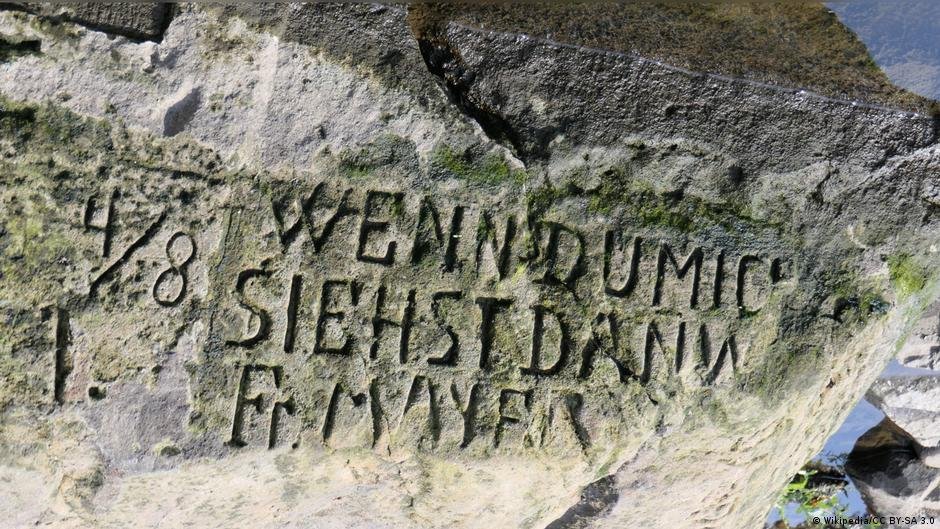
One such inscription, in German, reads: “Wenn du mich siehst, dann weine” — “If you see me, weep.”
These words are etched on a hunger stone in the Elbe River near Decin in Czechia, close to the German border.
Why ‘hunger’?
Hunger stones, or “Hungersteine” in German, are riverbed boulders that usually stay underwater and hidden, but become exposed when river levels drop significantly during prolonged droughts.
Unlike a high-water mark, which records the highest water level, the hunger stone marks the lowest.
For centuries, communities carved dates or inscriptions onto these stones whenever the waters of rivers like the Elbe, Danube or Rhine receded dramatically. Some hunger stones bear lists of years, including 1616, 1746 and 1842.
In a 2019 study “Extreme Droughts and Human Responses to Them: The Czech Lands in the Pre-Instrumental Period,” Czech historian and climatologist Rudolf Brazdil and his colleagues drew on chronicles, administrative records and other documentary sources to examine how drought-affected communities lived long before systematic weather measurements.
For people living along rivers such as the Elbe, low water created a host of problems. Barges carrying timber, grain and other goods struggled to navigate shallow channels, disrupting trade along one of Central Europe’s vital transport routes. In severe cases, shipping had to be restricted or halted altogether.
And drought also meant crop failure, rising prices — and hunger.
More than just drought memorials
While hunger stones were often treated as symbolic reminders of drought, they’ve proven to be more than that.
A 2020 study published in the journal Climate of the Past found that many of the dates and markings on Elbe hunger stones closely matched documented periods of exceptionally low water. The researchers concluded that many of the inscriptions were intended to record how low the river had fallen, rather than merely commemorate drought years.
The study also documented drought year markings on the Decin stone dating back to at least the 16th century, underscoring that the famous inscription “If you see me, weep” of 1904 represents only one chapter in the hunger stone’s much longer history.
A doomsaying stone?
Yet, its fame lies mainly in its seemingly foreboding message. Even its sighting during the more recent European droughts of 2020 and 2022 inspired media coverage, describing its message as “chilling”, “grim” or a “harbinger of hard times.”
In his 2019 study “Die Botschaft der Hungersteine” (or “The Message of the Hunger Stones”), Bernd Gross drew on newspaper reports, postcards and local historical records to reconstruct the history of the Decin hunger stone and noted that its inscription may have been inspired by an older one.
Gross cited newspaper reports from the 1890s that described a hunger stone near Techlovice, upstream from Decin, that reportedly bore German inscriptions such as: “We cried — We cry — And you will cry.”
The man most often associated with the Decin stone’s inscription is F. Mayer, a local innkeeper and boatman and member of the Elbe shipping community.
According to Gross, Mayer had the now-famous phrase carved onto the stone during the drought of 1904, dated July 18, along with his name.
A celebrity of its time
At the time, newspapers referred to it as the Bodenbach or Tetschen hunger stone, after the neighboring towns that today form part of Decin. They reported on the exposed stone and its message, while contemporary accounts described thousands of visitors who went to see it.
Postcards featuring the hunger stone also circulated widely, spreading awareness of the site far beyond the Elbe Valley.
The Reichenberger Zeitung, in circulation from 1860 to 1938, reported on August 28, 1904: “Day after day, groups gather on the rock; everyone wants to set foot on it at least once. However, the markings carved into the sandstone are likely to lose their visibility due to this frequent trampling.”
Visitors were reportedly intrigued not only by the inscription but also the earlier dates carved into the rock, recording drought years stretching back centuries.
The stone that nearly disappeared
Ironically, the drought of 1904 that put the Decin stone and its inscription on the map very nearly caused its destruction.
Local river authorities decided to remove rocks and other obstacles from the Elbe to improve navigation, and Gross’ study states that there were concerns that the Decin hunger stone could be removed as well.
Following the intervention of the Tetschen Boatmen’s Cooperative, which petitioned the imperial authorities, the stone was spared. News reports stated that officials agreed to route planned river works around it in order to preserve what was already regarded as a historic landmark of the Elbe.
And while other obstacles were removed from the river, the Decin hunger stone survived.
The stone’s story did not end there. When another severe drought exposed it in 1911, Mayer’s famous inscription was reportedly carved again, this time more deeply. Later in 1938, a Czech inscription was added alongside the older markings.
Together, these dates and inscriptions chart centuries of the stone’s history and its role as a marker of exceptionally low water levels on the Elbe.
Edited by: Oliver Mojen