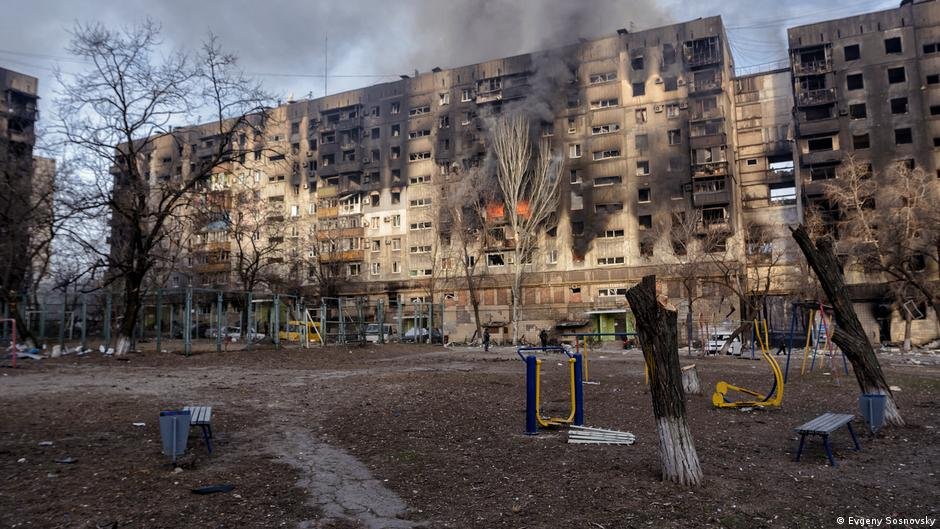
Halyna Artemova, an English teacher, lived in Mariupol for almost 40 years, at Metallurgy Avenue 87.
“It’s my beloved city. When I look at the photos, it brings tears to my eyes. I know every crack in the asphalt, every tree,” she told DW. Her apartment block in the city on the Sea of Azov was struck by a missile during a Russian attack in March 2022.
Photographer Yevhen Sosnovsky and his wife lived in the house next door, Metallurgy Avenue 85, for 20 years. “I did everything myself, all the interior renovations, and the furniture,” he said. “We invested a lot in it; we planned to spend our twilight years there, living quietly.” His building also caught fire during the missile attack, and residents were driven out by Russian troops. They weren’t even allowed to take food or clothing with them.
Now there’s a parking lot where Sosnovsky’s apartment block used to be. Next door, where Artemova once lived, stands a new building. The Russian building contractor Su-2007, which operates in the Ukrainian regions occupied by Russia, cleared several buildings on Metallurgy Avenue that were destroyed in the war and constructed high-rise apartment blocks in their place. These form part of a residential complex now known as the Leningradsky Kvartal.
“They’re building on human bones, and fast, to eradicate the traces of their crimes,” said Sosnovsky.
DW is not allowed in to the Russian-occupied parts of Ukraine, so cannot report directly from city. However, it is possible to get an idea of what life is like in Mariupol today by talking to people who used to live there, studying satellite images, and doing research online.
Newcomers benefit from cheap mortgages
Many people who have moved into the new apartments on Metallurgy Avenue communicate with each other online in neighborhood forums. From these forums, it’s clear that the majority bought the apartments either to live in themselves, or to rent out.
In chats, they ask how they can get furniture delivered from Russia, or which kindergarten or school they should choose for their children. People are reminded that the most important thing when submitting documents is that they should be of Russian origin.
Not everyone has finished remodeling their apartments, and some people with small children take the opportunity to complain: “It’s too late! Stop the goddamn renovations! Or maybe you’re pro-Ukrainian and oppose Russian laws?”
Economist Vyacheslav Shiryaev said apartments in the new buildings in Mariupol are being bought primarily by incomers: Russian security personnel, officials and people working in military logistics. “In addition, there are some who would just like to live by the sea but can’t afford Crimea or Sochi,” he said.
In the Russian-occupied regions, people are offered cheap mortgages at an annual interest rate of 2% for the whole period of the mortgage — provided the borrower has Russian citizenship. The maximum they can borrow is 6 million rubles (around €63,000/$72,000), and they must be able to put down a deposit of at least 2%.
Property prices have soared
Dozens of apartment blocks are being built in Mariupol, and many are already occupied. Russian banks report that the port city in the occupied region tops the list for mortgage loans. Property prices have risen by a third in just one year, primarily because of the coastal location.
You won’t find a location like this in Russia, said Shiryaev. However, he pointed out that the apartments are of very bad quality. “Construction companies are cutting corners wherever they can, but still demanding exorbitant prices,” he said.
The Leningradsky Kvartal residential complex, 15 buildings of 12 to 15 floors each, is near the center of town and just 10 minutes’ drive from the sea. One- and two-room apartments cost between 7.5 million and almost 10 million rubles (€104,000). Three-room apartments can be bought for upwards of 10 million rubles. Newcomers to the region are offered discounts of up to 12%.
In the chats, people living in the complex say they have insured their mortgages “against war risks.” If their building is destroyed, they won’t have to pay back their loan. They will, however, lose their apartment.
Nobody in the forum talks about the fact that there were other people living on the site of Leningradsky Kvartal just a few years ago.
Dead and wounded in Mariupol
According to the United Nations, 90% of the buildings in Mariupol were damaged or destroyed in the 2022 siege. Media outlets estimate that tens of thousands of people were killed. Former residents of Metallurgy Avenue told DW of neighbors who were killed or injured.
“A man and his son from the building next door were killed when they went out to fetch water,” said Artemova. “In house number 89, a woman was buried beneath a concrete slab after a missile strike and died. A missile struck the first floor of house number 91, and a family was killed.”
Artemova herself was wounded by shrapnel, but managed to leave Mariupol with her elderly mother and her son. Sosnovsky was hit by a bullet. He too fled the city, with his wife and mother-in-law.
Many of those who lived in buildings that were hit, but whose apartments were not destroyed, have remained in the city. However, DW was told that the occupying authorities demanded they leave their apartments nonetheless. They were promised new apartments in exchange.
To view this video please enable JavaScript, and consider upgrading to a web browser that supports HTML5 video
But a source told DW that none of the inhabitants of the former blocks on Metallurgy Avenue was allocated an apartment in the new Leningradsky Kvartal buildings. And those who had lost everything in the attacks could not afford a mortgage. Another source told DW that people were put in accommodation on the outskirts of town, or else in hostels.
‘We were robbed of our good life’
The majority of those who fled do understand why their former neighbors stayed in the city. Not everyone had the possibility of leaving Mariupol and starting again elsewhere.
“The local population is being pushed out of Mariupol,” said Artemova, who now lives in Kyiv with her son. Like others DW spoke with who had left the city, she said Mariupol had started to develop rapidly a few years before the Russian invasion in early 2022. People wanted to live there.
“We were robbed of our ordinary life, which may have been uninteresting for some, but it was a good life. We’d go to market, knew where to buy what; we’d have a coffee, bump into a school friend with her dog and say hello,” she remembered.
Neither Artemova nor Sosnovsky are considering returning to their hometown and re-registering their apartments according to the regulations of the Russian occupying authority. It’s not even clear whether or not they would be allowed to enter the zone. But Ukraine is not compensating people for the loss of property there, as its authorities can’t assess the situation without access to the occupied region.
“They’re building their shiny new houses on what used to be a graveyard. I’d like nothing better than to bomb them, but only when no one’s in the buildings. It’s enough to drive you to despair,” said one former resident of Metallurgy Avenue. He too lived there for decades, and remembers his child’s first steps, taken in an apartment that no longer exists.
This is how he describes the city today: “In the center it’s still OK, but if you go just a little to the left or right it smells of death.”
This article was originally written in Russian.