For children who live on Tonle Sap, Southeast Asia’s largest lake, education is a daily struggle. Climate change and fluctuating fuel prices due to the Iran war have forced some children to stay home from school.
Image: Anton L. Delgado/AP Photo/picture alliance
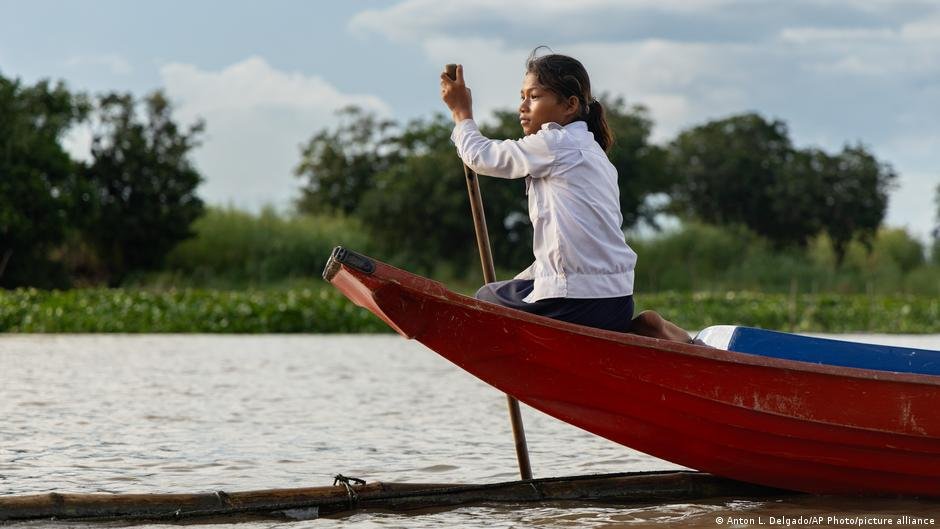
Every morning, motorboats chug through Kampong Prahok, a floating village in Cambodia, steered by students in school uniforms often no older than those climbing aboard. Climate change is making their daily commute to school across Tonle Sap, Southeast Asia’s largest lake, increasingly unpredictable, as droughts and floods alter the lake. Teachers report that 10 students have already drowned.
Image: Anton L. Delgado/AP Photo/picture alliance
Sou Sreynich is 13 and wants to become a teacher, but she didn’t set foot in a classroom until she was 10. Her mother waited until she could swim, too afraid that the boat taking her daughter to school might capsize.
Image: Anton L. Delgado/AP Photo/picture alliance
On Tonle Sap, everything and everyone must be transported by boat — teachers, students, food and supplies. Rising energy prices due to the Iran war are hitting these remote communities particularly hard. Running the school is becoming increasingly expensive. “Even the electricity to run this lab is 10 times higher,” Samphors Vorn of the nonprofit Aide et Action, which supports the school, told AP.
Image: Anton L. Delgado/AP Photo/picture alliance
Sreynich’s family makes a living mainly from fishing and earns extra money by picking chili peppers and gutting other people’s fish. Rising fuel prices have made trips to deeper, more fish-rich waters too expensive. When there’s no income, Sreynich sometimes has to skip school to help her parents. “I want to complete my studies,” she said, adding that she dreads every absence.
Image: Anton L. Delgado/AP Photo/picture alliance
Tonle Sap is a habitat, a waterway and a source of livelihood. Unpredictable floods and droughts are changing the lake. For families, this means not only increased risk on the way to school. The fishing industry, on which many residents depend, is also coming under pressure. For children, this increases the chance their education will be cut short.
Image: Anton L. Delgado/AP Photo/picture alliance
For families who are already poor, every price hike is a struggle. Will they be able to pay for food and fuel? Will they be able to keep all their children in school? Sabrina Hervey of Education Above All Foundation warns that the economic crisis could force millions of students out of the classroom, or prevent them from enrolling in school in the first place.
Image: Anton L. Delgado/AP Photo/picture alliance
During economic crises, girls in particular risk losing their educational opportunities. In parts of South Asia, families with limited resources often prioritize their sons’ education, said Arshad Malik of the nonprofit Save the Children International. Dropping out of school also increases the risk of early marriage. Financial hardship can thus permanently alter the trajectory of a child’s life.
Image: Anton L. Delgado/AP Photo/picture alliance
For Sou Sreynich, that future begins every morning on the shore. She boards a boat, even as the lake grows more dangerous and her family’s livelihood more precarious. Yet the 13-year-old holds fast to her dream: to study, finish school and become a teacher. Each school day brings her closer to that goal.
Image: Anton L. Delgado/AP Photo/picture alliance8 images1 | 88 imageshttps://p.dw.com/p/5J1CB
About The Author