Canada has been quietly praised for refusing to fold under pressure from US President Donald Trump in the long-running fight over trade tariffs.
The latest talks between the North American neighbors collapsed on August 21. Until the 11th hour, both sides were talking as if a deal was within reach.
The United States then put 50% tariffs on about $20 billion (€17.2 billion) worth of Canadian goods, while Ottawa pledged to match those duties on US imports.
Until the talks folded, Canada’s approach was to cut a deal that would reduce the tariffs and keep cross-border supply chains functioning, particularly in the automotive and steel sectors.
To view this video please enable JavaScript, and consider upgrading to a web browser that supports HTML5 video
US negotiators were, however, accused of changing the terms at the last minute, which the Canadian side said would have forced them to match US tariffs on China.
According to Ottawa, Washington wanted a say on future trade deals with other nations and to prevent Chinese goods being routed through Canada to evade US duties.
Trade spat becomes sovereignty issue
Dan Ciuriak, a senior fellow at the Waterloo, Canada-based Center for International Governance Innovation, described Trump’s tariff-matching plan as “fortress North America,” which he said was now a sovereignty issue for Ottawa.
“Canada is a trading nation,” Ciuriak told DW. “If we align perfectly with the Americans — primarily about China — we then end up sacrificing our trade policy.”
There is a recent precedent. When the US imposed 100% tariffs on Chinese electric vehicles last year, Canada followed suit. Beijing retaliated with 100% tariffs against one of Canada’s biggest exports — canola.
Canada’s $4.9 billion exports of canola oil, meal and seed to China were cut in half last year, according to data from the Canada China Business Council.
To view this video please enable JavaScript, and consider upgrading to a web browser that supports HTML5 video
“The smaller country is the one that bears the brunt in this kind of game. So that’s one very good reason for Canada to have an independent trade policy,” said Ciuriak.
As the US-Canada talks collapsed, Ottawa also complained that Washington had sought relief from rules on French-language movies and shows. Canada said this amounted to interference in its language and culture.
Canadians back walk away from US
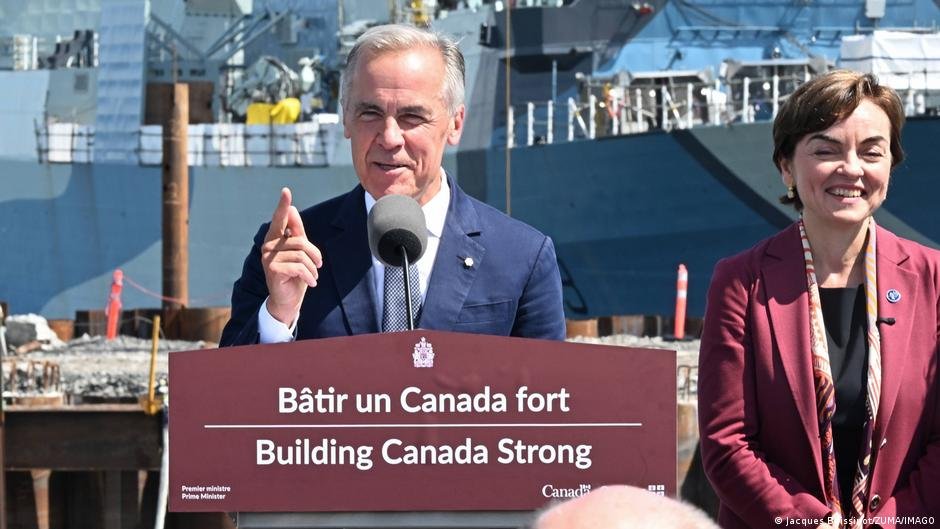
Despite the uncertainty and higher cost to business from walking away, the Canadian prime minister’s approach to negotiations with the US has broad public support.
A survey conducted by the Angus Reid Institute found that three-in-four Canadians backed the more hard-line move, despite concerns over the impact on the domestic economy.
Ciuriak noted how Trump’s barbs of turning Canada into the 51st US state and threats to rename Lake Ontario to Lake America have emboldened ordinary Canadians to boycott US travel and products.
“Travel by Canadians to the United States has plummeted,” he said. “There has been a popular consumer backlash against buying American products.”
New government data show Canadians made nearly 500,000 fewer trips to the US in the first three months of 2026 and spent about $800 million less on those visits.
A survey last month by the Angus Reid Institute found that 40% of Canadian grocery shoppers were checking product origins, and that most of those shoppers avoided US goods when they could.
Although the two economies are tightly bound together, the new US duties apply to only about 5% of the $382 billion in goods that Canada exports to its southern neighbor.
The Royal Bank of Canada has warned that a no-deal would impact 0.4% of gross domestic product (GDP) and jobs, while University of Calgary economist Trevor Tombe estimated it could cost as many as 90,000 jobs.
Canada’s stance closely watched globally
Other governments are also watching to see how standing up to Trump plays out.
During their own negotiations, the European Union, United Kingdom, Japan, South Korea and dozens of smaller partners all agreed to lower tariffs in return for market access, investment pledges or alignment with US policy.
Only China has so far met Trump’s tariff threat head-on, matching tariffs with tariffs and negotiating as a fellow superpower, rather than taking the first deal on offer.
Speaking at the World Economic Forum in Davos in January, Carney said middle powers must act together, warning that if they were “not at the table,” they would be “on the menu.”
But for now, Carney is holding the line largely on his own. New Canadian tariffs on $20 billion worth of US goods — including steel, aluminum, dairy, electronics and farm equipment — take effect on September 8. They are likely to be met with US retaliation.
While matching US tariffs dollar-for-dollar sounds aggressive, Ciuriak thinks they need not “punish” the Canadian economy.
“Canada’s tariffs … apply to products Canada both buys from and sells to the US. As American tariffs cut off Canadian sales south of the border, the Canadian measures create space at home for that production.”
New Trump pressure on Canadian autos
From January, Trump has threatened to raise duties on Canadian autos, trucks, parts and steel unless production moves to the US.
He also refused to extend the United States–Mexico–Canada Agreement (USMCA) for another 16 years. Instead, the North American free-trade pact, which still covers most cross-border goods, will be reviewed year by year.
To view this video please enable JavaScript, and consider upgrading to a web browser that supports HTML5 video
With no new talks planned with the US, Canadian lawmakers are talking up trade opportunities in other markets and weighing other retaliatory measures, including backing away from an order for US fighter jets.
Canada had planned to buy 88 Lockheed Martin F-35s, with 16 already on order. The rest are now on hold.
“When your friend kicks you in the back, one of the first rules is you don’t then go and buy $12 billion of fighter jets from that person,” British Columbia Premier David Eby said last week.
Edited by: Rob Mudge