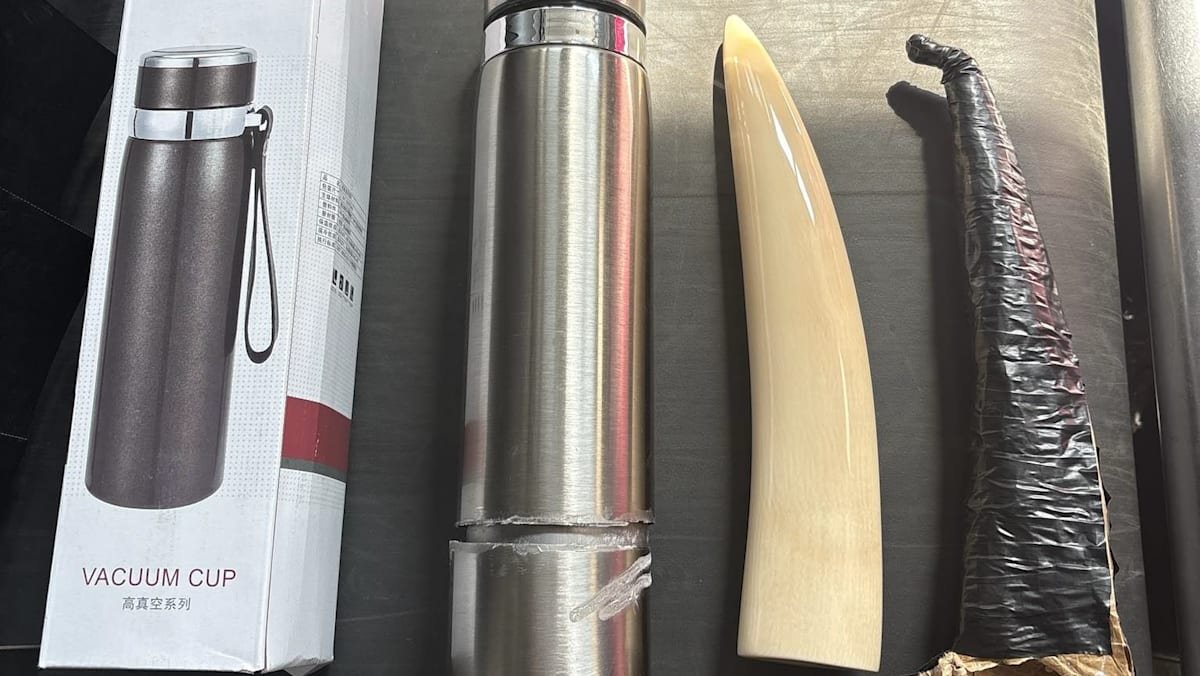
Man jailed for trying to smuggle ivory tusk into Singapore in thermos flask
The 30-year-old ship crew member repeatedly claimed that the object was a cigar-shaped apparatus made of plastic and used for smoking.
The elephant ivory tusk and the modified thermos flask it was concealed in. (Photo: National Parks Board)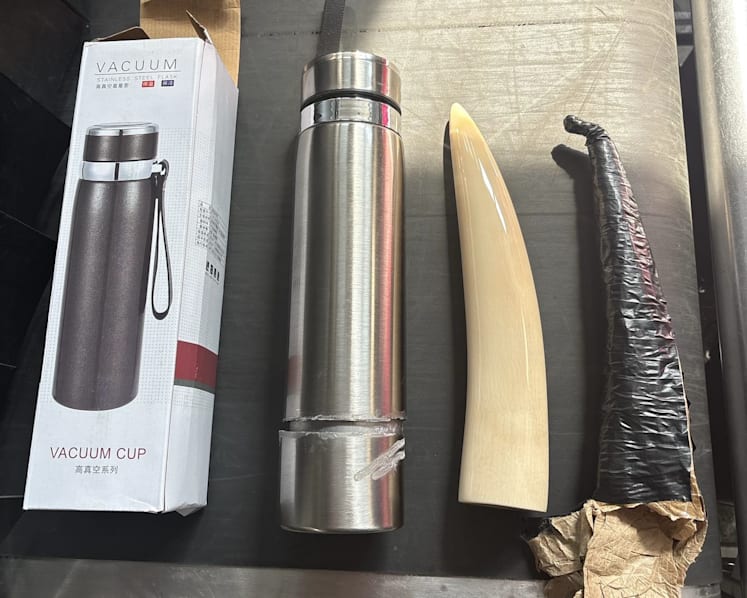
New: You can now listen to articles.

This audio is generated by an AI tool.

Read a summary of this article on FAST.
Get bite-sized news via a new
cards interface. Give it a try.
Click here to return to FAST
Tap here to return to FAST
FAST
SINGAPORE:A 30-year-old Indonesian man was sentenced to eight weeks’ jail on Thursday (Sep 10) after he was caught attempting to smuggle an elephant ivory tusk into Singapore, said the National Parks Board (NParks).
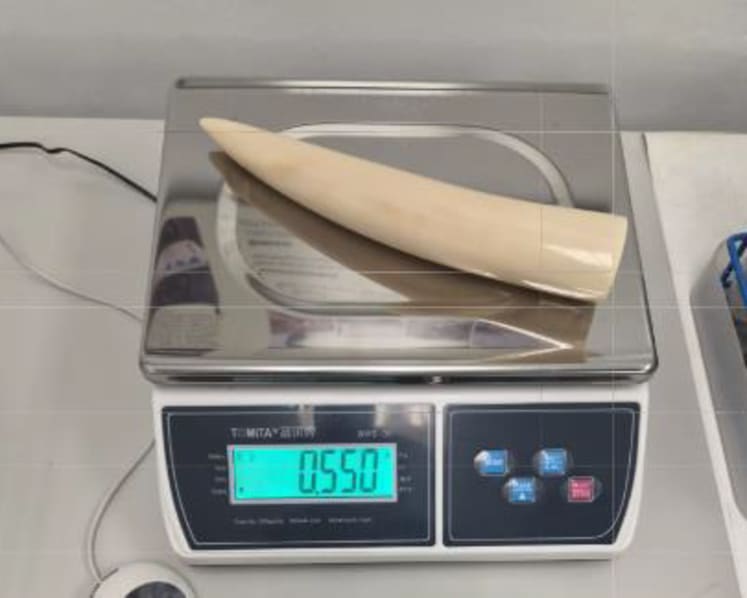
Hafiludin, a crew member, was caught on Aug 9 with the 550g tusk concealed in a thermos flask.
The vessel he was working on entered Singapore on Aug 8, and he disembarked with his luggage at about 12.15pm the next day, court documents showed.
Singapore was his last port of call before he was due to return home to Indonesia, and he was required to enter Singapore through the Immigration and Checkpoints Authority’s Keppel Entrance Crew office at 35 Keppel Road for his official sign-off.
During a routine X-ray security screening, officers flagged the thermos flask in his luggage. They checked his baggage and found a sharp, pointed object resembling an ivory tusk inside.
When questioned, Hafiludin repeatedly claimed that the object was a cigar-shaped apparatus made of plastic and used for smoking.
The matter was then referred to NParks for further investigation.
According to court documents, Hafiludin had bought the tusk months earlier from a travelling merchant who boarded his vessel in Lagos, Nigeria, in late December 2025.
Hafiludin bought one for US$150 (S$190), intending to give it to his father.
Knowing that it was an offence to possess ivory without the relevant permits in Singapore, he concealed the tusk in a thermos flask and placed it in his luggage.
As the approximately 27cm-long tusk did not fit inside the flask, Hafiludin sawed off the flask’s external casing to accommodate it.
Laboratory testing confirmed that it came from an African elephant, although its exact species could not be determined.
Under the Convention on International Trade in Endangered Species of Wild Fauna and Flora (CITES), all African elephants are listed as Loxodonta africana.
The tusk was therefore an Appendix I specimen under Singapore’s Endangered Species (Import and Export) Act 2006.
Hafiludin did not have the required permits or licences to import the tusk into Singapore.
Hafiludin was convicted of one count of importing a scheduled species under Section 4(1)(a) of the Act.
Source: CNA/ec(sz)
Sign up for our newsletters

Get the CNA app
Stay updated with notifications for breaking news and our best stories
Get WhatsApp alerts
Join our channel for the top reads for the day on your preferred chat app

Get bite-sized news via a new
cards interface. Give it a try.
Click here to return to FAST
Tap here to return to FAST
FAST