In Karachi’s coastal neighborhood of Ibrahim Hyderi, young boatbuilders are keeping a centuries-old tradition alive. Plank by plank, they build fishing boats by hand.
Image: Asif Hassan/AFP
In Ibrahim Hyderi, a centuries-old coastal settlement on the outskirts of Pakistan’s economi hub Karachi, fishing boats are still built by hand. Although it looks out of sync with the bustle of the megacity, the boatbuilders are preserving a tradition deeply intertwined with the history of the port city.
Image: Asif Hassan/AFP
Ibrahim Hyderi is known as the birthplace of the city’s thriving fishing industry. “This area put Karachi on the map and gave the city its fishing sector,” says Mehran Ali Shah of the Pakistan Fisherfolk Forum. While modern shipyards have long shifted to industrial production, boats are still built here using traditional techniques and physical strength.
Image: Asif Hassan/AFP
Muhammad Asif is only 22, but he has been mastering the art of boatbuilding for years. As a teenager, he learned the craft from his father. Today, he works independently on the massive wooden hulls.
“I was always fascinated by this work,” says Asif, who has sawdust covering his face and sun-bleached hair. “It has always been my passion.”
Image: Asif Hassan/AFP
A master boatbuilder creates a template for the craftsmen. The wood used depends on the boat’s purpose: It is mostly locally sourced eucalyptus or durable African teak, selected for its ability to withstand saltwater. Using hand-drawn pencil lines as a guide, the workers cut beams to size. Then, the hull slowly takes shape, rising from the sand.
Image: Asif Hassan/AFP
On shaky ladders, the men climb the gradually growing hulls. Every beam has to fit snugly, every nail must be in place. It is a painstaking process that takes time. According to Asif, even a small fishing boat just a few meters long can take up to three months and costs around 1 million Pakistani rupees (roughly $3,600, €3,000).
Image: Asif Hassan/AFP
Many workers start at seven in the morning and do not head home until around seven in the evening, with a two-hour lunch break in between. They work six days a week.
In summer, the sun beats down, and the air is hot, humid and heavy. During the monsoon, rain can soak the entire boatyard. Regardless of the weather, the craftsmen work throughout the year.
Image: Asif Hassan/AFP
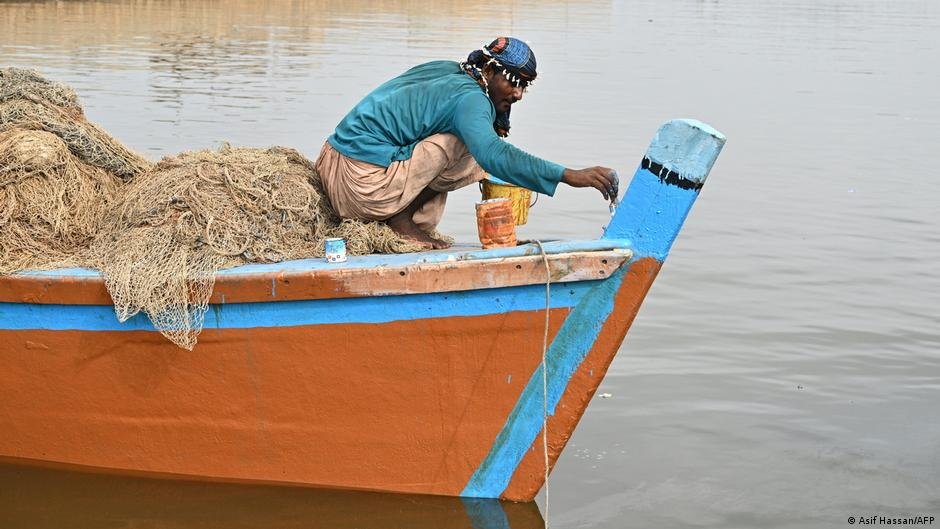
Once the carpenters are finished, Muhammad Ismail adds the colorful decorations. The 38-year-old has been painting boats for more than a decade. Blue paint stains his hands as he daubs flowers across a wooden hull. “Most fishermen prefer floral designs rather than fish,” he says, adding that he is happiest when he sees the owners’ excitement upon delivery of their newly painted boats.
Image: Asif Hassan/AFP
A fisherman sits in his wooden boat with his family, mending nets. The boat has been out at sea for more than 20 years and is now due for renovation. For the family, the work is more than just a way of making ends meet. The traditional process is deeply rooted in the community. “It’s like taking care of something precious — perhaps even your own child,” the fisherman says.
Image: Asif Hassan/AFP8 images1 | 88 imageshttps://p.dw.com/p/5MJ10