Man drove around Singapore with ‘SMS blaster’ that sent more than 10,000 phishing messages, gets jail
When he visited his sister while the device was in his car, he warned her about phishing messages targeting WhatsApp users.
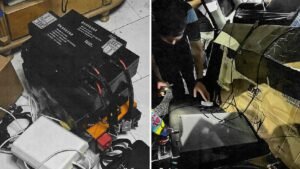
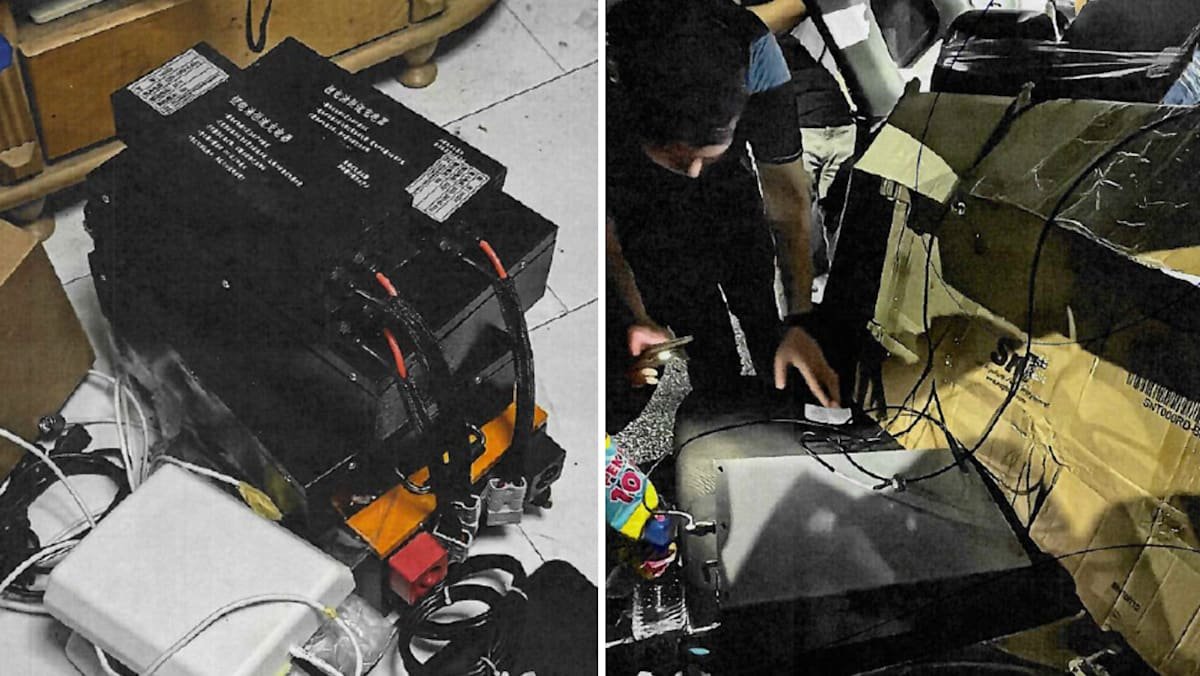
(Left photo) An antennae, a battery charger and battery packs at a housing unit. (Right photo) A man looking at an SMS blaster device found at the back of Ong Kak Seng’s car. (Photos: Court documents)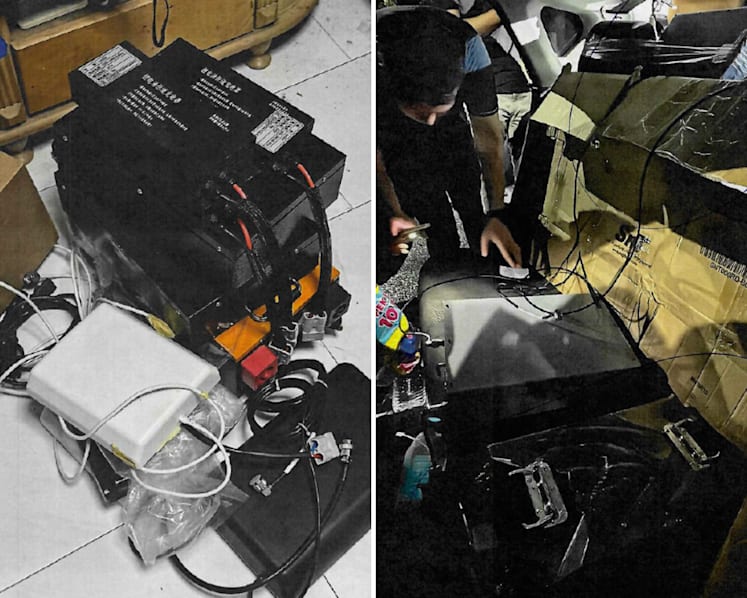
New: You can now listen to articles.

This audio is generated by an AI tool.

Read a summary of this article on FAST.
Get bite-sized news via a new
cards interface. Give it a try.
Click here to return to FAST
Tap here to return to FAST
FAST
SINGAPORE: A man spent up to 12 hours a day driving around Singapore with a device in his car that sent messages to thousands of nearby mobile phones, believing that he was helping to promote illegal online gambling.
However, the device, known as an SMS blaster, was really transmitting phishing messages intended to trick phone users into providing their WhatsApp login details through a fraudulent webpage. Third parties could then use the information to take over WhatsApp accounts.
Ong Kak Seng, who was heavily in debt, continued doing the job for money after he found out about the scam. He even warned his own sister about phishing messages when he visited her with the SMS blaster in his car.
The device mimicked a mobile network to push messages to phones within its range.
Ong, a 28-year-old Malaysian, was sentenced to one year and nine months’ jail and a S$1,500 fine on Monday (Sep 14).
He pleaded guilty to a charge of cheating as part of a criminal conspiracy. He will serve one more week in jail if he fails to pay the fine.
Two other charges were taken into consideration for sentencing. One was for causing a computer to perform a function with the intention of committing an offence, and the other for retaining a device to commit an offence.
HOW HE GOT INVOLVED
Around 2023, Ong first got to know a man called “Bai Ge” while tasked by someone to collect debt repayments from him. The two later became friends.
Two years later, in October 2025, Bai Ge learned that Ong owed unlicensed moneylenders around RM80,000, or S$24,900 (US$19,650). He offered Ong the chance to earn RM1,000 a day.
In exchange, Ong would have to drive around densely populated areas in Singapore or Hong Kong for 10 to 12 hours a day with a device in his car.
Bai Ge also told Ong about a “boss” in China who specialised in operating SMS blasters and disseminating messages through them.
Court documents stated that Ong believed the SMS blaster device would be used to disseminate messages promoting illegal online gambling platforms to people in the vicinity.
He knew the work was illegal because the sum offered by Bai Ge was almost 10 times what legitimate drivers earned in Malaysia.
Ong chose to work in Singapore so that he could use his own car. In Hong Kong, he would have to rent a car, which would eat into his earnings.
He then headed to Bai Ge’s home in Malaysia to learn how to assemble an SMS blaster from its components, including batteries, an antenna, wires and remote controls.
On Oct 11, 2025, Ong travelled to Singapore and met someone who handed him the SMS blaster’s components. He assembled the device the next day and placed it in the back of his car.
Ong then bought two mobile phones, one of which he used to operate the SMS blaster.
Between Oct 13 and Nov 18, 2025, Ong drove around Singapore for between 10 and 12 hours every day, with the SMS blaster device and components placed at the back of his car.
He hid the blaster by placing a cardboard box over it.
PROTECTED HIS OWN SISTER
After a few days of driving, Ong discovered that the device was transmitting WhatsApp account phishing messages to people in the vicinity.
On Oct 15, 2025, he went to visit his sister in Singapore.
Deputy Public Prosecutor Ong Xin Jie said: “As the accused knew that his sister might receive the WhatsApp account phishing messages transmitted by the SMS blaster device in his motorcar, the accused informed his sister not to visit any webpage on any WhatsApp or text messages that she received.
“The accused did so as he knew the messages transmitted by the SMS blaster device were part of a coordinated effort designed to scam individuals into delivering money to third parties.
“The accused additionally knew that his sister was vulnerable to falling prey to such scams, as she had previously been a victim of a scam.”
During his time in Singapore, Ong met another person whom he understood was also driving around Singapore for the same purpose.
MORE THAN 31,000 PHONES WITHIN RANGE
Between October and November 2025, the police received reports of suspicious WhatsApp or text messages. Between Nov 18 and 19, police officers conducted an islandwide operation to apprehend those involved in sending the phishing messages.
Ong was arrested on Nov 18.
His car and lodgings were searched, and the device was seized.
Ong said that he received RM5,000 for his services before he was arrested.
The authorities analysed the contents of the seized SMS blaster device and found that at least 31,820 mobile phones had fallen within its area of coverage, and 10,533 WhatsApp account phishing messages were successfully sent to mobile devices during the period that Ong was operating it.
At least one police report involved a victim who reported a loss of about S$1,800 after being led to transfer money to a bank account controlled by a third party.
SCAM OFFENCES A MAJOR CONCERN
The prosecution sought between 21 and 25 months’ jail and a fine of RM5,000, equivalent to the amount that the offender benefited from his crime.
The prosecutor said that the potential for harm was high, referring to the number of WhatsApp phishing messages that were sent, but noted that the actual amount lost from the scams was not high.
“However, we note that there may have been other victims that have not yet come forward,” the prosecutor said, adding that the police’s advisory on such scams, released on Nov 20, 2025, may have helped in preventing more losses.
The prosecution also highlighted the syndicated and transnational nature of the crime as aggravating factors.
Ong had displayed an element of sophistication in assembling and operating the SMS blaster, the prosecutor noted, adding that scam-related offences remain a “major and fast-growing crime of concern in Singapore”.
“When members of transnational crime syndicates are apprehended, the appropriate response is the unflinching imposition of appropriately stiff sentences in dealing with transgression.”
POTENTIAL HARM, ACTUAL HARM
Ong’s lawyer, Ms Claire Chong from law firm Chooi Jing Yen, argued for no more than 18 months’ jail.
She said that her client used to work on a farm before entering a pawn-related business in Malaysia. He accrued substantial debts due to gambling.
On the offence, Ms Chong noted that although 10,533 phishing messages were sent, the actual harm identified involved one victim.
“A transmitted message is not equivalent to a completed instance of cheating. Nor does the evidence establish that every transmitted message was received, read, believed or acted upon,” Ms Chong said.
“The disparity between the potential and actual harm is therefore stark,” she added.
She cautioned against speculating that there could have been other victims who had not stepped forward, as the prosecution had suggested.
“The prosecution cannot introduce new aggravating facts beyond the admitted facts through its submissions on sentence.
“Further, given that the messages were transmitted in October to November 2025, it is highly unlikely that any further victims will come forward now, if they have not already,” Ms Chong said.
She also argued that even though the device required some technical knowledge in assembly and operation, Mr Ong had not planned or devised a sophisticated scheme.
“Mr Ong plugged things into a machine and placed this in his car. He covered the SMS blaster device with a cardboard box. All of this was done in accordance with instructions and teaching from Bai Ge. This was not, by any means, sophisticated.”
For cheating, Ong could have been jailed for up to 10 years and fined.


Source: CNA/wt(sf)
Sign up for our newsletters

Get the CNA app
Stay updated with notifications for breaking news and our best stories
Get WhatsApp alerts
Join our channel for the top reads for the day on your preferred chat app

Get bite-sized news via a new
cards interface. Give it a try.
Click here to return to FAST
Tap here to return to FAST
FAST