Skip next section What you need to know
What you need to know
- Polls have opened in key state elections in Berlin and Mecklenburg-Western Pomerania
– follow live here - Germany’s famous Oktoberfest is underway in Munich —with flu jabs on offer as well as beer
- Annual anti-abortion marches have taken place in Berlin and Cologne
- A port union has warned that German seaports are at significant risk of cyberattacks and sabotage
Here is a roundup of the top headlines from and about Germany on the weekend of September 19-20, 2026:
Tired of missing our real-time updates? Click here to add DW as a Preferred Source on Google.
Skip next section O’piekst is!: German doctors offer Oktoberfest flu jabs09/20/2026September 20, 2026
O’piekst is!: German doctors offer Oktoberfest flu jabs
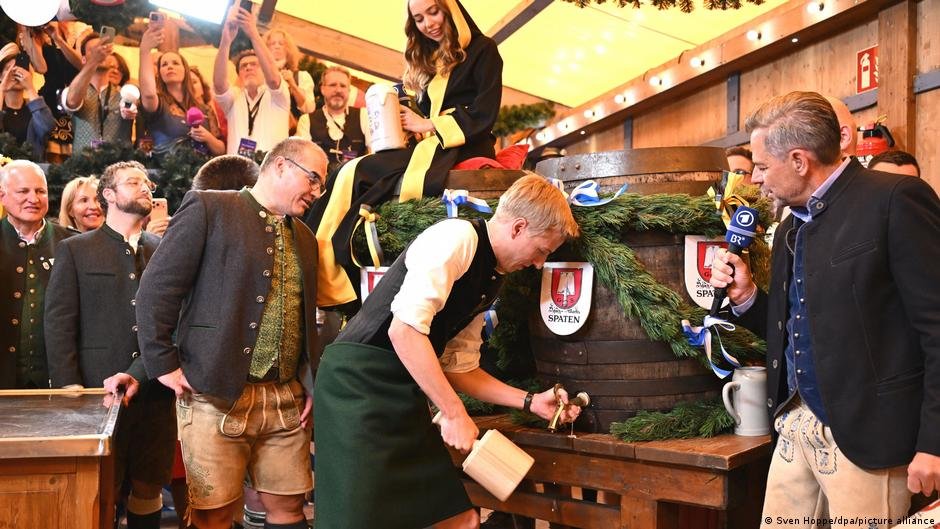
Munich’s annual Oktoberfest officially got underway on Saturday when the first beer keg was opened with the traditional cry of O’zapft is! (“It has been tapped!”).
But another slogan is also being promoted in Bavaria this year: O’piekst is! (“It has been pricked!”) — as doctors offer vaccine jabs against flu and Covid-19.
“With so many people coming together in such tight spaces in the beer tents, the risk of infection at Oktoberfest is higher,” explained Christoph Spinner, head of infectiology at Munich‘s Rechts der Isar hospital.
Oktoberfest coincides with the start of the annual flu season, and Spinner warned that less than a third of people who are recommended a flu jab have actually had one.
Beatrix Zurek, a health expert from the city-led initiative München impft! (“Munich vaccinates!”) said: “It’s our job to go where people are. And that means: Oktoberfest.”
https://p.dw.com/p/5MuH3Skip next section Welcome back09/20/2026September 20, 2026
Welcome back
Matt Ford | Karl Sexton Editor
Guten Morgen! And welcome back to our coverage of Germany on Sunday, 20 September.
Voters in two more German states head to the polls today as elections take place in the northeastern state of Mecklenburg-Western Pomerania and in the capital, the city-state of Berlin.
We will have all you need to know about those elections in a separate blog which we will be launching when polls open at 8 a.m. local time, so keep an eye out for that.
And for all your non-election Germany news – stay right here!
https://p.dw.com/p/5MuFPSkip next section This blog is now paused09/20/2026September 20, 2026
This blog is now paused
We are pausing our coverage on Saturday, 19 September and will be back on Sunday, 20 September with more headlines from Germany.
https://p.dw.com/p/5Mu5SSkip next section Anti-abortion protests held in Cologne, Berlin09/19/2026September 19, 2026
Anti-abortion protests held in Cologne, Berlin
Protests against abortion and assisted suicide took to the streets of the German capital Berlin as well as the western city of Cologne on Saturday, in protest dubbed “March for Life.”
Police said some 2,200 took part in Berlin, whereas no figures on the Cologne protests were immediately available. Catholic bishops were among those attending.
Meanwhile in both cities, pro-choice protests were also held.
Abortion in Germany is banned but women are allowed to carry out the measure if the first 12 weeks of the pregnancy have not yet concluded. They are however obligated to hold consultations first, and the abortion can only be held at least three days after such consultations.
Exceptions are naturally if the pregnancy poses a risk to the woman’s health.
https://p.dw.com/p/5MtyHSkip next section WATCH: Holocaust survivor on ‘very dangerous’ AfD Saxony-Anhalt win09/19/2026September 19, 2026
WATCH: Holocaust survivor on ‘very dangerous’ AfD Saxony-Anhalt win
Tina Gerhäusser
Charlotte Knobloch, a Holocaust survivor and one of Germany’s most prominent Jewish community leaders, has voiced her alarm at the Alternative for Germany’s (AfD) landslide victory in the Saxony-Anhalt state election.
Speaking to DW, she warned that some Jews are once again considering leaving Germany, saying years of efforts to rebuild trust after the Holocaust are being undermined. Knobloch described the rise of the far-right party as a serious threat, urged mainstream politicians to confront extremism more forcefully and called for greater engagement with young people.
Her comments come amid renewed concerns about antisemitism, political polarization, and reported death threats against her.
To view this video please enable JavaScript, and consider upgrading to a web browser that supports HTML5 video
https://p.dw.com/p/5MtuNSkip next section Far-right AfD holds final rally before Mecklenburg-Western Pomerania election09/19/2026September 19, 2026
Far-right AfD holds final rally before Mecklenburg-Western Pomerania election
The far-right Alternative for Germany (AfD) party held on Saturday its final rally in Mecklenburg-Western Pomerania, ahead of the Sunday vote in the eastern state.
Ulrich Siegmund, the party’s winner in Saxony-Anhalt two weeks ago, addressed a rally of some 1,000 AfD supporters in Schwerin, according to police estimates.
He said that what happened in Saxony-Anhalt, where the AfD won but without an absolute majority, was also possible in Mecklenburg-Western Pomerania.
The latest ZDF Politbarometer poll puts the AfD in the eastern state one percentage point behind the Social Democrats (SPD); at 36% and 37% respectively. Next is the Left Party (Die Linke) at 9%, then the CDU at 6% and the Greens at 5%.
The AfD rally was also attended by the party’s candidate in the state, Leif-Erik Holm, who echoed previous remarks that the election “should serve as a signal that this government must finally go.” Several other AfD leaders have repeated the same calls since the results of the Saxony-Anhalt state vote.
The far-right party’s final rally of the campaign also saw some 350 counter-demonstrators, according to police. No incidents were reported.
https://p.dw.com/p/5Mtw9Skip next section Merz schedules CDU meeting with all party leaders to discuss election results09/19/2026September 19, 2026
Merz schedules CDU meeting with all party leaders to discuss election results
In an unusual measure, German Chancellor Friedrich Merz will convene the Christian Democratic Union leadership on Sunday to discuss the results of the state elections in Mecklenburg-Western Pomerania and Berlin.
Unlike in previous state elections, Merz has invited the entire party executive committee to a formal meeting at 5:00 p.m. (1500 GMT) at the CDU headquarters in Berlin. The committee includes some 25 members, either electees or representatives by virtue of their offices.
Due to attend are the eight influential CDU premiers who backed him ahead of the election.
Compounding pressure has befallen the conservative chancellor since the state elections in Saxony-Anhalt earlier this month, which saw the far-right Alternative for Germany (AfD) narrowly missing out on an absolute majority, while Merz’s CDU secured half their previous result.
Polls for the upcoming votes are also grim, with the CDU threatened with the prospect of falling below the 5% threshold needed to enter parliament.
In the capital Berlin, where CDU is currently in power, polls suggest the conservative party is in a neck-and-neck race with the socialist Left Party.
To view this video please enable JavaScript, and consider upgrading to a web browser that supports HTML5 video
https://p.dw.com/p/5MtuMSkip next section Germany’s Carsten Breuer to become NATO’s Military Committee chairman09/19/2026September 19, 2026
Germany’s Carsten Breuer to become NATO’s Military Committee chairman
Germany’s highest ranking military officer, General Carsten Breuer, will be the next chairman of NATO’s Military Committee, after being voted into the role on Saturday.
“The support of the chiefs of defense of our NATO allies means a great deal to me. The alliance faces major challenges – for our security and peace in Europe and beyond,” Breuer, who is also Germany’s chief of defense, told German news agency DPA.
The position is considered among NATO’s most influential ones.
Breuer succeeds Italian Admiral Giuseppe Cavo Dragone and will take over as of July 2027.
Breuer was competing for the position against Canada’s Chief of Defense General Jennie Carignan. Had she been elected, she would have become the first woman to head the committee.
https://p.dw.com/p/5MtqKSkip next section Cologne opera house reopens after 14-year redo09/19/2026September 19, 2026
Cologne opera house reopens after 14-year redo
Cologne’s cultural complex, which includes the city’s main opera house, theater and children’s opera, has finally reopened after renovation works that extended for some 14 years.
“With the reopening of our theaters, we are giving the city back a central place of meeting, inspiration and artistic freedom that belongs to all people of Cologne,” Mayor Torsten Burmester said.
The western German state’s opera house dates back to 1957, with the theater coming shortly after in 1962.
Since 2012, renovations on the pair commenced with an original budget of €250 million (roughly $287 million) that has somehow multiplied nearly three fold as the years rolled on.
The final price tag on the refurbishments stood at around €800 million.
In the 14 years it took to get the job done, Cologne’s opera and theater houses had to relocate to other venues.
Celebrations of the reopening include music, dance, as well as other hands-on activities. On Sunday evening, the opening ceremony will conclude with a concert at the opera house.
https://p.dw.com/p/5MtlBSkip next section Kremlin envoy offers economic cooperation to AfD09/19/2026September 19, 2026
Kremlin envoy offers economic cooperation to AfD
A senior Kremlin envoy has offered Russian help with Germany’s energy supply in cooperation with the far-right Alternative for Germany (AfD) party, which has been widely criticized for its perceived links with Moscow.
The remarks by Kirill Dmitriev, Russian President Vladimir Putin’s envoy for international economic cooperation, come as voters are set to go to the polls in the northeastern state of Mecklenburg-Western Pomerania on Sunday, with the AfD locked in a close race with the ruling Social Democrats (SPD).
“Mecklenburg-Vorpommern will thrive again when affordable, reliable Nord Stream gas returns through joint work with AfD,” Dmitriev wrote on X, using the German name for the state.
“Lower energy bills, more jobs and higher growth,” he continued.
“No more German energy and industrial suicide,” he added, responding to response to a post by AfD co-leader Alice Weidel calling for political change in the state.
Moscow has in the past offered to resume supplying Germany with cheap gas through the Nord Stream pipelines in the Baltic Sea if sanctions over its invasion of Ukraine are lifted.
The AfD has argued that cheaper Russian energy would benefit the German economy and has called for Russian gas supplies to Germany to resume.
However, critics say that Germany’s previous reliance on Russian gas made it prone to energy blackmail from Moscow, while buying it would also serve to fuel Moscow’s war machine.
Sunday’s state election will have no direct bearing on the issue, with Russian pipeline gas subject to European Union sanctions.
Only one of the original four Nord Stream pipeline strands remains intact following explosions that damaged Nord Stream 1 and 2 in 2022. The remaining strand is not in use.
https://p.dw.com/p/5MtSiSkip next section Oktoberfest opens as Munich mayor taps first beer kegPublished 09/19/2026Published September 19, 2026last updated 09/19/2026last updated September 19, 2026
Oktoberfest opens as Munich mayor taps first beer keg
Crowds rushed onto the Oktoberfest grounds in the southern German city of Munich shortly after the gates opened on Saturday.
Some visitors ran toward the beer tents to claim the best seats after waiting for several hours. Members of the first group in line said they had arrived at 7 p.m. on Friday with camping chairs, sleeping bags and emergency blankets.
Beer could not be served until the official opening ceremony at midday, when new Munich Mayor Dominik Krause of the environmentalist Greens tapped the first keg with the traditional cry of “O’zapft is” — Bavarian dialect for “It is tapped.”
“Hop” over to our story for more about the opening of Oktoberfest.
https://p.dw.com/p/5MtAbSkip next section Driver seriously injured in collision with plane at Munich Airport09/19/2026September 19, 2026
Driver seriously injured in collision with plane at Munich Airport
The driver of a car operated by a cleaning company has suffered serious injuries in a collision with a plane engine at Munich airport overnight and has been flown to hospital by rescue helicopter, police said Saturday.
The car struck both the engine and then a passenger staircase, a police spokeswoman said, saying that the driver might have been affected by a medical problem before the crash.
The accident, which occurred at around 3. a.m. local time (0100 GMT), is being analyzed to determine the exact cause.
There was never any danger to other people, police said, and flight operations were unaffected.
No scheduled flights are permitted at Munich Airport between midnight and 5 a.m.
https://p.dw.com/p/5MtPrSkip next section Germany’s Carsten Breuer seeks to chair NATO Military Committee09/19/2026September 19, 2026
Germany’s Carsten Breuer seeks to chair NATO Military Committee
Germany’s highest-ranking soldier, General Carsten Breuer, is standing as candidate for the post of chair of the NATO Military Committee at a vote to take place on Saturday in Copenhagen.
The post is currently held by Admiral Giuseppe Cavo Dragone of Italy.
Breuer, 61, will contend against General Marie Annabelle Jennie Carignan, who is currently Chief of the Defence Staff in Canada.
Breuer himself is the current inspector general of the Bundeswehr, or German armed forces.
The winner of the vote would take over leadership of the NATO Military Committee from July 2027.
The head of the committee is seen as the most influential person in NATO alongside the Supreme Allied Commander Europe (Saceur), a position currently held by General Alexus G. Grynkewich of the US Air Force.
To view this video please enable JavaScript, and consider upgrading to a web browser that supports HTML5 video
https://p.dw.com/p/5MtABSkip next section High-profile Jewish representative calls for AfD ban09/19/2026September 19, 2026
High-profile Jewish representative calls for AfD ban
Charlotte Knobloch, the former president of the Central Council of Jews in Germany, has reiterated her call for the far-right Alternative for Germany (AfD) to be banned.
“A lot about the AfD reminds me today about the path the Nazis took to power,” the 93-year-old Knobloch told the daily Augsburger Allegemeine.
She said the party “teems with Jew-haters and extremists” — something she said had already existed before, “but once, such parties disappeared from the scene very fast.”
This would not be the case with the AfD, she said: “It has broad support in the population, not least with young people.”
The party spouts hatred, including “hatred of Jews,” she said.
“Unfortunately, no one has managed to clamp down on it so far, so it needs to be banned,” she said, even if this is “perhaps difficult legally.”
Knobloch called on voters in Berlin and Mecklenburg-Western Pomerania on Sunday to “read the newspaper, listen to the radio and watch TV; then you can’t help seeing that the AfD is a profoundly anti-democratic party.”
She also warned that Jews in Germany were “literally under fire once more,” with much reminding here of the 1920s and early 1930s.
“There is hatred of Jews from right, from left and from the Muslim milieu,” she said.
Knobloch herself was recently the target of a death threat following the AfD’s landslide victory in the state of Saxony-Anhalt two weeks ago.
https://p.dw.com/p/5Mt5aSkip next section Police raid home of aide to AfD top candidate in Berlin09/19/2026September 19, 2026
Police raid home of aide to AfD top candidate in Berlin
Police this week searched the home of an aide to the top candidate for the Alternative for Germany (AfD) at Sunday’s election in Berlin, Kristin Brinker, media reports have said.
Responding to the reports, Berlin prosecutors said the police had been investigating suspected violations of laws governing the use of explosives and weapons.
According to the prosecutors, the police found no evidence to support those suspicions in the September 15 search but did turn up other items of potential criminal interest.
Reports in the Bild and Berliner Zeitung dailies said the investigators had found Nazi relics and drugs in possession of the 48-year-old aide.
In comments to the Bild, Brinker appeared to downplay the significance of the police finds.
“I never had any indication that he was of that bent. He is simply a collector,” she said.
https://p.dw.com/p/5MszUShow more posts