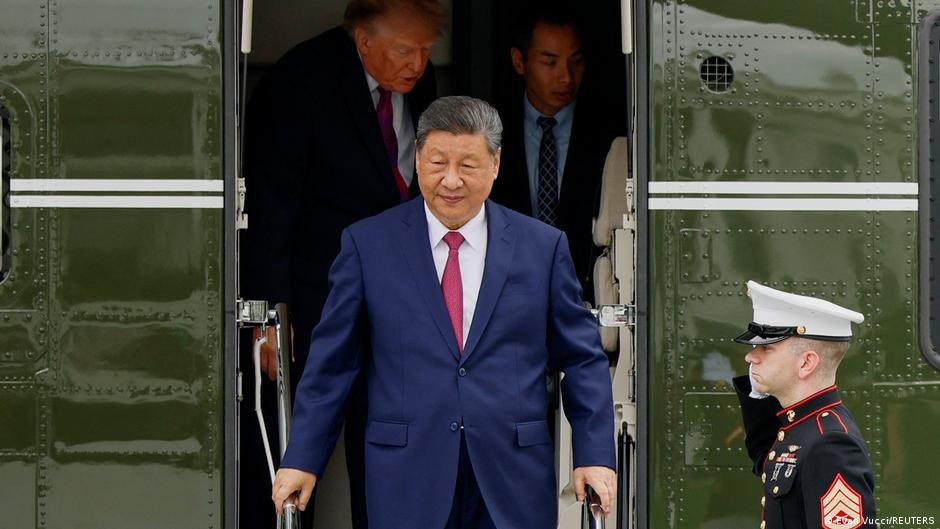
When US President Donald Trump rolled out the red carpet for Chinese leader Xi Jinping at Andrews Air Force Base on Wednesday evening, it was a rare diplomatic gesture that has only happened a handful of times in US history.
Generally, world leaders are received by the president at the White House. Xi’s VIP reception underlines the importance Trump places on his personal rapport with China’s most powerful leader in a generation.
After 90 minutes of bilateral talks in the Oval Office, Trump spent Thursday afternoon showing his “good friend” Xi his various White House construction projects, including the helipad completed just days earlier over the South Lawn. He then welcomed Xi aboard the presidential helicopter Marine One for a brief tour.
Trump’s ‘personal diplomacy’
Trump then told reporters “we had a great meeting,” adding that Xi “loves good granite.”
The optics continued at a glitzy state dinner Thursday night, where Trump said he and President Xi have “never gotten along better” and lauded building a “relationship that promotes prosperity and security for future generations.”
Judging from Xi’s mannerisms, it isn’t clear the Chinese leader shares Trump’s enthusiasm for personal diplomacy. When Trump arrived in Beijing for a summit in May, Xi sent diplomatic envoy, Vice President Han Zheng, to meet the US president.
“Trump’s ‘personalized diplomacy’ is a one-sided construct — one that exists mainly in his own mind. He may believe his personal rapport with Xi is the key factor shaping Sino-American relations, but there’s little to no evidence backing that claim,” said Aurelio Insisa, senior analyst at the Berlin-based Mercator Institute for China Studies, or MERICS.
Xi’s whirlwind visit to the US, his first in 10 years, has been heavy on pomp, but relatively low on substance.
As of Friday morning, most summit coverage has focused on what was for dinner and the tech CEO guest list, in lieu of any deliverables on thorny issues like trade deals or cooperation on artificial intelligence. There is still time for announcements when Xi departs Washington later Friday after visiting the National Archives with Trump.
“The summit did signal a temporary detente, even if concrete deliverables on issues such as AI regulation and trade tensions remained limited. For either government to take steps that would rupture the truce, approval would likely be required at the highest political level, namely from the two presidents,” Dominic Chiu, senior analyst for China and Northeast Asia at the political risk consultancy Eurasia Group, told DW.
“The summit’s optics therefore matter. By meeting publicly and emphasizing stability, both leaders have raised the political cost of actions that could rapidly destabilize the relationship,” he added.
Trade truce extended, rare earths a question mark
The most-pressing issue remains managing a trade war launched by Trump’s scattershot tariffs in April 2025 that at one point were so high they essentially amounted to an embargo on Chinese goods.
On Wednesday, US Treasury Secretary Bessent said a trade truce due to expire in November would be extended until January “to give us more time to see what we can do on the economic front.” Such an extension had been widely expected before the summit.
The trade truce builds on the “Busan deal” Trump and Xi agreed on at a meeting in South Korea last October, where Trump backed off on more tariffs in exchange for Xi easing export control for rare earths, which are critical ingredients for building high-tech kit.
Leveraging China’s chokehold on rare earths to confront Trump’s tariff blitz represented a major victory for Xi.
The Financial Times reported earlier this week that the US “believes China has not fully lived up to its commitment of uninterrupted supply,” adding that China’s shipments of rare earths to the US have dropped recently, amid concerns China could again “choke supplies.”
To view this video please enable JavaScript, and consider upgrading to a web browser that supports HTML5 video
On tariffs and trade, Trump made nebulous comments on Thursday about “progress,” but no specific deals on sectors or goods have yet been reported as of Friday morning. Reports ahead of the summit of an expected $30 billion in two-way tariff cuts have also yet to be proven.
Melanie Hart, director of Global China Hub at the Atlantic Council, wrote in a briefing earlier this week that the tariff cut announcement has been “so widely expected that if it is derailed, it will indicate something has gone horribly wrong.”
Eurasia Group analyst Chiu said the trade truce “buys time for both countries to advance strategic decoupling in national-security-sensitive sectors, including leading-edge technologies and rare earths.”
“However, neither side is likely to decouple sufficiently in the next several years to eliminate the economic damage each could impose through supply-chain leverage. These mutual chokepoints should in turn reinforce incentives for a relatively stable and managed relationship over the next few years,” he added.
Agreements and negotiations are happening through the US-China “Board of Trade,” which was announced in May. US trade representative Jamieson Greer has said the board is operating, with initial lists of possible products including US agricultural goods and Chinese LNG and low-tech goods.
China also wants more access to cutting-edge chips made by US companies needed to develop frontier AI models.
Also unresolved is the question of US secondary sanctions targeting Iran’s financiers, which would include Chinese banks. Trump has also dismissed reports China provided targeting intelligence to Iran.
“The foundations of this trade truce are brittle, and it will likely not survive the end of the second Trump presidency,” Insisa told DW.
“Beijing will not radically alter its industrial and trade policy to meet Washington’s demands, and future US administrations — even Republican ones — will likely deviate from Trump’s approach to China.”
Talk but no walk on AI
Following safety warnings from AI labs, AI regulation and the US-China tech race were thrust into the spotlight ahead of the summit, but expectations for true cooperation are low.
On Sunday, a US-China AI “dialogue” was announced after US Treasury Secretary Scott Bessent and trade representative Greer met with Chinese Vice Premier He Lifeng. Other items included a possible crisis communications line. It is unclear when the group will meet again, with the APEC summit in November providing a possible venue.
To view this video please enable JavaScript, and consider upgrading to a web browser that supports HTML5 video
Trump sees developing AI as a winner-take-all race to the top, and has also reduced the incentive for China to slow down its own development, having called the AI labs’ safety warnings a “hoax.”
Further complicating any parallel AI regulatory frameworks between the US and China is a lack of trust or transparency, where it is impossible to verify if one side is complying with agreed-upon rules. There are also diverging ideas on what regulation means, according to MERICS analyst Antonia Hmaidi.
Xi’s ask on Taiwan
Almost every Trump-Xi summit has been overshadowed by fears that the transactional US president will trade in supporting the self-ruled democracy Taiwan for a deal with Beijing.
This has been compounded by Trump having delayed a $14 billion (€12.2 billion) US arms package for Taiwan passed by Congress in January. Following the May summit, Trump called the package a “good bargaining chip.”
“The truce does benefit China insofar as it constrains US actions that Beijing views as harmful to its national interests. I would also expect the Taiwan arms-sales package to face delays due to the need to maintain the truce,” said Chiu.
Beijing claims Taiwan as Chinese territory and has vowed to crush any attempts at “independence.”
But despite these fears, the US under Trump has yet to shift its narrative on Taiwan, maintaining a posture of “strategic ambiguity” by providing defense support but not officially taking a position on Taiwanese sovereignty.
This creates a delicate diplomatic balance based on language.
Chinese state media reported Xi told Trump he hopes the US will “adhere to the correct position of opposing Taiwan independence.” If Trump accepted “opposition,” it would represent a major break from the current, more passive, formulation of “not supporting” independence.
Trump’s off-the-cuff communication style has led to concerns an errant utterance could be interpreted as a change in position, but this has yet to happen.
Freezing the US-China rivalry
By holding summit after summit building on positive superficial optics, Beijing is maintaining what Chinese policymakers have recently begun calling “constructive strategic stability” in its multifront competition with the US.
“The underlying rivalry will continue, likely through calibrated measures designed to discourage US leading-edge technology companies from investing in China, while also continuing to limit Chinese investment in the US,” said Chiu.
At the White House dinner, Xi’s statement echoed similar remarks made during May’s state dinner in Beijing.
“President Trump has pledged to make America great again … China is committed to achieving great national rejuvenation … These two goals are both ambitious and can surely be mutually reinforcing,” Xi said.
But Xi’s Trump-aligned rhetoric belies what Beijing sees as a fading US-led world order, or what it calls “great changes unseen in a century.” While Trump is focused on US midterm elections in November, Xi has his eye on securing another five years at the helm during next year’s CCP national congress.
“The summit is evidence that the current trajectory in the bilateral relationship continues to favor China,” said MERICS analyst Insisa.
“China has perfected its ‘Trump playbook’ since his return to power and the tariff spat triggered by his ‘Liberation Day’ announcement in April 2025,” Insisa said.
“For the time being, Beijing has found a way to keep the Trump administration engaged while avoiding concrete steps on the most pressing issues: AI governance, trade relations, export controls,” he added.
The next time the two leaders are expected to meet will be on the sidelines of November’s APEC summit in Shenzhen. These issues will most likely all still be on the table, and Xi can wait.
Edited by: Ole Tangen Jr
To view this video please enable JavaScript, and consider upgrading to a web browser that supports HTML5 video