37 minutes agoShareSaveAdd as preferred on GoogleMichael Teferi,BBC AfricaandLucy Fleming

 Social media via Reuters
At least 52 civilians have been killed during three days of heavy fighting around Alamata in Ethiopia’s northern Tigray region, hospital sources have told the BBC.
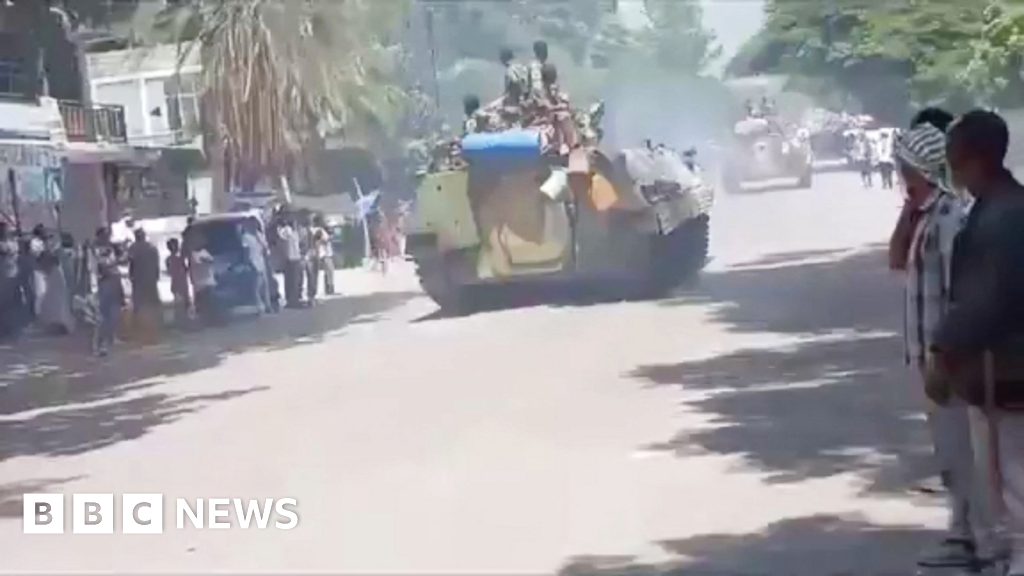
It appears government troops have taken control of the town from regional fighters and intend to push north towards Mekelle, the region’s main city. Social media clips show army tanks on Alamata’s streets.
Clashes broke out last week after months of tension between the government and the party that controls Tigray, with both accusing each other of violating a 2022 deal that ended a two-year civil war.
Fighting has also affected neighbouring regions with 33 tourists stranded for the last week in Lalibela, a Unesco world heritage site.
“We have heard fighting, gunfire and artillery cannons firing throughout the week,” a British tourist, who asked not to be named, told the BBC’s Newsday programme about clashes near Lalibela in the Amhara region.
He said there was a large military presence in Lalibela, famous for being home to 13th Century churches hewn from rock and a holy site for millions of Orthodox Christians.
The fighting around the town has involved the army and an Amhara militia that has allied with Tigrayan fighters.
Earlier in September, they joined forces with other Ethiopian armed movements to form a seven-member alliance with the stated intention of removing the government in the capital, Addis Ababa.
There is also a fear that neighbouring Eritrea could be drawn into the conflict – as the government accuses Asmara of supporting the armed groups, something it denies.
The BBC is unable to report from Tigray and surrounding areas and it is difficult to find out what is happening because communications to the region have been cut.
The two sides disagree over who started the latest fighting.
The Tigray People’s Liberation Front (TPLF), the party that runs Tigray, says it was responding to a federal offensive, including drone strikes, while the government says Tigrayan forces attacked first after seizing control of airports in the region.
TPLF fighters are also fighting in the Afar region, in a strategic area which connects landlocked Ethiopia to Djibouti and its ports.
Over the last few days, medical charity Médecins Sans Frontières (MSF) said more than 700 wounded people had been admitted to hospitals it supports in Tigray.
The doctor at Alamata General Hospital, who requested anonymity, told the BBC the fighting in and around the town had taken place between Saturday and Monday, and involved heavy explosives and artillery, some of which landed in residential homes.
Those killed in the crossfire included children as young as three days old, mothers and cattle herders.
Twelve people had died in a single strike on the town’s marketplace, the medic said.

Since the fighting erupted, banking services in Tigray have been suspended by the government. Access to the internet has also been cut – though it is not clear who ordered the closure.
A separate source in Alamata told the BBC there was a worsening humanitarian crisis in the area, as the town swelled with people fleeing fighting.
“All the residents of the surrounding areas entered the town of Alamata by walking on foot for as long as an hour, hoping the town would be safe.
“Unfortunately, everything is blocked – no banking service, no money transfer, no power, no internet, no phone. Hence people are in crisis, simply suffering, everyone is desperate and frustrated.”
The British tourist in Lalibela said online banking was working in Lalibela but there was a shortage of physical cash.
He said the situation around the town had calmed down in the last two days and there were indications the airport, which was still being used by the military, might reopen on Thursday.
“The local people, they are still scared of what might happen. The military presence here in the town has remained and a larger military force has been seen leaving the town heading north,” he said.
When the airport was first closed to commercial flights, 53 tourists had been in the town, he explained.
But some had since been evacuated, including 14 Israelis by military helicopter on Monday while another five had left the day before via an NGO convoy, despite advice not to travel by road.
Of the remaining tourists in Lalibela, the largest group were Americans, with Israelis, Britons, South Korean, South Africans, an Ethiopian-New Zealander and a Mexican also stranded, he said.
Meanwhile, for those cut off in Tigray because of the telecoms shutdown, the Tigray Broadcasting Service (TBS), based in Addis Ababa, has started an initiative to help reconnect families.
The broadcaster has said it will collect video messages via its Telegram channel from people outside the region and air them via satellite TV.
While limited to greetings and updates, this will provide a rare lifeline for families separated by the blackout.
The clampdown on Tigray’s banking services is also affecting Tigrayans who are not physically in the region.
Customers have told the BBC that bank accounts opened in Tigray have been frozen or restricted.
“I boarded public transport from Addis Ababa to Adama and tried to pay using a mobile transfer, but it didn’t work,” said a former Mekelle resident who moved to the capital two months ago because of growing tensions in Tigray.
“It has created havoc for many people like me who escaped the situation in Tigray,” he told the BBC’s Tigrinya service.
“Many Tigrayans are now in trouble.”
Additional reporting by Yemane Nagish and Lion Tsigab

Go to BBCAfrica.com for more news from the African continent.
Follow us on Twitter @BBCAfrica, on Facebook at BBC Africa or on Instagram at bbcafrica