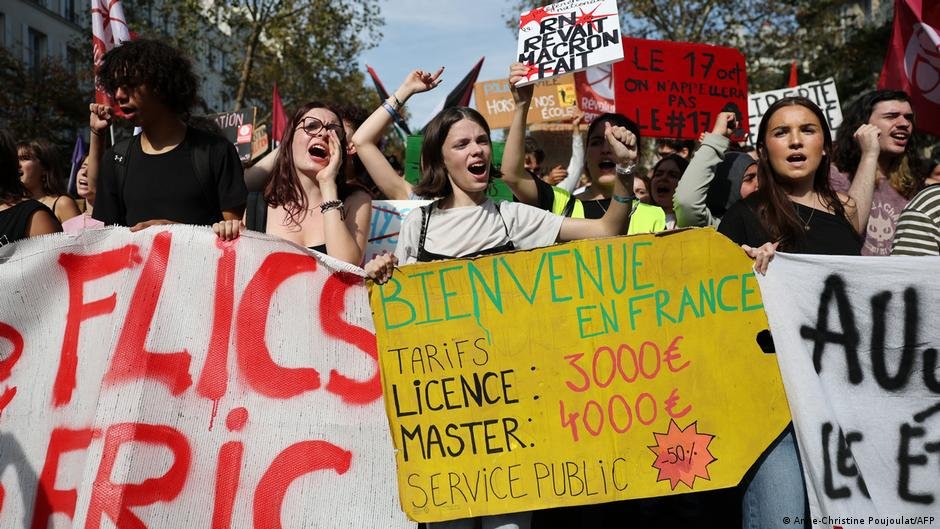
French students protested against dilapidated schools, teacher shortages and overcrowded classrooms. At blockades across the country, 76 people were injured and 440 were arrested.
Image: Anne-Christine Poujoulat/AFP
Since Friday, teenagers have been taking to the streets outside various schools in Lille, Lyon and Saint-Denis. The students are protesting dilapidated buildings, overcrowded classrooms, a shortage of teachers and stressful exams. Local blockades have given rise to a nationwide movement that is increasing pressure on the French government. And discontent continues to grow across the country.
Image: Kenzo Tribouillard/AFP
The protests are taking a more serious turn. Education Minister Édouard Geffray says 76 people were injured, including students and police officers. Interior Minister Laurent Nuñez reports about 440 arrests during Tuesday’s demonstrations, most involving minors. Authorities also say that in seven incidents, hydrochloric acid was allegedly thrown at police officers during clashes.
Image: Giannis Alexopoulos/NurPhoto/picture alliance
Students are complaining about oversized classes and a shortage of teachers. While the government describes the blockades as irresponsible, it acknowledges that the difficulties at the lycées must be taken seriously. OECD data show that the share of the French budget allocated to education has recently declined.
Image: Kenzo Tribouillard/AFP
The unrest comes at a delicate time for France. On Thursday, the government plans to present its 2027 budget. Spending cuts are expected to ease the strain on public finances. Student protests and a public-sector strike are increasing the pressure. The debate over funding for education is thus becoming part of a broader conflict over France’s austerity measures as a whole.
Image: Giannis Alexopoulos/NurPhoto/picture alliance
Education Minister Édouard Geffray has reacted strongly to the riots and announced legal consequences. “This violence is unspeakable,” he said. Anyone who legitimizes or calls for further blockades is endangering students as well as public service employees. Prime Minister Sébastien Lecornu also warned against escalation and called the protests irresponsible.
Image: Raphael Lafargue/ABACA/IMAGO
Anger is particularly intense in Seine-Saint-Denis. Hundreds of students are gathering in front of the Lycée Paul-Éluard. Many young people there feel they are at a disadvantage when it comes to education and resources. Sixteen-year-old Victoire describes the conditions at her school as dire. Her complaint: “We, the children of the suburbs, are abandoned and neglected.”
Image: Raphael Lafargue/ABACA/IMAGO
In Paris, Marseille, Lille, and other cities, thousands of civil servants and public-sector employees demonstrated for higher salaries. They warned of the consequences of years of austerity measures. Firefighters also participated en masse in the rallies. According to union figures, about 8,000 firefighters took part.
Image: Julien Mattia/Le Pictorium/IMAGO
France’s national debt has reached a record high, forcing the government to take action. But any austerity plan is politically explosive. Lecornu must cut billions without sparking new social protests. At the same time, President Emmanuel Macron’s camp does not have a majority in Parliament. The budget thus threatens to become yet another political test.
Image: Gérard Cambon/Le Pictorium/ZUMA/picture alliance
As with the previous budget, Lecornu is seeking support outside the government camp. The prime minister is particularly keen to find common ground with the Socialists in order to get the budget through Parliament. However, there is little room for maneuver: The presidential election is coming up next spring. Radical cuts could further exacerbate the social discontent that is already palpable.
Image: Gérard Cambon/Le Pictorium/ZUMA/picture alliance9 images1 | 99 imageshttps://p.dw.com/p/5NXYj