16 minutes agoShareSaveAdd as preferred on GoogleHugh SchofieldParis correspondent

 AFP via Getty Images
It is a piece of wisdom that all French leaders take care to heed: young people on the street equals trouble.
Since the student protests of May 1968 – memorably described by President De Gaulle as chienlit (bed defecation, in other words chaos) – every government has run scared of angry French youth.
Why? Because youth movements are unpredictable and shapeless, often with no clear structure to negotiate with. Because when they protest, other groups join in.
Also: because as they’re young, the public tends to sympathise. And because if the police mess up and cause injury or worse, then the consequences are incalculable. And presidential elections are only months away.
For all these reasons, when la jeunesse en colère (angry youth) is at the barricades governments tread very carefully indeed.
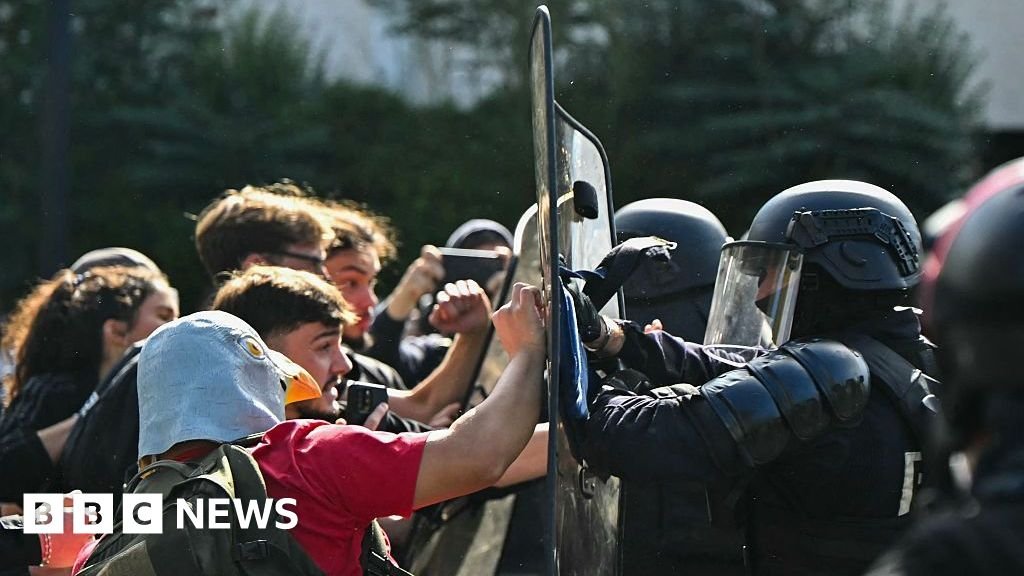
Right now, French teenagers are at the barricades and if they are not visibly angry (the mood is more excitement), they certainly have the government of President Emmanuel Macron in what Le Monde called on Friday “the cold sweats”.
A movement that started nearly two weeks ago in the low-income Seine-Saint-Denis area of northern Paris has in the last few days spread across the country.
On Thursday – the high point so far – hundreds of lycées (where 15-18 year-olds finish their schooling) were being blockaded. On Friday, the situation had improved but around 400 lycées were closed in order to protect staff and students. Universities are beginning to join in.
Violence has erupted. On Thursday the main hall of a lycée in Nantes was destroyed by fire. Smaller fires too numerable to mention were lit at school entrance gates around the country. The cost of the damage is millions of euros.
According to Education Minister Édouard Geffray, 65 teaching staff including 40 school heads have been injured. “Most of the staff who were hurt said that the people they were facing… were not their own pupils,” he said.
 AFP via Getty Images
In addition, the government says that around 300 police and firefighters have been treated for injuries, and some 2,000 people – mainly minors – taken into custody. For their part, student groups say they have a long list of people injured by police. Two teenagers have serious eye injuries and one has lost many of his teeth.
The problem would be hard enough if it was just a question of meeting the protesters’ demands. But there is another dimension – a political and social one – which makes this student crisis far more dangerous than in the past.
The demands do exist, even if they remain vague. They are about money – the lack of it – and the need for more teachers, smaller classes and better buildings.
On such matters, many in France would agree with the teenagers. Certainly using protest to demand money from government is such a national habit that even governments agree it’s legitimate. And of course, things are indeed getting worse in the education system – because money is so tight.
This week Prime Minister Sébastien Lecornu published his draft for next year’s budget. The motif is “More cuts – and this time we’re serious!”
Whether or not he manages to remove €54bn (£46bn) from state spending, as he promises, remains open to question.
But it is surely obvious that the era of public largesse to defuse social unrest in France is now in its twilight. Students demanding an extra school nurse or insulation in the dining-block are likely to be disappointed.
But that is the lesser of the worries.
The far greater fear is that these student protests are being manipulated by the hard left – and that the violence of recent days is a foretaste of what awaits a dangerously polarised society in the year of elections that is coming.
For the right and centre, there is no doubt that behind the student trouble lies the cunning hand of the France Unbowed party (LFI) and its popular presidential candidate, Jean-Luc Mélenchon.
LFI leaders have regularly appeared next to the students – notably in the Paris suburb of Saint-Denis whose mayor Bally Bagayoko was criticised for saying that “violence can sometimes be legitimate.”
 Getty Images
An internal report prepared for the Paris police department which was leaked to the media analysed the opening of the movement in Seine-Saint-Denis. It concluded that students were being “egged on by far-left elements from students unions… and political groups such as… LFI.”
It said the tensions “could be part of a flame-kindling strategy… aimed at imposing their ideas ahead of the national elections”.
In support of its conclusion, the report’s writers cited the presence of protesters who are not themselves lycéens, the vagueness of the demands, the flying of Palestinian and Algerian flags, and the use of tactics – like calling for supplementary protests at police-stations – that come from the radical-left playbook.
The LFI strongly denies doing anything more than lending its natural support to a movement it regards as legitimate. On Thursday Mélenchon called on students to avoid violence “which only serves our enemies’ interests”.
But his opponents believe that the 75-year-old veteran – who stands a good chance of making it to the second round of the presidential elections in May, probably against the hard-right’s Marine Le Pen – knows exactly what he is doing.
Polls show he has massive support – some 40% — among 18-24 year-olds in France, and that this is concentrated in the populous, high-immigration city suburbs where his talk of a “new France” and “creolisation”, to reflect France’s changing language and population, are highly appreciated.
But young people are also the biggest abstainers in French elections, so the strategy – as the elections approach – will be to give constant reminders to this part of the population that the LFI is at their side, and that their vote can count.
Whether this will be enough to ensure victory for Mélenchon is another matter. He must surely take seriously the polls which all show him losing massively in a run-off against Le Pen.
If that happens, France will be in very unstable territory – for which the young people’s protests of recent days will indeed have been a harbinger.