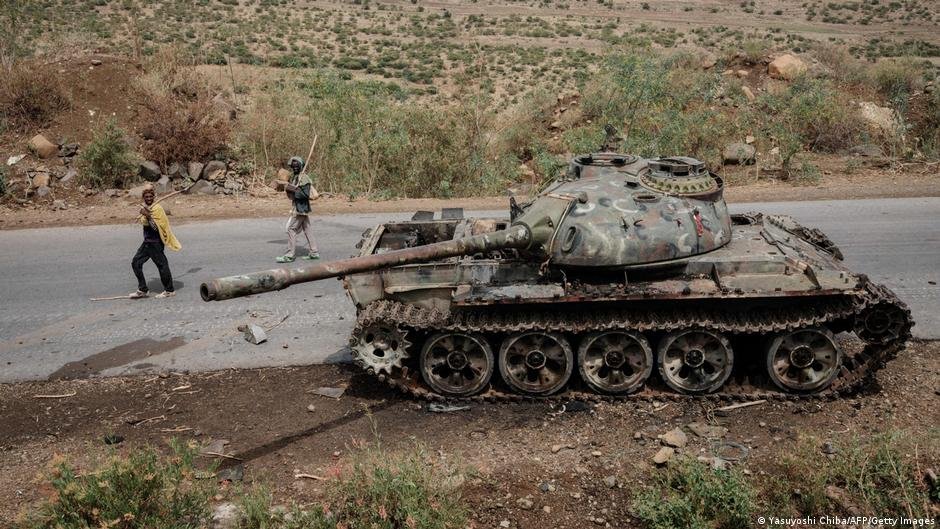
Days into Ethiopia’s renewed conflict in Tigray, the frontlines appear to be expanding into the political arena.
Ethiopia, Eritrea and Egypt are locked in a rapidly worsening diplomatic confrontation, raising fears that frictions could escalate beyond borders and draw in rival regional powers in and around the Horn of Africa.
On Thursday, Addis Ababa ordered the closure of its embassy in neighboring Eritrea, and expelled ten Eritrean diplomats, giving them 48 hours to leave the country.
Eritrea immediately severed diplomatic ties altogether in response to the increasing crisis.
Soon thereafter, Ethiopia also declared an Egyptian diplomat persona non grata, prompting Cairo to expel an Ethiopian embassy counsellor in return.
This diplomatic tit-for-tat comes as fighting between Ethiopian federal forces and an opposition alliance led by the Tigray People’s Liberation Front (TPLF) continues to intensify, threatening to reopen old wounds from a civil war that killed hundreds of thousands between 2020 and 2022.
A resident of Dessie, located about 250 kilometers (155 miles) north of Addis in Amhara State, told DW that even beyond Tigray, the northern “region has been greatly hurt, economically and in every other aspect.”
Eritrea: From peace to hostility
The latest escalation marks a dramatic collapse in relations between Ethiopia and Eritrea.
Only eight years ago, Ethiopian Prime Minister Abiy Ahmed reopened his country’s embassy in the Eritrean capital Asmara as part of a historic rapprochement with Eritrean President Isaias Afwerki.
The peace agreement ended two decades of hostility, and helped Abiy earn the 2019 Nobel Peace Prize.
In the 2020-2022 Tigray war, Eritrea fought alongside Ethiopian forces to repel the onslaught of TPLF fighters. However, that partnership seems to have unraveled.
Addis Ababa now accuses Eritrea of backing the rebel alliance in Tigray, Amhara and Afar. Ethiopia has described Eritrea’s actions as outright “hostility and belligerence,” as Eritrea keeps denying the allegations amid the diplomatic fallout between the two countries.
Eritrean Minister of Information Yemani Meskel went as far as referring to the current tensions as a “declaration of war” by Ethiopia.
This major deterioration of relations reflects deeper disputes between Addis and Asmara, which emerged long before the current fighting, in particular Ethiopia’s long-running push to gain more secure access to the Red Sea.
With Ethiopia being landlocked since Eritrea’s split in 1993, Abiy has sought to establish sea access for years now, saying it is vital for the country’s economic future and national security.
Eritrea, however, has repeatedly issued warnings against any attempt to gain such access through pressure or force, as the uneasy peace between them began to fall apart.
Analysts say that with the two parties now on opposing sides, Eritrea is providing rebel forces access to its Red Sea coastline, providing a lifeline to the otherwise isolated Tigray region.
To view this video please enable JavaScript, and consider upgrading to a web browser that supports HTML5 video
Egypt: ‘Reciprocity is the currency of diplomacy’
The diplomatic crisis meanwhile has spread further across the region, as the Ethiopian government also started accusing Egypt and Sudan of supporting the opposition alliance. Both countries, however, reject those accusations.
Cairo responded swiftly to the expulsion of their diplomat from Ethiopia, with Egypt’s Foreign Ministry spokesman summing up Cairo’s position in a single sentence: “Reciprocity is the currency of diplomacy,” expelling an Ethiopian embassy counsellor in response to Addis’ actions.
But relations between the two countries had been strained long before the onset of current conflict.
For over a decade, Egypt has been expressing its opposition to the building of the Grand Ethiopian Renaissance Dam (GERD) close to the border with Sudan, with Cairo arguing that the project could affect downstream water flows from the Nile.
Against that backdrop, any deterioration in bilateral relations carries to potential to reach far beyond the current conflict.
Sudan, Somalia and Gulf states also drawn into conflict
Meanwhile to the west, Sudan’s civil war appears to have become yet another factor in the growing regional crisis.
More than three years after the start of hostilities between the Sudanese army and the Rapid Support Forces (RSF) paramilitary group, the impoverished country remains trapped in what the UN has referred to one of the world’s worst humanitarian crises.
As part of that conflict, Sudan has repeatedly accused neighboring Ethiopia of subverting the military by supporting the RSF, including reports of hosting training camps for the militias — a claim Addis Ababa rejects.
To the east, Somalia continues to face its own domestic insecurity challenges from the al-Shabab insurgency and an overall sense of political instability, as Ethiopia is reportedly preparing to withdraw more than 3,000 troops from the country and redeploy them to areas affected by the fighting in the north, according to Bloomberg.
At the same time, Gulf powers such as the United Arab Emirates (UAE) and Saudi Arabia also keep vying for influence across the region amid unconfirmed reports of supporting various players.
Reports of explosions in Addis Ababa
Concerns about the current escalation intensifying grew after a number of overnight explosions were reported in Addis Ababa; several diplomatic sources have since confirmed witnessing blasts in the Ethiopian capital,
If reports that link the drone attacks to an anti-government alliance are fully verified, the attacks could be highly significant for the current outlook: Anti-government groups have never demonstrated the ability to strike Addis Ababa with drones before — especially while fighting a conflict hundreds of kilometers away in northern Ethiopia.
The Ethiopian government has not publicly confirmed the claims, though the country’s intelligence service announced a ban on drone flights over the capital.
Shrinking hope for diplomatic solution
The African Union meanwhile continues to call for restraint, attempting to pull the region back from the brink.
In a statement issued after Thursday’s diplomatic expulsions, the AU Commission urged Ethiopia, Eritrea and Egypt to resolve their differences through dialogue rather than confrontation.
Amhara Region President Arega Kebede told DW that the conflict continued to cause death, displacement and economic damage.
“No matter how much justification is presented, the ongoing bloodshed cannot be a sustainable answer to the region’s problems,” he stressed, calling on community and political figures to play a greater role in mediation efforts.
Today, African leaders gather in Cairo for the Egypt-Africa Summit, providing one of the first major diplomatic forums since the latest crisis erupted.
The meeting could offer an opportunity for informal discussions between regional leaders at a moment when official relations keep deteriorating rapidly.
However, no major actor from within the region or outside has yet stepped forward to broker talks, as tensions across the entire Horn of Africa threaten whatever little peace and stability there remains.
Edited by: Sertan Sanderson