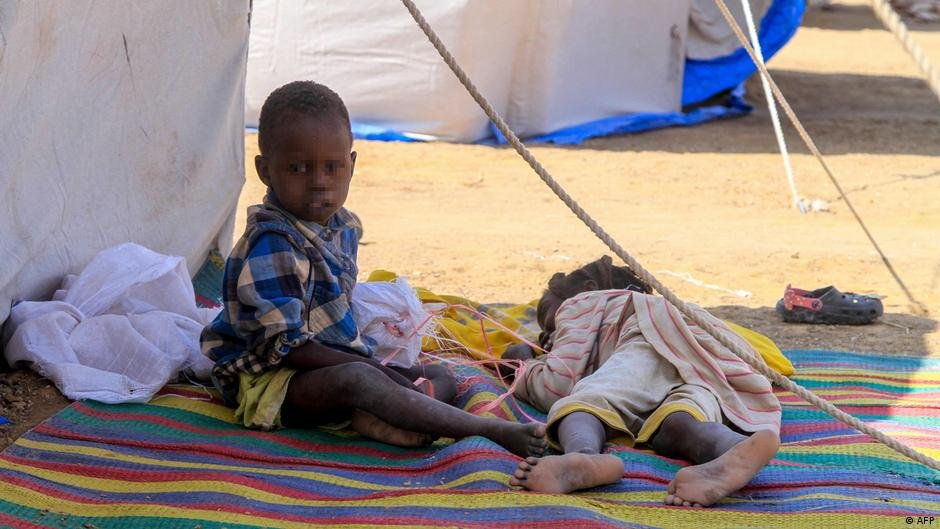
In Sudan, clashes between the Sudanese Armed Forces (SAF) and the Rapid Support Forces (RSF) have intensified in North Kordofan and parts of Blue Nile state. The fighting has forced thousands of civilians to flee amid the planting season.
Since war broke out between the two factions and their allied militias in April 2023, both sides have fought for power. However, neither has managed to establish control over the entire country.
The SAF, the nation’s official army, is in control of Sudan’s north and center, including the capital, Khartoum, while the RSF maintains its presence in the western Darfur region and parts of the south.
The brutal war has plunged Sudan into one of the world’s worst humanitarian and displacement crises, according to the United Nations and international aid organizations. The estimated death toll ranges from 40,000 to 250,000 people as reliable figures remain difficult to obtain amid the ongoing fighting. More than 12.4 million Sudanese have also been displaced, both within Sudan and to neighboring countries.
This week, the aid organization Action Against Hunger sounded the alarm.
“24.6 million people are experiencing high levels of acute food insecurity,” Jan Sebastian Friedrich-Rust, executive director of the German section of the NGO, told DW.
Friedrich-Rust added that an estimated 825,000 children younger than 5 suffer from severe acute malnutrition in 2026, while a total of 4.2 million children and pregnant or breastfeeding women are thought to be acutely malnourished.
In October, the Famine Early Warning Systems Network (FEWS NET) — which monitors food insecurity and uses the internationally recognized Integrated Food Security Phase Classification (IPC) system — also warned that several areas including camps for internally displaced people in Greater Darfur and Greater Kordofan, are expected to face Catastrophe (IPC Phase 5), the most severe classification of acute food insecurity.
“The situation in Sudan continues to deteriorate and humanitarian needs are growing, even as the resources to respond are shrinking,” Fabrizia Falcione, the Sudan representative of the United Nations Population Fund, the UN agency for sexual and reproductive health, said.
“I recently visited the displacement camp Tawila and I am still struggling to find the words to describe what I witnessed,” Falcione told DW. “Imagine a population larger than that of Frankfurt, Germany, forced to flee their homes and seek refuge in one place in less than three years.”
She added that more than 700,000 people there rely on just one hospital capable of performing Caesarean sections.
Despite repeated warnings about the deteriorating humanitarian situation, the 2026 Humanitarian Response Plan, which calls for $2.9 billion (€2.59 bn), is just 41% funded, with $1.2 billion (€1.07 bn) received from international donors so far.
To view this video please enable JavaScript, and consider upgrading to a web browser that supports HTML5 video
Climate shocks exacerbate Sudan’s humanitarian crisis
The United Nations Office for the Coordination of Humanitarian Affairs (OCHA) recently warned that extreme heat and heavy flooding are worsening the crisis in Sudan.
“This year, a massive heatwave brought power cuts of up to 12 hours per day in some regions,” Hager Ali, a Sudan researcher at the German Institute for Global and Area Studies (GIGA), told DW. “Riverbeds and dried-out fields are barren, which comes on top of the damage from combat, the RSF’s scorched-earth tactics and environmental destruction.”
While the drought is affecting roughly half the country, heavy rains and localized flooding have worsened conditions in other areas of Sudan.
“As if that wasn’t enough, there is also a massive shortage of fertilizer and diesel,” Ali told DW.
Sudan relies on imported fertilizer and diesel shipped from the Persian Gulf through the Strait of Hormuz and the Bab el-Mandeb Strait. However, amid the wider Iran war, Iran has been blocking shipping in the Strait of Hormuz, while the Iran-aligned Houthi rebels in Yemen have threatened and at times disrupted shipping through the Bab el-Mandeb Strait.
“Fertilizer supply collapsed from 450,000 metric tons to only about 50,000” in 2026, Ali said, adding that a similar diesel shortage and the soaring cost of diesel compound the situation in two ways.
“Agricultural equipment uses diesel and the transportation of humanitarian and agricultural goods within the country is getting a lot more expensive,” Ali said.
In October, the International Food Policy Research Institute warned that staple food- and fuel prices in Sudan rose sharply in September 2026.
Limited arms embargo curbs hope for an end to the war
Observers have long pointed out that the war in Sudan will not end until foreign backers stop supplying arms. The SAF is officially supported by Egypt, Turkey, Russia and Iran while the United Arab Emirates is alleged to be the RSF’s main backer, a claim Abu Dhabi denies.
However, in October, the UN Security Council extended the existing arms embargo only on Sudan’s Darfur region until December 11, dropping calls for a nationwide embargo.
“To expand the UN embargo across Sudan would have included drones in particular,” Hager Ali said, noting that Sudan is one of the biggest theaters for drone warfare: As of 2026, the leading cause of civilian casualties in Sudan are drone strikes.
She also told DW that Al-Harith Idriss al-Harith Mohamed, Sudan’s permanent representative to the United Nations, opposed the extention of the embargo over concerns that it would disproportionately limit the Sudanese Armed Forces on the battlefield.
“An arms embargo would deter potential backers from cooperating with the Sudanese Armed Forces, whereas the Rapid Support Forces don’t necessarily source their weapons through official ways,” Hager Ali said.
“The RSF rely on trafficking with other militias, private military contractors and traders in the region,” she said, adding that because the RSF obtains supplies from numerous sources and actors, it is difficult to target the group through a single embargo.
To view this video please enable JavaScript, and consider upgrading to a web browser that supports HTML5 video
Edited by: Carla Bleiker