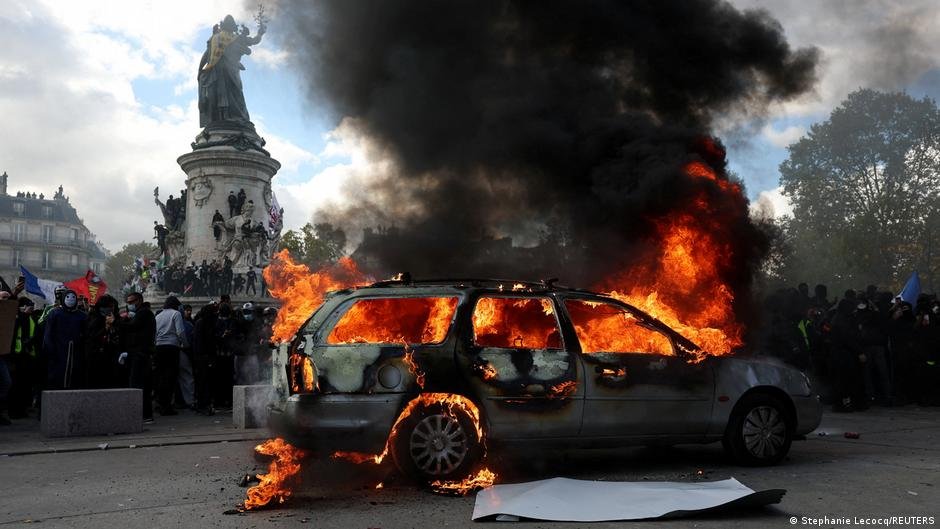
More than 1,800 people were arrested across France following riots, looting and arson during cost-of-living protests, Interior Minister Laurent Nunez said Sunday.
The unrest on Saturday has sharpened tensions ahead of France’s 2027 presidential election, as anger over living costs collides with tight limits on government spending.
What happened during the protests?
Clashes, fires and looting broke out in several cities during Saturday’s demonstrations. Prime Minister Sebastien Lecornu said 150 police officers had been injured and blamed what he described as a highly organized, violent far-left group.
Paris police reported 855 arrests, describing the figure as a record. Prosecutors said 517 people remained in custody, including 171 minors. Those figures were provisional, with arrests continuing until early Sunday.
Most arrests in the capital were linked to suspected handling of stolen goods, participation in a group intending to commit violence, and vandalism.
In central France, rioters set fire to Limoges’ historic town hall, leaving much of it gutted. Mayor Guillaume Guerin condemned the destruction.
“There are no words to condemn what happened, so appalling is it,” he told broadcaster LCI. “The country is in chaos.”
Authorities reported attacks on public buildings and shops in Marseille, Lyon, Avignon and Grenoble. Police used tear gas, batons and water cannon in several cities.
Demonstrators were also reported injured. The newspaper Le Figaro reported that a 17-year-old lost a hand to a grenade fired by police in Saint-Etienne.
What have leading French politicians said?
President Emmanuel Macron vowed that those responsible would be prosecuted and punished.
“No room for violence in our Republic,” he wrote on X, condemning attacks on government buildings, businesses and town halls.
The Elysee Palace said French President Emmanuel Macron would address the nation at 8 p.m. local time (1800 UTC) on Sunday.
To view this video please enable JavaScript, and consider upgrading to a web browser that supports HTML5 video
Opposition politicians seeking to succeed Macron in presidential elections in April and May also responded to the unrest.
Far-right candidate Marine Le Pen accused the party of her far-left rival Jean-Luc Melenchon of having “legitimized the violence.” She pledged to protect the French “from the violence of the extreme left.”
Melenchon, who had backed the demonstrations and preceding student protests, urged demonstrators to stay away from looting, calling it “contrary to our methods.”
The demonstrations brought together grievances over fuel prices, low wages and problems facing farmers and firefighters. School and university students demanding better learning conditions also participated.
The interior ministry put nationwide turnout at 550,000, including 110,000 in Paris. The CGT trade union gave a higher national estimate of 800,000.
France’s high debt and budget deficit limit the government’s ability to meet demands for additional spending.
Online calls to revive the yellow vest movement have added to government concerns that student demonstrations could grow into broader unrest.
The yellow vest movement began in 2018 over planned fuel tax increases and grew into wider protests over living costs and inequality. Named after the high-visibility vests worn by demonstrators, it brought months of nationwide demonstrations, some marked by violent clashes with police.
To view this video please enable JavaScript, and consider upgrading to a web browser that supports HTML5 video
Edited by: Karl Sexton
If you rely on our team for trusted reporting, please take a moment to select us as your Preferred Source on Google, so you’ll always see our verified news first.