https://p.dw.com/p/5ObnKPrefer DW on Google
Düsseldorf Airport is a historically symbolic location. This is where the first Turkish “guest workers,” as they were called at the time in Germany, arrived 65 years ago.
At a ceremony there in in mid-September, North Rhine-Westphalia’s premier, Henrik Wüst, commemorated the courage of this first generation of migrants and their contribution to Germany’s prosperity.
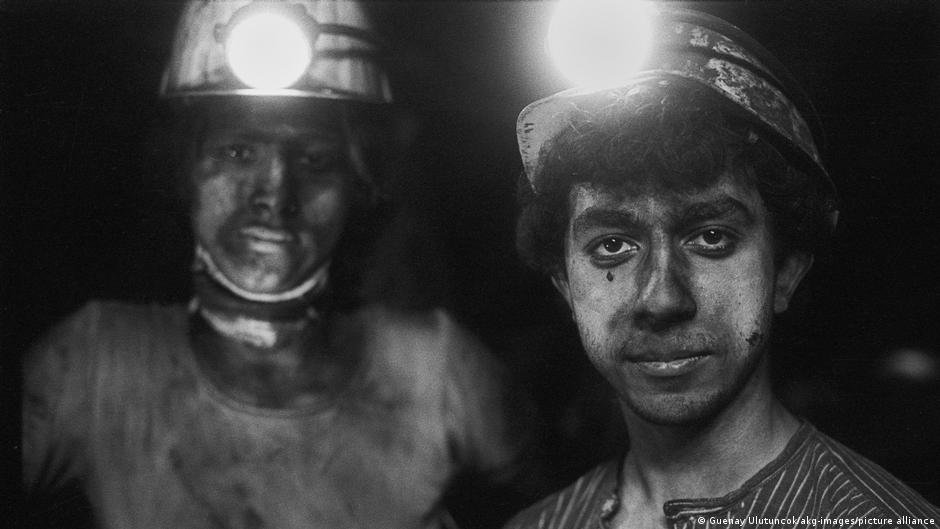
By the time recruitment ended in 1973, some 870,000 Turkish men and women had migrated to Germany for work. They toiled in the coal mines, did piecework on assembly lines or cleaned factory floors. Most settled in Düsseldorf, Cologne or Duisburg. “They have made our country more diverse, more open and stronger,” said Wüst. However, he also stressed: “We will have reached our goal only once name, skin color and religion no longer matter.”
Some upward mobility among migrants, but discrimination a big problem
According to integration expert Haci-Halil Uslucan, Germany is still a long way from that.
Even 65 years later, he told DW, people of Turkish descent still suffer a great deal of discrimination in Germany.
But he believes that the German Turkish labor recruitment agreement was, in the main, a success story.
“We’ve seen success in many areas, such as education. Today, we have a large number of college graduates, and we’ve seen professional advancement. And successful political careers. Take Baden-Württemberg’s state premier, Cem Özdemir, for example,” he said.
Uslucan himself is one such a success story. His father came to Berlin from Turkey and worked in the textile industry. Two years later, his father brought his wife and two sons to join him in Germany.
Haci-Halil Uslucan subsequently earned his Ph.D. in psychology and a professor of contemporary Turkish studies at the University of Duiburg-Essen.
One of his most recent research topics addresses the dark side of the labor recruitment agreement. He is examining loneliness, an issue that affects and troubles many former so-called “guest workers.”
But poverty is also increasingly taking its toll on some people of Turkish descent reaching retirement age.
With a rate of between 25-30%, poverty in old age is twice as high among migrants in Germany than among Germans, which is about 12-14%, he says, adding that the disability rate and the rate of early retirement are significantly higher among migrants because the first generation did very heavy physical labor.
They are also twice as likely to become unemployed 10 years before reaching retirement age, says Uslucan.
“In addition, their monthly income is lower, they are more likely to have had employment gaps and worked in low-wage sectors. As a result, their pensions are also low.”
To view this video please enable JavaScript, and consider upgrading to a web browser that supports HTML5 video
Pensions €360 lower among Turkish citizens in Germany
An analysis by Germany’s pension insurance fund (DRV) for the Mediendienst Integration, an information service for journalists on migration topics, uncovered some alarming figures: In Germany, pensioners with Turkish citizenship receive, on average, about €890 ($997) in pension benefits per month. That is €360 less than German pensioners, who receive €1,250 per month on average.
Even more troubling is that in June 2026, more than three times as many retirees with Turkish citizenship relied on top-up welfare benefits as Germans (9.3% compared to 2.7%).
One reason for this is that many of the Turkish workers who came to Germany were already in the middle of their working lives and consequently has less years to contribute to their pension fund, social scientist Eric Seils of the Hans Böckler Foundation in Düsseldorf told DW.
“But, of course, the most important reason is that they earned less in wages and had a shorter work history. The guest workers who came to Germany often went straight to factories, mines or construction sites. There, they didn’t earn high hourly wages because they were often less educated than the Germans,” he added.
With deindustrialization in the early 1970s and the oil crisis, many Turkish workers in Germany also lost their jobs.
“There weren’t as many good jobs available at traditional industrial companies. Those who weren’t as well-educated were more likely to become unemployed than those with an education — and the same was true for Germans. And when working lives are interrupted, that naturally has an impact on retirement benefits at some point.”
Few chances for migrant workers to train
Janina Söhn of the Institute for Sociological Research (SOFI) at Göttingen University has also studied the issue of poverty among older immigrants in Germany.
It’s a major problem in Germany that nearly one-third of immigrants are at risk of poverty, she said.
“This group faces even greater hardship than, for example, women in general, who already have a higher risk of poverty. And when you then look specifically at female migrants living alone, the figures are truly dire and alarming. If there were no family support, it would be an even sorrier situation.”
Older Turkish migrants in Germany also often have limited opportunities to earn extra euros during retirement.
This is because either because they are poorly qualified or because the hard physical labor they performed when they were younger has left them physically unfit.
According to figures from Germany’s Federal Employment Agency, the employment rate of for retired Turkish people living in Germany is only half that of Germans (5.2% compared to 10.8%).
“Basically, they face a whole series of disadvantages or hardships in life. That generation of guest workers was brought to Germany and then had to do the worst jobs here, whereas many Germans were able to progress through education and training,” Söhn said.
The Turkish workers in Germany didn’t get similar chances.
“The people who did these tough jobs, which are always necessary for any economy, paid for it with their health,” she said.
This article was originally written in German.