https://p.dw.com/p/5PNiKPrefer DW on Google

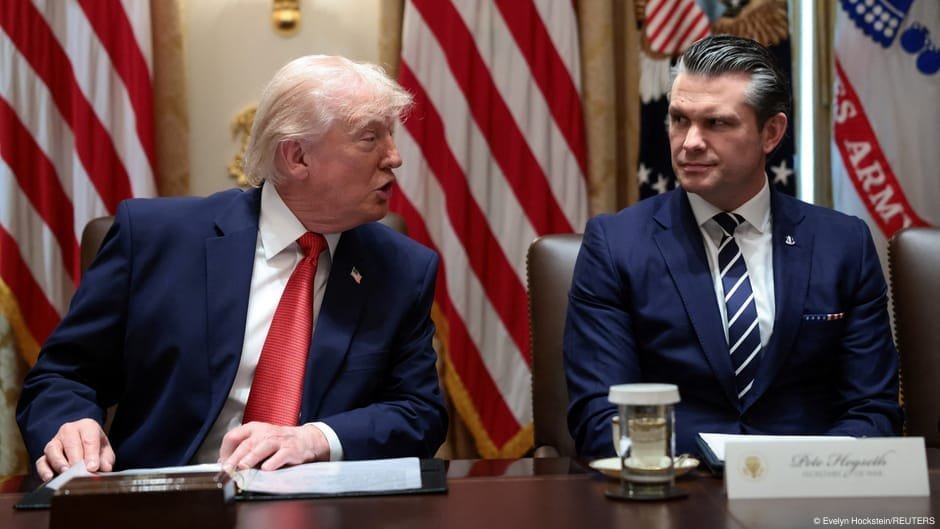
Pete Hegseth, US President Donald Trump’s secretary of war, described the failed efforts to impeach him this week as “farce” and “sabotage”.
The case, built on an accusation that Hegseth waged war on Iran without the proper congressional approval, always looked a long shot. But many observers believe it could be the first in a wave of impeachment attempts, possibly headlined by a third attempt to impeach Trump.
DW takes a look at impeachments and why you may be hearing more about them.
What is impeachment?
While there are global variations in how impeachment works, in the US it is a process that allows the legislature (usually Congress, state or tribal legislature) to bring charges against an elected figure — a judge or a president, for example. These are not criminal charges but can result in the removal of the accused party from their post.
For federal impeachment, once an impeachment case is raised in the House of Representatives, it must be heard in a trial in the Senate, with both sides able to cross-examine relevant figures. However, for a conviction to be obtained, a two-thirds majority must be reached, a factor which often limits the chances of success given the partisan nature of US politics.
It is a simple process to introduce and, once started, the case is heard within 48 hours, as was the case with Hegseth.
What is impeachment used for in US politics?
Given only eight people, all judges, have been impeached since the first case concluded in 1799, the odds of impeaching a high-level politician are long. The two-thirds majority rule has meant that impeachment is instead often used to draw attention to perceived misdemeanors and potentially force a resignation.
“Using impeachment threats as a signaling device is a fairly old tactic, but it has certainly become more common in the Trump-[Joe] Biden era,” Frank O Bowman III, a law professor at the University of Missouri and author of a forthcoming book on impeachment and Donald Trump, told DW.
That, added Keith Whittingtona Yale Law School professor and impeachment expert, was not what impeachment was intended to do.
“Congress has tended to take an extremely partisan approach to making use of the power. That has doomed any possibility of conviction and removal,” he told DW.
“The possibility of partisan use of the impeachment power became evident very quickly in American history, but the founders certainly would not have intended or hoped that the impeachment power would be used as a partisan weapon or a means of partisan messaging.”
Will Donald Trump be a target for impeachment for a third time?
The recent midterm results will see the Democrats control both houses of Congress from next year, meaning there is a greater chance that the US President could be impeached for an unprecedented third time. He was acquitted on “charges of abuse of power and obstruction of Congress” in 2020 and then on the charge of “incitement of insurrection” in 2021.
Bowman consulted in both cases. “In my view, they should have succeeded,” he said. “But they didn’t and, from the perspective of the average member of the public, it’s just fuss and bother, but nothing happened. So why are we even bothering? I do think that in the public mind, impeachment has been significantly devalued.”
The law expert said there are multiple ways Congress could try again, including “conduct that rises to the level of treason, bribery, other high crimes or misuse,” but political considerations are critical.
“Democrats should not start out their control of the House by rushing off to impeach Trump because … it would detract from what I think they need to be doing. That is demonstrating to the public that, having regained control of the legislature, they’re at least going to try to do things which are of practical importance to the average person.”
To view this video please enable JavaScript, and consider upgrading to a web browser that supports HTML5 video
However, given the midterm results, Bowman thinks there is a chance that if enough Republicans — and public sentiment — turn further against Trump, the numbers could work. Should that time come, added Whittington, there is one particular avenue open to the Democrats.
“The best strategy would be close negotiations with Republican senators to discover if there are any grounds that might peel off the votes that they would need from across the aisle,” Whittington said. “That might not be very satisfactory for the Democratic base, but that would put the president at greatest risk of conviction and removal.”
What about other members of the Trump administration?
The Hegseth case, effectively killed after the House of Representatives voted to refer impeachment articles to a committee, shows an appetite for impeachment against members of Trump’s cabinet.
Indeed, impeachment resolutions have already been filed against Health and Human Services Secretary Robert F. Kennedy Jr. and Education Secretary Linda McMahon, and Attorney General Todd Blanche could also be in the sights of Democrats in the upcoming Congress.
“The Democrats will face a tremendous amount of pressure from their own base to consider impeachments, and the fact that so many Democrats in the House supported the Hegseth impeachment in this procedural vote suggests that there will be an appetite to pursue that possibility in the next Congress,” said Whittington.
With getting the votes to impeach Trump perhaps tougher due to his “cult of personality” within the Republican party, picking off his closest allies may be in play, said Bowman.
“You could eliminate cabinet officers, as a means of making a point to the administration, that: ‘OK, we’re not going to come after the big man himself, but if the rest of you minions insist on doing bad stuff, we will take you out.’”
Why do so few impeachment cases seem to fail?
Essentially, this is down to the two-thirds majority rule, according to both experts. Given that neither party has enjoyed such a majority since the mid 1960s, any conviction requires significant support from opponents.
But, actually, said Whittington, a conviction is not the only way to judge the success of an impeachment.
“Often the impeachment threat is itself sufficient to encourage an officer mired in scandal to resign, so that an actual conviction at trial is not necessary,” he said
“Impeachment trials are more rare than they might otherwise be simply because impeachment threats are often successful. But, of course, some officers are willing to ride an impeachment out and take their chances at trial.”