https://p.dw.com/p/5PgnFPrefer DW on Google
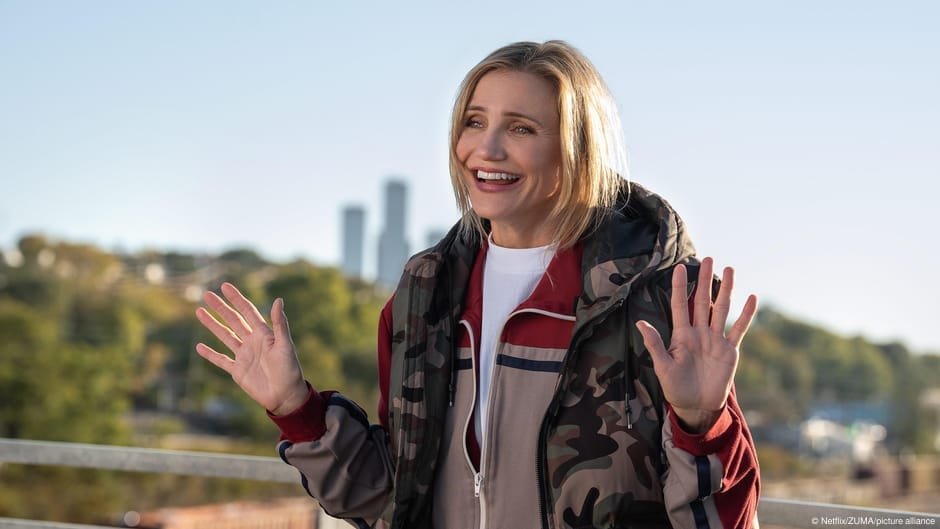
When does Cameron Diaz not sound like Cameron Diaz? When you’re in a German cinema.
For more than 30 years, whenever the Oscar-winning actor has appeared on German screens, she has spoken with the voice of Katrin Fröhlich.
The same goes for all other famous actors. In Germany’s €125-million ($138-million) voiceover industry, Hollywood‘s up-and-comers are “adopted” by a voice actor who provides their German voice — often for decades — ensuring continuity and a certain relationship to the stars for audiences.
But on Netflix, and perhaps elsewhere, many of those voices might be about to change.
Netflix contract sparks AI dispute
Recently, Fröhlich and fellow voice actors Anne Helm (Margot Robbie) and Luise Helm (Scarlett Johansson) published a video on social media, letting their followers know they wouldn’t provide their voices anymore.
The reason? They refuse to sign Netflix‘s contract, seen by DW, which contains a clause that lets the American entertainment giant use their voices for training its AI.
They’re not the first voiceover artists to speak out on the topic. But they are the first ones to go viral.
“It was unexpected, completely,” Fröhlich said. “For whatever reason, we managed to reach people, perhaps because … we are three well-known women in the voiceover industry.”
“Over the years, we’ve managed to make good names for ourselves. It seems to have touched people that we made this statement together,” she said.
Union says deal offers legal safeguards
The new AI clause has been in Netflix’s contracts since January 2026. Voice actors sign one ahead of every production. It was negotiated by BFFS, Germany’s union for film and television actors.
Fröhlich, like a significant number of voice actors, is not a member and feels as though the union went over their heads. However, BFFS says the deal gives them protection they wouldn’t otherwise have.
Till Völger, an attorney and member of the union’s board, says previous contracts and those with other streaming services are silent on AI or contain sweeping AI permissions.
If an AI-generated voice doesn’t sound like a particular person, companies are free to use the data they have gathered as they wish. Training can take place in other jurisdictions and may not require the actor’s consent at all, he pointed out.
“We have a massive, massive protection gap,” Völger told DW.
To view this video please enable JavaScript, and consider upgrading to a web browser that supports HTML5 video
Against that backdrop, BFFS argues the deal with Netflix is a step forward. It allows the company to train its own systems with recordings, but voice actors must give separate, explicit consent before their recordings are used to create actual AI-generated voices, even if the voice isn’t recognizable as theirs.
“We’ve created a contractual right that the law doesn’t provide,” said Völger. “Is the situation perfect? No. Is it better than before? Yes.”
He would like to see other streaming services agree to the same conditions that Netflix has. In his view, only legislation could create the necessary protections voice actors are seeking.
Netflix says human performance “is and remains important to us,” in statement provided to DW.
“In recent years, we have commissioned thousands of hours of German dubbing, and we intend to continue supporting a similar volume of work and the use of human voices,” the statement continued.
Voice actor plans legal challenge
Matti Klemm, the voice of Jason Momoa and beloved children’s cartoon elephant Benjamin Blümchen, sees things differently. Like Fröhlich, he is refusing to sign the new contract.
“In short, it says: as soon as I record something for Netflix, I’m automatically training their AI, for free,” he told DW. “My job is to create a German original, a dubbed version with my performance, not to train the computer systems of some tech companies.”
He is taking Netflix to court, backed by the Society for Civil Rights (GFF), to find out how his voice has been used for training in previous projects.
According to Davy Wang, who is coordinating the case for Klemm and GFF, the lawsuit will seek to stop Netflix using his recordings for training, disclose how previous data was used and establish whether Klemm is entitled to any damages.
The suit will be filed at the end of the year or in early 2027. Supporters donated more than €50,000 to the legal fund in the first week following its announcement.
For Klemm, what is at stake goes beyond training. “It’s not about our voice, it’s about our soul, our performance, the way we are,” he said. “How far have we come when AI training matters more than my actual work?”
Netflix said it cannot comment on a case that has not yet been filed.
Industry fears growing AI impact
For a multimillion-euro industry, the outcome of the case could reach well beyond Netflix and other companies and creative branches are watching. But no matter what the outcome of the lawsuit or contract agreements, voice actors’ fears for their future run deep.
Those who don’t sign contracts can’t work, and streaming companies can make up a significant part of their income.
“Many say: I’ve held out for 10 months, but I can’t anymore. I have to sign this contract, I have to pay my rent, I have to feed my children,” explained Fröhlich.
Beyond that, many fear the future of their industry and the connections they have formed with stars and audiences.
“For a many people I’m connected with Cameron Diaz and I evoke something within them,” said Fröhlich.
But if Diaz is involved in more Netflix projects, “then I’ve basically lost her,” she concluded. “I’ll never be her voice again.”
Edited by: Tim Rooks