Heavy rains and flooding linked to the El Niño climate phenomenon have once again battered the Galápagos Islands. More than 7,400 people have been affected, and over 1,000 homes have been damaged.
Image: Carlos Espinosa/AFP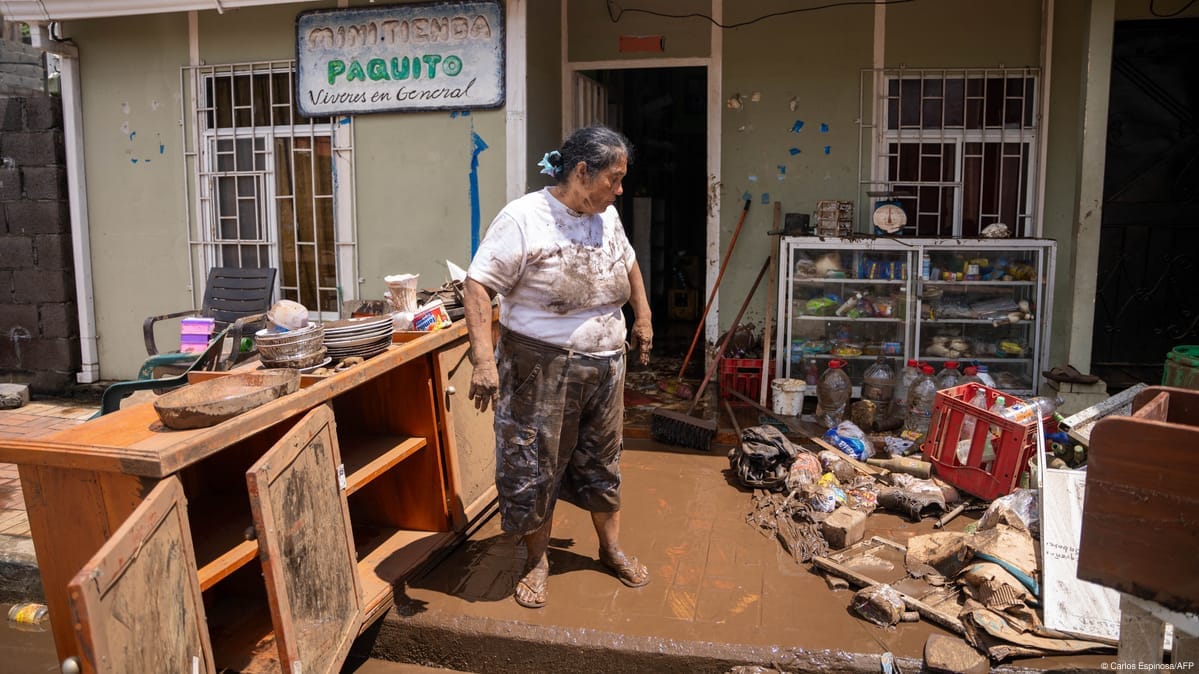
Wading through water up to their knees, people on the island of Santa Cruz are once again trying to save household appliances and personal belongings from the flood. Heavy rains have been falling on Ecuador’s Galapagos Islands since Friday afternoon, and Santa Cruz has been particularly hard hit. Earlier rains in late October also brought flooding to the same region.
Image: Carlos Espinosa/AFP
Emergency responders have urged residents to immediately evacuate the affected area. Here, a couple fled their home in the La Cascada neighborhood in Puerto Ayora on Saturday.
Image: Carlos Espinosa/AFP
For Paula Calderon, the floodwaters turned her life upside down in a matter of hours. “I’m going through a very difficult time,” she told the AFP news agency through tears. “I’ve lost almost everything because my house was completely flooded.”
Image: Carlos Espinosa/AFP
Since Ecuador declared a state of emergency on August 29 due to the El Niño climate phenomenon, more than 1,000 homes on the Galapagos Islands have been damaged by flooding. On Saturday alone, more than 200 people were evacuated. Roads and tourist attractions are closed, and hospital patients are being transferred to clinics in safer areas.
Image: Carlos Espinosa/AFP
In late October, severe flooding on the Galapagos Islands already claimed at least one life and affected thousands of people. Many families were just beginning to recover from the damage. For those hit by the renewed flooding, this means not only new material losses, but also the painful experience of having to start all over once again.
Image: Carlos Espinosa/AFP
Maria Cobos, 23, had just begun to rebuild her life after the previous floods. “We had just started over, and now we have to start all over again,” she told AFP. In her three-story apartment building, the water rose to the second floor.
Image: Carlos Espinosa/AFP
Climate experts have linked the unusual rainfall to the El Niño effect. During El Niño, surface waters in the central and eastern tropical Pacific warm up, affecting atmospheric patterns worldwide. While some regions suffer extended drought, the risk of heavy rain and flooding increases elsewhere — including off the coast of Ecuador.
Image: Carlos Espinosa/AFP
The disaster is no longer confined to the Galapagos Islands. According to Ecuador’s National Disaster Management Agency, more than 20 people across the country have already lost their lives as a result of the El Niño-related emergency. On the Galápagos Islands, where approximately 28,500 residents live on four islands, the extent of the crisis is particularly evident.
Image: Carlos Espinosa/AFP
The Galapagos Islands are seen as a unique natural laboratory, home to animal and plant species found nowhere else on Earth. But right now, the focus is on the fate of their inhabitants. Experts have predicted that the current El Niño cycle could be one of the strongest on record, and many families are worried this may not be the last flood.
Image: Carlos Espinosa/AFP9 images1 | 99 imageshttps://p.dw.com/p/5Poh0