https://p.dw.com/p/5Py8wPrefer DW on Google
Skip next section What you need to know
What you need to know
- German lawmakers to vote on 2027 federal budget
- Left Party hosts summit on femicide and violence against women
- BSW party conference starts in Dresden
- Rheinmetall lowers revenue forecasts
- Chancellor Merz to meet Pope Leo on Monday
Welcome to DW’s coverage of what Germany is talking about on Friday, 27 November. Catch up on yesterday’s news here.
Skip next section German parliament approves 2027 budget11/27/2026November 27, 2026
German parliament approves 2027 budget
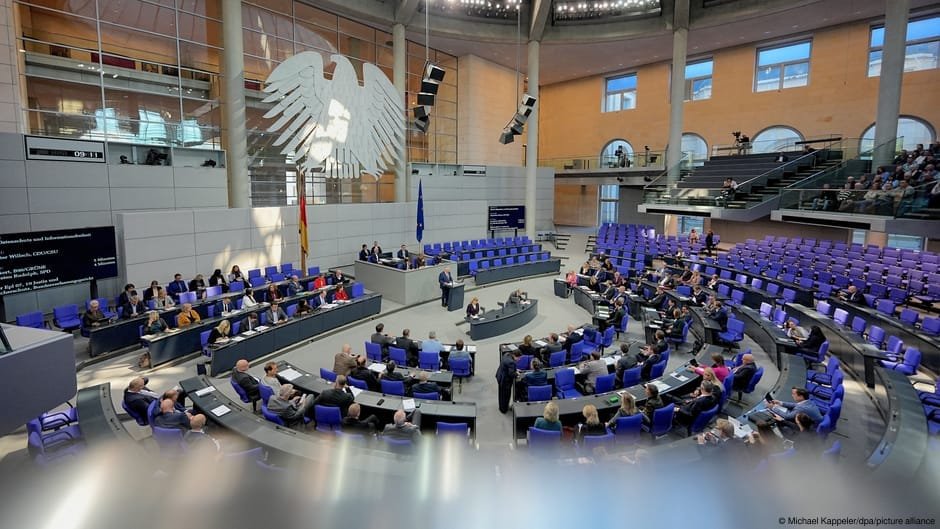
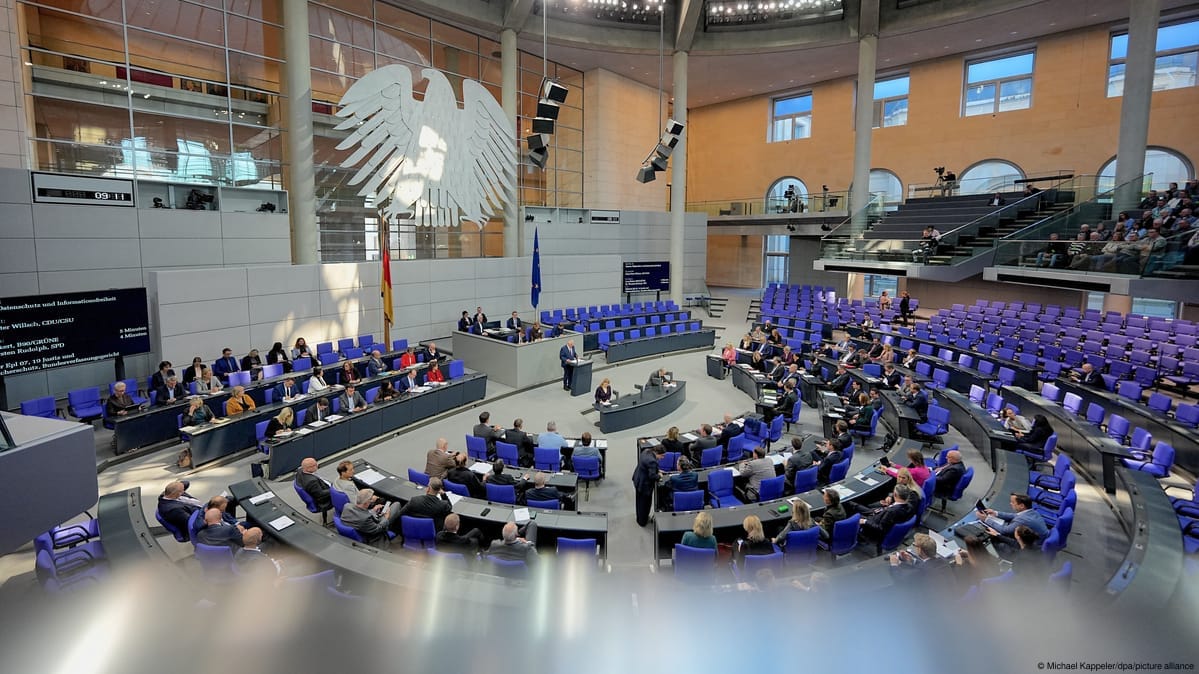
Germany‘s lower house of parliament, the Bundestag, voted in favor of a €556 billion ($610 billion) 2027 federal budget on Friday, taking on additional debt to boost defense and infrastructure spending.
Total new borrowing will reach €210 billion, just short of the record €215.4 billion recorded in 2021 during the COVID-19 pandemic, according to budget figures.
Chancellor Friedrich Merz‘s government has vowed a push to strengthen Germany’s core civilian infrastructure and rebuild its military after decades of underinvestment.
“It is right that we invest in the railways and in climate protection,” said Finance Minister Lars Klingbeil in parliament on Friday, defending his budget. “It is right… that we invest in our security.”
German core defense spending will increase from €82 billion to almost €110 billion. When additional spending from the special defense fund is also taken into account, total defense spending will pass €150 billion.
“We are putting up the money for defense so that Ukraine can defend its freedom,” Klingbeil said. “No child born in Germany today should ever have to experience war again.”
But there was criticism of the budget from the opposition Left Party, with party leader Ines Schwerdtner accusing the government only ever talking about emergency and war.
“But for millions of people in this country, the emergency comes every month when money gets tight,” she said. “But you’re not interested in these emergencies.”
317 members of parliament voted in favor of the budget and 260 against it. There were no abstentions.
Edited by:Wesley Dockeryhttps://p.dw.com/p/5PzpNSkip next section Merz to meet Meloni and Pope Leo11/27/2026November 27, 2026
Merz to meet Meloni and Pope Leo
German Chancellor Friedrich Merz will have a private audience with Pope Leo XIV at the Vatican on Monday before meeting Italian Prime Minister Giorgia Meloni in Rome later, a government spokesman confirmed on Friday.
Merz, himself a Catholic, had a brief encounter with Pope Leo at the pontiff’s inauguration in May 2025, but this will be the pair’s first private meeting.
According to Politico, who first reported on the planned meeting earlier this week, officials expect the discussion to focus on “human dignity, artificial intelligence and efforts to bring peace to Ukraine.”
Afterwards, Merz will be received with military honors by Italian Prime Minister Meloni, with whom he will hold talks on Russia’s ongoing invasion of Ukraine, economic cooperation and, “with certainty,” the European Union budget for the period 2028-2034, known as the multiannual financial framework (MFF).
Negotiations over the MFF in Brussels this week ended without agreement, with Germany leading a group of more fiscally conservative member states which also includes Austria, Denmark, Sweden, Finland, Belgium and the Netherlands.
Italy, on the other hand, along with countries like Poland and Spain, would like to see a more ambitious EU budget.
Edited by:Kieran Burkehttps://p.dw.com/p/5PzNxSkip next section Rheinmetall lowers medium-term revenue forecast11/27/2026November 27, 2026
Rheinmetall lowers medium-term revenue forecast
German arms manufacturer Rheinmetall has revised its medium-term revenue forecast for 2030 down from around €45 billion to between €33 billion and €37 billion, with an expected profit margin of around 20%.
The announcement, made on Friday at a market event in Hamburg, comes after the Düsseldorf-based company also lowered its forecast for the current year following delays in major orders notably from the German government.
In July, the German defense ministry canceled a multi-billion-euro contract to produce six new type-F126 naval frigates and there are now reportedly delays in an expected large-scale order of Boxer armored fighting vehicles (AFV).
Rheinmetall chief executive Armin Papperger said the government was negotiating hard on price and that he would only sign off on the deal once “sufficient profitability” was guaranteed.
Meanwhile, Rheinmetall is set to deliver 66 additional Lynx AFVs to Romania, part of an order which now totals 298 such vehicles.
The deliveries to the European Union and NATO member state are set to begin in 2028 and be completed by 2030.
Rheinmetall is also manufacturing four battleships for the Romanian navy and has increased its production capacities in the eastern European country which borders Ukraine.
To view this video please enable JavaScript, and consider upgrading to a web browser that supports HTML5 video
Edited by:Kieran Burkehttps://p.dw.com/p/5Pz88Skip next section Rheinmetall ‘grieving’ for employees killed in Kuwait attack11/27/2026November 27, 2026
Rheinmetall ‘grieving’ for employees killed in Kuwait attack
German arms manufacturer Rheinmetall has confirmed that two of its employees had been killed in a drone attack in Kuwait.
“Two highly valued employees lost their lives while carrying out their professional duties, providing technical support for air-defense systems,” the Düsseldorf-based company said in a statement.
“Protecting the people of that country was a matter of deep personal importance to them. Both the company’s leadership and the entire workforce are devastated by the loss of our colleagues. We share in the grief of those they have left behind.”
The two victims were Italian citizens who worked as technicians for subsidiary Rheinmetall Italia, Italian Foreign Minister Antonio Tajani confirmed in Rome.
Tajani said the pair had been at an air surveillance station in Kuwait when it was attacked by two Iranian drones. Two other people, a Pakistani national and Kuwaiti army captain, were also injured.
The Iranian foreign ministry has denied any involvement in the deadly attack.
Rheinmetall secured a contract to supply the Kuwaiti navy with defense systems in July.
Edited by:Kieran Burkehttps://p.dw.com/p/5PyzqSkip next section BSW: Left-wing populists seek path forward at annual party conference11/27/2026November 27, 2026
BSW: Left-wing populists seek path forward at annual party conference
Germany’s left-wing populist BSW party is holding its annual conference on Friday and Saturday as it looks to remain relevant following a series of electoral defeats and internal splits.
The BSW was founded in 2024 by former Left Party politician Sahra Wagenknecht who leant her initials to the party’s original name, the Sahra Wagenknecht Alliance or Bündnis Sahra Wagenknecht (BSW). The founder herself stepped down as party leader in 2025 and the party officially changed its name last month to “Alliance for Social Justice and Economic Reason” – also still abbreviated as BSW.
After initial successes in European and eastern German state elections in 2024, the BSW failed to reach the minimum 5% required to enter parliament in the 2025 federal election. In September, the BSW crept into the state parliament in Saxony-Anhalt with 5.3% of the vote but fell short in Mecklenburg-Western Pomerania and Berlin.
BSW split over stance on AfD
Ahead of its party conference in Dresden this weekend, the BSW has been split over its approach to the far-right Alternative for Germany (AfD) — which with it shares some economic and geopolitical policies, such as support for trading relations with Russia and opposition to military support for Ukraine.
Like most other German political parties, the BSW has ruled out entering into any coalition with the AfD but, in Saxony-Anhalt, has already voted with the far-right on certain policies and has held talks over support for certain issues which an AfD minority government would want to implement.
The BSW intends to abstain from the vote for the AfD’s Ulrich Siegmund as state premier for Saxony-Anhalt on December 8 – but ultimately cannot force its five lawmakers to do so in what will be a secret ballot.
The softening of the BSW’s position on the AfD has the backing of founder Wagenknecht and the party’s lead candidate in Saxony-Anhalt, Claudia Wittig, who has slammed the policy of refusing to work with the AfD as “firewall idiocy.”
“We’re not cozying up to the AfD,” she insisted, but said: “Let’s not get tied up in knots over lies in the mainstream media.”
Wagenknecht added: “Vibrant parties should have vibrant discussions about their future course, but we shouldn’t accuse ourselves of things which aren’t true. The BSW is not team AfD. Rather, we take voters seriously and want to implement political change to improve the lives of the majority.”
But other founder members are resisting, writing in the Zeit newspaper this week that a “clear political distancing from the AfD” was a “foundational consensus” for the BSW.
“Just as it was right to reject the firewall, which only served the AfD anyway, so it is also wrong to make common cause with the AfD,” they wrote, warning that the approach could morph into “political cooperation with AfD” which would “compromise the BSW and make it irrelevant in the long term.”
They demanded: “No tolerance of an AfD government, no cooperation agreements, no abstentions from the vote for the state premier.”
To view this video please enable JavaScript, and consider upgrading to a web browser that supports HTML5 video
Edited by:Kieran Burkehttps://p.dw.com/p/5PylmSkip next section Left Party hosts international femicide summit11/27/2026November 27, 2026
Left Party hosts international femicide summit
Germany‘s socialist Left Party (Die Linke) is on Friday hosting an international summit on femicide and violence against women.
Under the title “Voices Against Femicide,” the summit in Berlin brings together activists, politicians and researchers from around the world, including Kenya, Nigeria, Kurdistan, India, Afghanistan, Syria, Mexico, Argentina, Spain and Germany.
Across three panel discussions, the speakers will highlight women’s rights, feminist struggles and legal perspectives and debate political measures which are urgently needed in Germany to effectively combat femicides and patriarchal violence.
The summit comes just two days after Germany’s parliament, the Bundestag, marked Orange Day, the United Nations’ officially named day for the elimination of violence against women, with a minute’s silence and a series of speeches.
Germany’s Federal Criminal Police Office reported a total of 1,176 female victims of attempted and completed homicide in 2025, up from 859 in 2024.
The number of female victims of domestic violence in Germany in 2025 rose by 2.8% to 197,667.
Edited by:Kieran Burkehttps://p.dw.com/p/5PyO7Skip next section German parliament to vote on €556 billion budget for 202711/27/2026November 27, 2026
German parliament to vote on €556 billion budget for 2027
German lawmakers will on Friday vote on a federal budget for 2027 which foresees €556 billion ($610 billion) in government spending, around €31 billion more than in 2026.
The largest chunk of expenditure (just over €200 billion) will go on federal contributions to the statutory pension system, while €110 billion is to be allocated to defense – a 32.7% increase.
The plans call for around €210 billion in fresh borrowing, a figure which is only expected to increase between now and 2030, while €2.7 billion are also expected to be shifted away from Germany‘s climate protection and transformation fund.
Chancellor Friedrich Merz‘s conservative Christian Democrats (CDU) and their Social Democrat (SPD) coalition partners have spent an unusually long time wrangling over the budget, with Merz finally clinching a deal last week after more than eight hours of talks at the Chancellery.
Edited by:Kieran Burkehttps://p.dw.com/p/5PyMWSkip next section Welcome to our coverage11/27/2026November 27, 2026
Welcome to our coverage
Guten Morgen! Welcome to DW’s coverage of what Germanyis talking about on Friday, 27 November.
The German parliament, the Bundestag, is set to vote on a 2027 federal budget that foresees around €556 billion ($610 billion) in spending, around €31 billion more than in 2026.
Also in Berlin, Germany’s socialist Left Party (Die Linke) is hosting an international summit on femicide and violence against women.
Meanwhile, the left-wing populist BSW party is holding its party convention in Dresden as it looks to remain relevant following a series of electoral defeats.
Edited by:Kieran Burkehttps://p.dw.com/p/5Py8xShow more posts