“I too would have been interested in it had it not worked out [for me],” Joshua Kimmich said. “It’s interesting to learn new things in a different culture and country. They all have a scholarship, which is a cool thing. I had the feeling they were happy with the path they had taken. I think it’s a really interesting option.”
The words of the Germany captain were in reference to three young German footballers playing just five minutes from the fields of Wake Forest University where the likes of Manuel Neuer, Kai Havertz and Jamal Musiala are training to realize Germany’s World Cup ambitions.
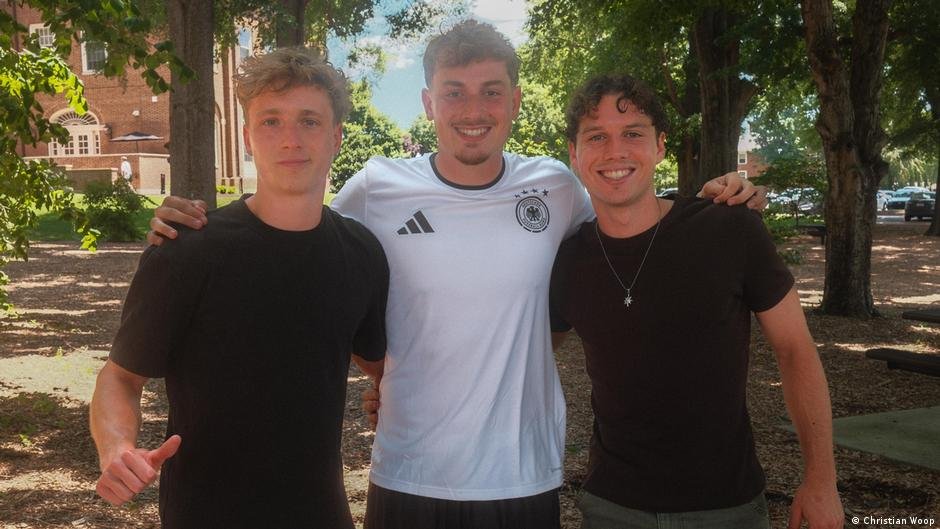
Linus Musielak (22), Noah Vasilev and Flynn Meves (both 23) changed their summer plans for the chance to be closer to their football heroes.
“This is a once in a lifetime opportunity,” Vasilev told DW.
The trio came to the USA to play football for a university on a scholarship. A 2020 survey from the National Collegiate Athletic Association (NCAA) revealed that 367 men and 126 women from Germany played college soccer in the country. That number is expected to have risen since the last survey and international recruitment is a trend that is now redefining the way college soccer is developing here.
Football dreams and reality
With the college leagues finished, the trio chose to play for Salem City FC in USL League Two (USL2). The league, which operates in the summer, has 158 clubs across 37 states and acts as a pre-professional platform, with the best players drafted into the MLS. All of this will change considerably from 2028 when American college soccer enters an existential revamp, but none of that was decisive for the German lads. The most important factor was it was right around the corner from the four-time World Cup winners.
Roots in Germany, blossoming in the USA
Musielak, who still has ambitions to play professionally, played for amateur club TSC Eintracht Dortmund before making the move across to the US, where he plays college soccer in Boston. Vasilev is from Würzburg and played for Würzburger Kickers youth teams before a lecture on the concept of college soccer helped him make his mind up and move to Chicago. Meves, from Münster, joined him there, after playing for Osnabrück’s youth teams and later fourth-tier Rödinghausen SV.
“Once I started training with the first team more often, I just realized that it probably wouldn’t be enough for the really big leap—like the Bundesliga,” Meves told DW. “I just noticed a lot of them [players] didn’t really have a backup plan. I decided I’d rather have a safety net, and because I realized that it’s hard to build that safety net in Germany, I decided to do this here and take a different path.”
The trio have carved out an education and a life in the US thanks to their footballing ability. Their hopes of meeting their heroes were rewarded when the trio briefly met Nico Schlotterbeck. They talked about the facilities at Wake Forest, and how the pitch is a bit drier than they are used to back home. Vasilev and Meves got even luckier, bumping into Germany captain Joshua Kimmich and goalkeeper Oliver Baumann by chance at a cafe near the campus and ended up talking for about 15 minutes.
A summer of soccer in the USA ― and beyond?
With the New York Knicks sealing the NBA title and the Carolina Hurricanes winning the Stanley Cup, there is hope that America’s sporting radar has a bit more space for the World Cup after a slow start. The three young Germans believe the tournament can change soccer’s standing in the country.
“(Lionel) Messi, along with other stars like Marco Reus, moving to the MLS helped the league and football grow,” said Musielak, a left-footed forward who grew up watching Reus. “College soccer has more international players, the sport is smaller here but is growing and the World Cup will play a large role in that.”
Vasilev is also hopeful that the tournament can change the landscape.
“Soccer has never really been much of a thing at the big universities,” he said. “First and foremost, it’s always football. And then there’s a long gap, and then comes baseball, basketball, and (ice) hockey, and eventually soccer. Of course, I hope for us, too, that soccer might become a bigger deal.”
Although they miss German bread and the taste of a doner kebab, the trio are an example of another way to make the most of sporting talent. The Bundesliga isn’t the only end goal, and in this case three young men have given themselves a platform to succeed in professional life through the sport they love. And the best part is that this summer, they were able to do so with their football heroes as their neighbors.
Edited by: Chuck Penfold
About The Author