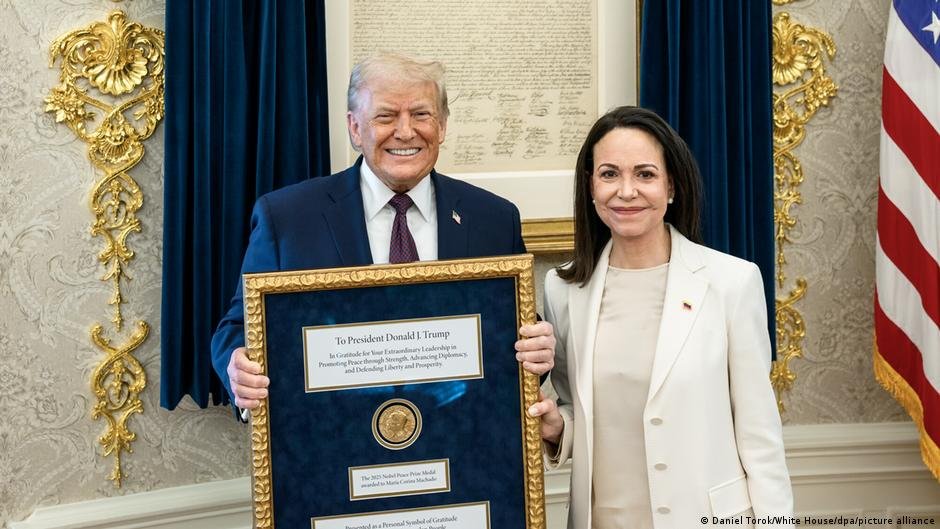
The opposition politician Maria Corina Machado has been planning her return from the United States to Venezuela for months. When the devastating double earthquake hit the coastal region of La Guaira in June, she believed that the time was right. In a video message, the 2025 Nobel Peace Prize winner accused Venezuela’s interim government, led by Delcy Rodríguez, of actively obstructing disaster relief. This accusation is also voiced by earthquake victims and some aid organizations.
Machado recorded the video in Panama City. From there, she planned to fly to Venezuela. Sources close to her allege that Venezuela’s government threatened the airline with a landing ban if Machado were on board. Neither Copa Airlines nor Venezuela’s government has confirmed the claim, nor have they denied it.
In the video, Machado does not mention an incident that The Wall Street Journal reported in early July. According to the article, in June Machado attempted to fly from the United States to the Dutch-held Caribbean island of Curacao by private jet and then to travel to Venezuela by boat. In December, she had secretly left traveled the same route in the opposite direction to fly to Oslo for the Nobel Prize ceremony.
Citing high-level sources, The Wall Street Journal reports that the private jet provided for Machado was over the state of North Carolina when it was ordered back by the US government. The State Department justified demanding that the plane turn back over concerns that political disputes could further complicate relief efforts following the earthquakes.
The conservative Machado was long considered the most important ally within the Venezuelan opposition for US President Donald Trump. A New York Times headline on the rift between Machado and the Trump administration said: “US Undercuts Venezuela’s Opposition Leader as She Tries to Return.”
Machado seizes moment
Phil Gunson, of the International Crisis Group in Venezuela, told DW that it is clear that the US government does not view Machado as a transitional politician. And he sees at least one good reason for this: “She was really essential to the opposition victory in 2024. But she’s not a negotiator. She has a lot of problems even reaching agreements with people on her own side.”
Venezuela’s electoral commission declared the incumbent president, Nicolas Maduro, the winner of the 2024 vote, though the result was protested within the country and abroad. International observers said opposition candidate Edmundo Gonzalez had clearly won the election. Machado had actively — and, according to many analysts, decisively — supported him during the campaign, since she herself had been barred from running based on a court ruling.
On January 3, 2026, US troops abducted Maduro and brought him to the United States. Since then, Delcy Rodriguez has been Venezuela’s acting president.
There had never been any doubt about Machado’s own presidential ambitions. Yet, the longer she remains abroad, the more she must fear that her popularity could erode within Venezuela. The earthquake disaster seemed to be the right moment for her to pursue her return to Venezuela, so much so that she was apparently willing to risk a break with her backers in the US government.
“They’ve told her again and again, ‘This is not your time’,” Gunson said. “But she has refused basically to take the hint. And she continues to proceed with her own plan. She is very anxious to come back.”
To view this video please enable JavaScript, and consider upgrading to a web browser that supports HTML5 video
US prioritizes stabilization
The US government is clearly not interested in making Machado the next president of Venezuela as quickly as possible. Trump has made it clear on several occasions, including with regard to Iran, that, for him, the democratization of other countries is secondary to US interests. Consequently, democratic elections are at the very bottom of the US government’s three-point plan for Venezuela: stabilization, reconstruction, and reconciliation and democratic transition.
“He doesn’t have a high regard for democracy,” Gunson said. “He regards authoritarian rulers as much simpler and more efficient.”
“The current plan is basically an economic and commercial plan and also turning Venezuela into a somewhat reluctant US ally on the geopolitical front,” Gunson said. In other words: It’s about Venezuela’S natural resources, investment opportunities for US companies and weakening China’s influence in the Americas.
US’s ‘fault lines’
The events of the past few days highlight not only the differences in priorities between Machado and the US government, but also tensions within the Trump administration. “Venezuela’s earthquakes are exposing the fault lines in US policy,” Benigno Alarcon Deza, a political scientist with the Universidad Catolica Andres Bello in Caracas, wrote in the magazine Americas Quarterly. Alarcon describes this as a break with the US’s long-stnading foreign policy, which, he writes, has been dedicated to weakening socialist governments since the Cold War. Now, Trump apparently seeks to “protect the remnants of Chavismo that he has chosen to leave intact,” Alarcon writes, referring to the left-populist policies of the now-deceased Hugo Chavez.
The US government also does not appear to have a consistent strategy. While members of Trump’s inner circle accuse Machado of opportunism, Secretary of State Marco Rubio has, according to The Wall Street Journal, repeatedly expressed understanding for her desire to return to Venezuela soon.
This is not surprising, given that Rubio is known for his commitment to transforming Venezuela and Cuba, his parents’ homeland, into US partners. Possibly with an eye on a 2028 presidential run, he has attempted to cultivate an image as an advocate of the rule of law, to the extent that his role as secretary of state allows, Tom Bateman, a BBC correspondent who covers the US State Department, saidin a podcast. That is why he repeatedly distances himself from aspects of Trump’s foreign policy, such as his remarks regarding Greenland and strikes on drug-trafficking boats in the Caribbean. “What he usually does is basically shift the blame onto Trump and clearly place the responsibility on him,” Bateman said.
For now, Machado remains one of Venezuela’s most prominent and popular opposition politicians. Still, her return at this point could further destabilize the country politically, Gunson said. In this regard, Trump’s decision not to allow Machado into Venezuela may indeed have been the right one, whatever the US president’s motives. “Washington’s rejection of approving Machado’s return at this moment, even if driven by self-interest, is not necessarily a bad thing,” Gunson said. “The immediate focus should be rescue efforts; Machado’s interests are primarily political.”
To view this video please enable JavaScript, and consider upgrading to a web browser that supports HTML5 video
This article was originally published in German.