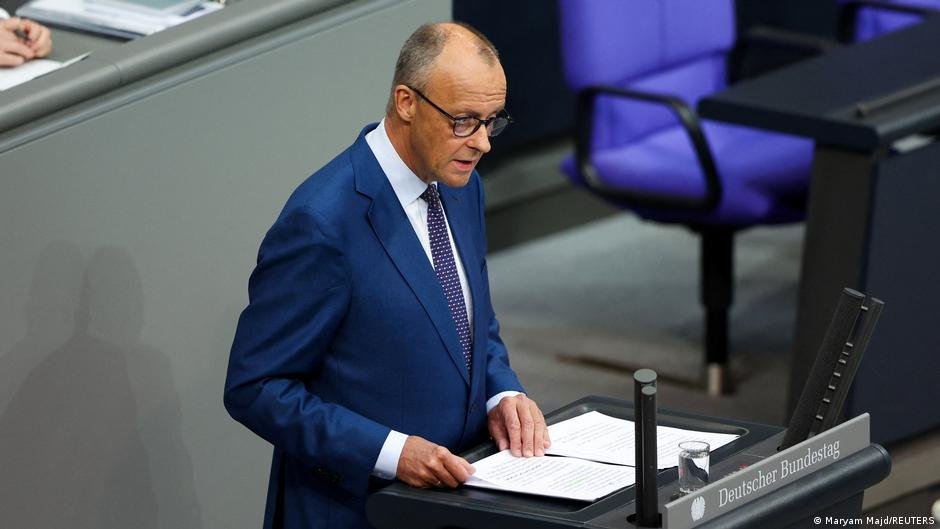
Germany has agreed to purchase US Tomahawk cruise missiles and station them in Germany, Chancellor Friedrich Merz told the Bundestag parliament on Thursday morning.
Merz has just returned from the NATO summit in Ankara, Turkey, also attended by President Donald Trump and other senior US government officials.
What did Merz tell parliament after the NATO summit?
Merz was speaking in a broader address to the Bundestag touting his government’s record.
As well as a string of domestic and economic priorities — like planned income tax and pension reforms working their way through parliament — he listed a final goal as moving towards “a future where our country is not susceptible to blackmail, but rather can confidently meet every threat posed to our free way of life using its own strength.”
Merz said the “results” of this week’s NATO summit in Turkey “exceeded all of my expectations,” saying it had showed that the Alliance was “united, strong and self-confident.”
“On the sidelines of the NATO summit in Ankara we also agreed with the American government that Tomahawk missiles would be purchased by us and stationed in Germany,” Merz said. “With this we are closing an important strategic gap in our defense. And at the same time we will work on devloping our own European systems and deploying them in Europe.”
Merz also touted the deal reached this week to sell TKMS submarines to Canada as the largest military contract in modern German history.
He said that agreements such as these “make it clear to me that NATO is, and remains, a transatlantic alliance.”
“But we as Europeans are also strong, and we have understood that we cannot simply outsource our security,” he told the chamber in Berlin.
Edited by: Natalie Muller
Don’t let the algorithm hide the news. If you rely on our team for trusted reporting, please take a moment to select us as your Preferred Source on Google by clicking here and hitting the “star” or “preferred” button, so you’ll always see our verified news first.