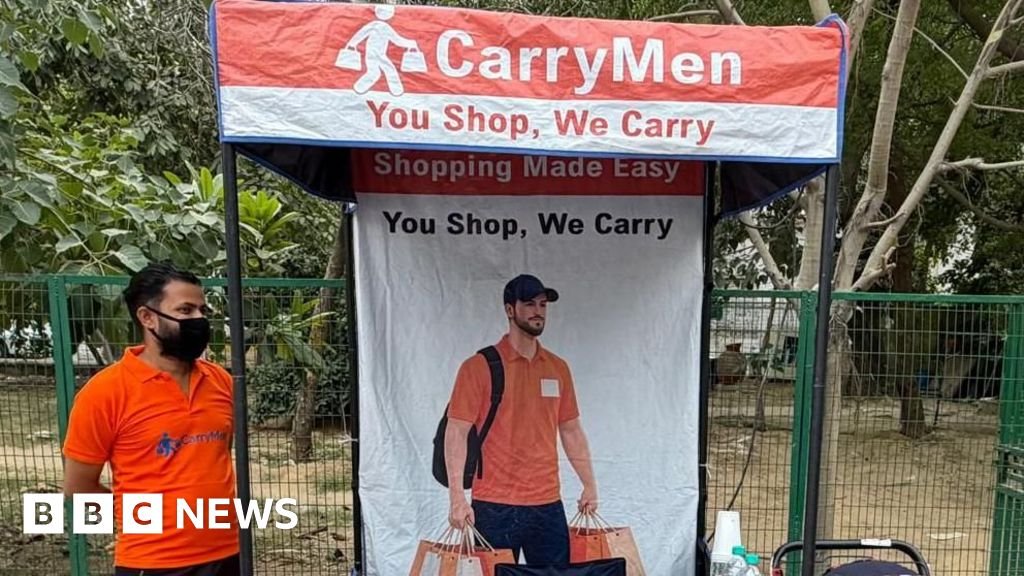
Now you can hire people to carry your shopping bags in Delhi – will it work?
3 hours agoShareSaveAdd as preferred on GoogleGeeta PandeyBBC Correspondent, Delhi

 Chitral Khambhati/ BBC
Imagine if someone could carry your bags as you move from shop to shop. Or push your toddler’s pram while you shop.
That’s exactly what a new start-up is offering shoppers in a busy market in the Indian capital, Delhi.
Launched in April, CarryMen offers male and female assistants to shoppers in Lajpat Nagar market for up to four hours – starting at 79 rupees ($0.83; £0.62) for 30 minutes. An hour costs 149 rupees.
The service has gone down well with customers who say these CarryMen are making their lives a lot easier.
But it has also started a debate over whether the Indian middle class is too entitled and whether these assistants are just glorified “coolies” in exploitative jobs.
The start-up has been founded by friends Ritu Kandari Srivastava and Kanishka Malhotra – both mums of toddlers.
“The idea was born last year when Kanishka and I went to Lajpat Nagar with our toddlers. We found it really tough to manoeuvre our prams while carrying all our shopping bags,” Ritu told the BBC.
“Also, we saw an older woman struggling with her bags and we wanted to help her. But we could barely manage our own things. That was very frustrating.
“So, we thought if there was a service where we could pay and get some help, we won’t have to beg our family members to take us shopping.”
Lajpat and many other markets frequented by Ritu, Kanishka and millions of Indians are not malls with even surfaces, escalators and air-conditioning. These are overcrowded open-air bazaars with footpaths that are missing or uneven or have been encroached upon by vendors, making it hard to navigate prams or sometimes even walk.
 Geeta Pandey/BBC
That evening the co-founders discussed the idea with their families and CarryMen began to take shape.
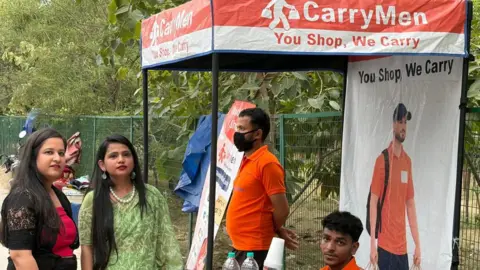
Over the next few months, they registered their company, got all permissions from the municipal corporation and police, and set up a kiosk in Lajpat Nagar.
Then they hired five young men – later also recruiting two women – and launched the service after a month of intensive training.
The start-up quickly went viral, with thousands sharing the news and dividing opinions on social media.
Many hailed it as an ingenious idea that could be scaled up to create thousands of jobs in a country where urban unemployment has consistently been higher than 5% with millions unable to find work.
But critics called it peak entitlement displayed by lazy affluent Indians who outsource all menial work and chores to domestic helpers.
Some of the backlash came after AI-generated photos appeared on social media, imagining well-dressed affluent women as prospective customers for the service.
“It sounded like the service would be catering to the ultra-rich woman who’s just got a manicure and doesn’t want her nails spoiled,” said labour rights activist and sociologist Akriti Bhatia.
Some also said the CarryMen were glorified “coolies” who would be swelling the ranks of workers in the exploitative gig economy and some even called it modern-day slavery – accusations the start-up founders rejected.
“First of all, there’s no slavery. We are not forcing anyone to work for us. And all our workers are full-time salaried employees, they are not gig workers,” Ritu said.
“Also, this is not about entitlement. We are just providing assistance to those who have difficulty navigating the streets and overcrowded markets on their own.”
A majority of their clients in the past six weeks, she says, have been pregnant women, mothers with young children, the elderly and the disabled.
 Chitral Khambhati/ BBC
Their very first customer, says Anand Kumar, one of the CarryMen, was a pregnant woman. During his training, he said he was told he had to be courteous at all times and treat the customers like family.
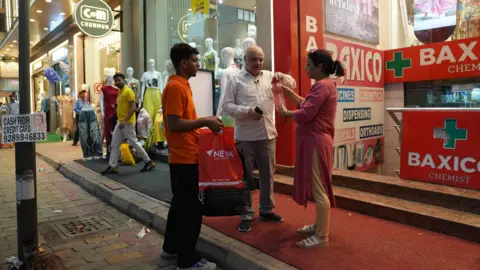
The CarryMen also carry prams, umbrellas, foldable chairs, water bottles and portable chargers and are trained in opening and locking prams to ensure safe usage.
“We were also told to make ourselves familiar with the market layout so we can guide customers quickly to shops they want to visit. We also queue up at food counters for them while they sit on chairs and wait,” Anand said.
The 18-year-old, who worked as a helper in a sari shop and as a delivery man with app-based food and grocery delivery services in the past, says the pay is better here and he feels respected in his new role.
He especially remembers a man with artificial arms who handed over all his cash to Anand and asked him to count out the notes and pay for his shopping. “I was so touched by the trust he reposed in me,” he told the BBC.
In the first week after the launch, Ritu said there were no bookings, “but we were able to generate interest”.
“People were stopping by our kiosk to check it out, find out more about the service. But now we are getting nearly half-a-dozen bookings a day and during the weekends, that number goes up to eight or nine.”
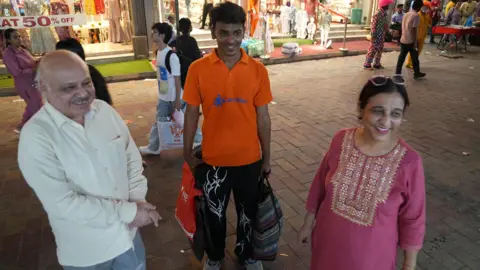
On a hot and humid afternoon last week when we visited their outlet, Jatinder and Anita Sabharwal turned up at the CarryMen’s orange-and-white kiosk seeking to hire an assistant.
Jatinder, who says he would be turning 60 – “a senior citizen” – in a couple of months, was carrying a heavy shoulder bag. Anita was also carrying two bags and the couple still had a few more things to pick up.
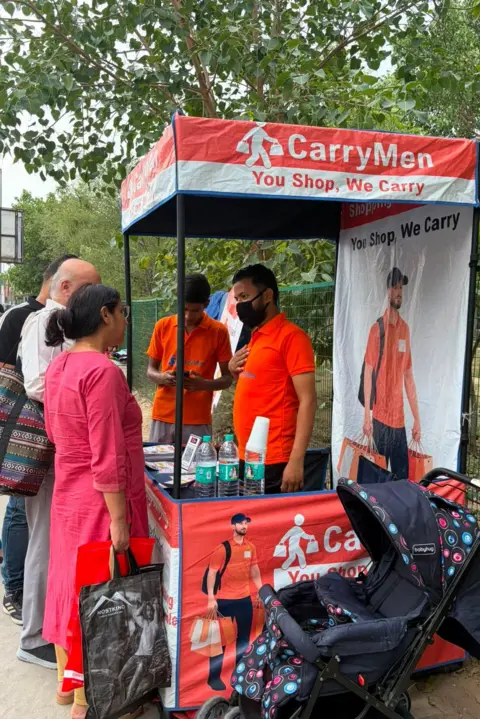 Geeta Pandey/BBC
This was the Sabharwals’ first time hiring an assistant though they live in the neighbourhood. Jatinder said he heard about CarryMen from his wife who learnt about the service from Instagram.
Anand, who accompanied them, led them to their first stop – a chemist because Anita had developed a migraine headache and wanted to buy a painkiller. As the Sabharwals went into the store, he waited outside with their bags.
Once they came out, he handed them their water bottle for Anita to take the tablet.
“He’s helping us navigate too. We didn’t know where the pharmacy was. I think this is a very good service. With him around, we’re getting some help and can shop comfortably,” said Jatinder.
“Now we can move freely, unencumbered by baggage,” added Anita.
The couple said they were not convinced by the debate around entitlement and exploitation.
“I think people who can manage their bags should carry them. And those who can’t can avail of the service. I think it’s a very good service for people like us. It should be available in every market,” said Jatinder.
Ritu said they plan to expand the service – in July, they would be setting up CarryMen in the busy Chandni Chowk market. It would gradually cover other markets in the city and across India, she added.
Labour activist Bhatia pointed out that to expand, CarryMen would require funding, which could determine how long the service would be sustained.
At the moment, CarryMen is a very small set-up with seven employees who are full-time staff.
“But would they be able to follow the same system once they scale up? A lot of gig work and platform work started off with high payouts, with start-ups promising lots of benefits, but then it fizzled out,” said Bhatia.
“And in India, with such an abundance of cheap labour and a lack of unionisation, companies are able to continue squeezing workers. Which way would CarryMen go, we’ll have to see.”
About The Author