Extreme heat is pushing the Tour de France to its limits. Stages are being shortened as riders struggle to keep going. Defending champion Tadej Pogacar is calling for a new race calendar excluding July and August.
Image: Anne-Christine Poujoulat/AFP
Even in the morning, a shimmering heat hangs over the streets of France. The ninth stage of the Tour de France was shortened by about 30 kilometers (18 miles) — from 185.5 to 155.5 kilometers — due to a heat warning. Temperatures of up to 40 degrees Celsius (104 degrees Fahrenheit) push riders and teams to their limits.
Image: Stephanie Lecocq/REUTERS
Tour leader Tadej Pogacar has voiced openly what many are thinking. “If I had the power to change all, I wouldn’t race in hot regions in July and August anymore.” The Slovenian is calling for a completely new race calendar. For him, it’s no longer enough to combat the effects of the heat — the sport needs to adapt fundamentally.
Image: Loic Venance/AFP
In Pogacar’s view, a later start offers hardly any advantages. “Starting at 10 a.m. doesn’t change anything, because you’ll still cross the finish line in the hottest part of the day.” He suggests that stages should start as early as 8 a.m. or even earlier. The body can get used to waking up early — but not to the extreme midday heat.
Image: Stephanie Lecocq/REUTERS
The extreme heat is taking its toll not only on the riders but also on the spectators lining the route. While the professional cyclists race through the scorching heat, fans on the side of the road are looking for creative ways to cool off. Some have turned a trailer into an improvised pool.
Image: Jeff Pachoud/AFP
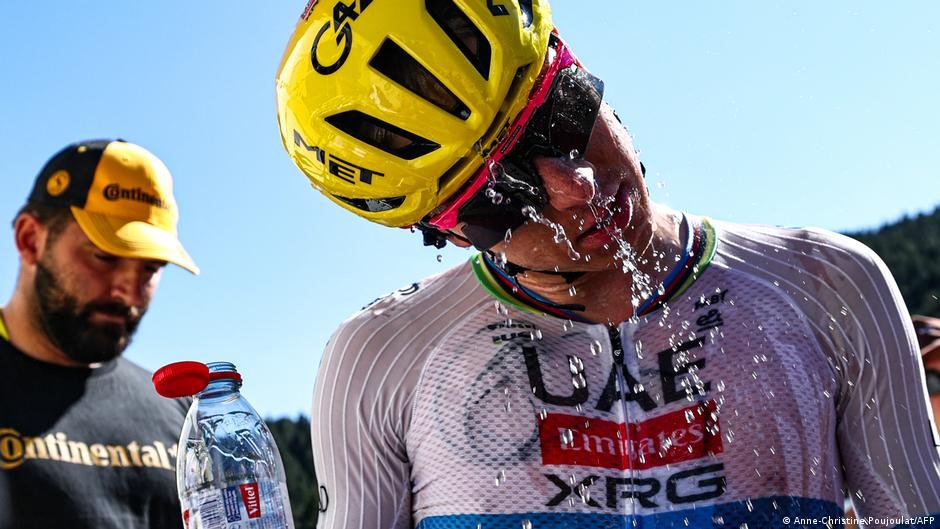
During the race — and even at night in the hotels — it’s all about staying cool. Cooling vests, ice, hydration plans, and air-conditioned rooms have long been part of the riders’ routine. The teams go to great lengths to keep their riders performing at their best. The biggest challenge no longer lies on the mountain, but in the ambient temperature.
Image: Anne-Christine Poujoulat/AFP
The tour organizers are responding to the heat wave with extraordinary measures. To protect the riders as best as possible, the organizers are providing the teams with about 450 kilograms of ice every day. In addition, three cooling motorcycles and misting systems are now in use to provide the pros with additional cooling during the stages.
Image: Jeff Pachoud/AFP
Australian Luke Durbridge has been on the tour for years, but even he rarely experiences conditions like these. “I remember days when the roads melted,” he says. He notes that the heat has been exceptionally consistent this time around. Since the start, the road temperature has hardly ever dropped below 35 degrees Celsius.
Image: Tomas Sisk/Photo News/IMAGO
Frenchman Guillaume Martin notes that temperatures are changing the dynamics of the race. Those who cope better with the heat gain valuable minutes. The time gaps are widening, especially in the mountains. It’s not just the legs that determine victory or defeat; it’s increasingly also the ability to endure the scorching heat.
Image: Vincent Kalut/Photo News/IMAGO
The debate over the future of the Tour de France has begun. Increasingly prolonged heat waves are presenting organizers and teams with new challenges. Shorter stages, earlier start times, or even a different race schedule — several options seem possible. Pogacar’s call for change may have been the catalyst for the biggest transformation of this cycling classic in decades.
Image: Gonzalo Fuentes/REUTERS9 images1 | 99 imageshttps://p.dw.com/p/5H8bR
About The Author