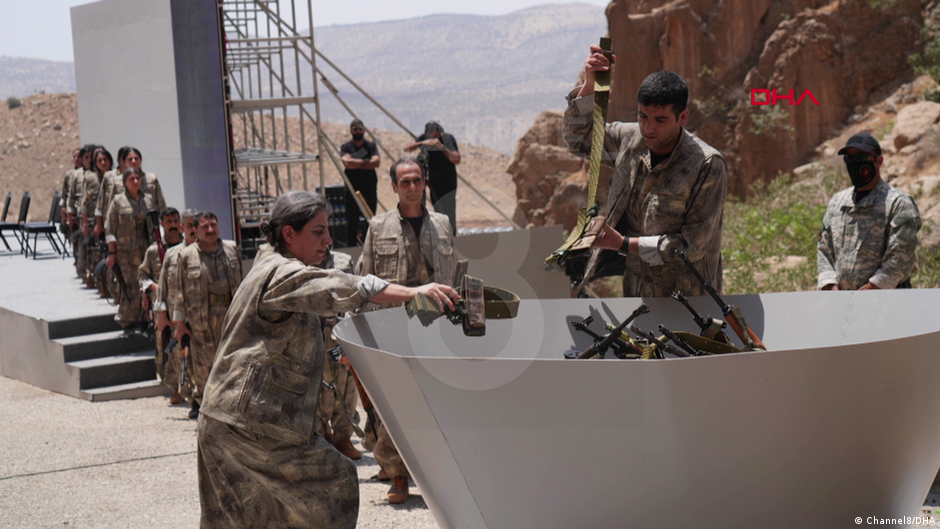
July marks a year since the Kurdish militant group known as the PKK, listed as a terrorist organization by numerous countries, symbolically burned their weapons.
Last May, the PKK, or Kurdistan Workers’ Party, announced it would end its “work under the name of PKK,” halting a decades-long armed insurgency between the Turkish state and those fighting for Kurdish rights or independence inside Turkey, one that had cost an estimated 40,000 lives.
Later, on July 11, a group of around 30 PKK fighters in northern Iraq burned their weapons in a symbolic disarmament ceremony.
This year, on that same date, human rights activists, academics and politicians gathered in Diyarbakir, the largest city in Turkey’s Kurdish-majority southeast, to assess progress in the ongoing peace process between the Turkish government and the PKK.
The conference was organized by Diyarbakir’s administration and the Human Rights Association, or IHD.
One of the IHD’s co-chairs, lawyer Cihan Aydin, has proposed making July 11 an official day of remembrance. A vibrant culture of remembrance contributes to coming to terms with the past and prevents future conflicts, he argued. Aydin also called for a legal solution for all those impacted by the peace process, including PKK leader Abdullah Ocalan, who has been jailed by Turkey since 1999.
For decades, Ocalan was considered a terrorist in Turkey. Today the 77-year-old is the focal point of the current peace process. It was he who called on the PKK to lay down its arms in February 2025, a call that members responded to.
Turkey-PKK peace process
Following this, the Turkish parliament established a committee that heard testimony from approximately 140 representatives of politics and civil society, including human rights activists and relatives of soldiers, veterans and prisoners. The committee then recommended a series of reforms to advance the peace process, including the reintegration into society of PKK members who renounced violence, as well as state security institutions verifying that the PKK had genuinely given up its weapons.
Talks have focused on the rules on the return or potential prosecution of PKK members as well as their possible integration into civilian and political life. The Kurds want to see Ocalan released from prison along with other political prisoners.
The Turkish government has not been open to a general amnesty, only a partial one, and has yet to make any concrete commitment regarding Ocalan. However, more recently the country’s ruling party, AKP, seems to have struck a more moderate tone.
This makes Aret Demirci, head of the Istanbul office of Germany’s Friedrich Naumann Foundation, believe that progress in the talks should be seen as “cautiously positive.”
The fact that the PKK symbolically burned their weapons marked an “historic turning point,” he says. “And unlike previous peace initiatives, the process has not collapsed at an early stage.”
But, Demirci cautions, so far the central political questions have mostly been ignored. The Turkish government is pushing for the PKK’s complete disarmament while the Kurdish side wants political and legal guarantees before that happens. “The parties’ differing expectations are likely to be the biggest challenge in coming months,” Demirci notes.
After meeting with Ocalan and others in prison on Monday this week, pro-Kurdish political party DEM released a statement in which Ocalan repeated his call for a legal framework to advance the peace process. “The Kurdish-Turkish alliance is the cornerstone of Anatolia’s shared future,” Ocalan stressed in the statement.
The PKK’s own leadership also seems optimistic. Duran Kalkan, one of the PKK’s co-founders, said in an interview this weekend that the peace process wouldn’t fail because the situation in the region is so different this time.
Changing security situation for Turkey
Many observers share Kalkan’s opinion. Conflicts in the Middle East have intensified recently, especially due to tensions between Israel, Iran and the US. The changes in Syria are also important.
Turkey faces a totally different security situation than it did 10 years ago, when informal talks between Turkish intelligence agencies and the PKK, that began in 2009, evolved into negotiations between 2013 and 2015. In March 2013, Ocalan had also declared a ceasefire, although this didn’t last.
But Demirci thinks that geopolitical changes are forcing dialogue between the PKK and Turkey to move forward.
To view this video please enable JavaScript, and consider upgrading to a web browser that supports HTML5 video
The new government in Syria plays a key role. Having a better relationship with Kurds inside Turkey gives the Turkish government greater leverage regarding Syrian Kurds and Iraqi Kurds. The picture has also changed for the PKK and its affiliates.
The Turkish have been worried that PKK members might join Iranian-Kurdish militias over the border. And previously, during the Syrian civil war, Syrian Kurdish groups, allegedly associated with the PKK and supported by the US, had been semi-independent and controlled a large area almost directly on the Turkish border. This also concerned Turkish security agencies immensely. But now Syria’s Kurds have had to find an accommodation with the new Syrian government and are no longer in complete charge of this area.
How successful the peace process is in the longer term won’t depend only on the end of violence though, Demirci told DW. It also depends on whether a political dialogue emerges that encompasses democratic reforms, the rule of law and more general questions about Kurdish identity in Turkey.
As long as opposition politicians are arrested, Kurdish mayors removed from office and political freedoms restricted, the end of armed conflict alone won’t lead to genuine, sustainable peace.
“This very ambivalence currently shapes the debate in Turkey and makes the process both historic and extremely fragile,” he says.
A lack of transparency is also problematic. “There is hardly any public information about which agreements have actually been reached and what steps are planned,” Demirci continued. “That makes it difficult to build public trust.”
With additional reporting by Gülsen Solaker.
This story was originally published in German.
To view this video please enable JavaScript, and consider upgrading to a web browser that supports HTML5 video