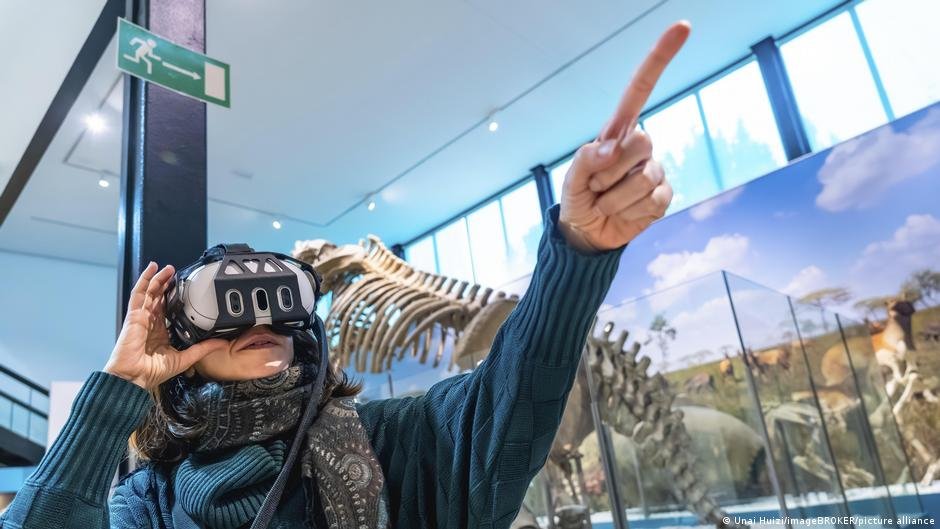
Imagine sitting in a virtual room and coming face to face with yourself — 10 years older, slightly grayer, but unmistakably you. Not a fantasy. Not a filter. Just you, aged by a decade, staring back.
That’s the core of an experiment developed by Jean-Louis van Gelder, a criminologist and psychologist at the Max Planck Institute for the Study of Crime, Security and Law in Freiburg, Germany. His team has just published findings showing that confronting people with a digitally aged version of themselves —their “future self” — can sharpen long-term thinking and help them act on their own goals.
The science of the future self
The setup is deceptively simple. Participants come into a lab, where they have their photo taken. After software has aged the respective face by 10 years, they enter a virtual reality (VR) environment, look into a virtual mirror and see their present self — while the older version sits across the room. They interact with their future self and ask it questions. They hear their own voice played back, slightly lowered to match the aging effect.
The result, van Gelder says, is that the future becomes more concrete rather than abstract. “When future states or future events become more vivid in our minds, we’re also more likely to actively work towards them,” he tells DW. A clear mental image of who you’re going to be makes it easier to divide a goal into actionable steps — and gives you stronger motivation to take them.
In the study, participants set their own goals: better health, improved academic performance, less procrastination, reduced screen time.
The VR edition outperformed a parallel smartphone-based version. Both tools helped people feel more connected to their future self, but only the VR one demonstrably helped them achieve their goals.
Why a criminology institute is studying self-improvement
The link to the Max Planck Institute for crime research is not incidental. Van Gelder’s original target group was not university students. It was young delinquents.
Impulsivity and short-term thinking are among the most robust predictors of juvenile delinquency, he explains. Crime almost always involves immediate benefits — quick cash, status, gratification — but also long-term costs that tend to far outweigh them. From this perspective, delinquents are not irrational; they are simply disconnected from their later lives, discounting the future so heavily that it barely registers.
“If you talk to some of them, you realize they actually know that what they’re doing is not good for them,” van Gelder says. The aim, then, is not to lecture but rather to help people to persuade themselves — using their own face, their own voice and their own imagined future.
What you can try right now
No VR headset is required. Van Gelder’s team is currently developing a smartphone application to broaden access. In the meantime he suggests a lower-tech version: simply ask yourself how your future self will look back on a decision you’re making today. This practice — sometimes called episodic future thinking, or mental time travel — is something he incorporates into his own daily life.
Van Gelder believes the technology could go even further. He envisions a personalized AI avatar — fed with data about how you speak, think and write — acting as a daily coach from five or ten years in the future. “I can see your future self being your present-day coach,” he says.
For now, there’s the extremely accessible option of one of the oldest tools available: a piece of paper, a pen, and a question worth pondering. Where do you want to be in ten years’ time — and what would that future individual tell you to do today?
This article is an excerpt from our podcast Science Unscripted. You can subscribe to the podcast here.