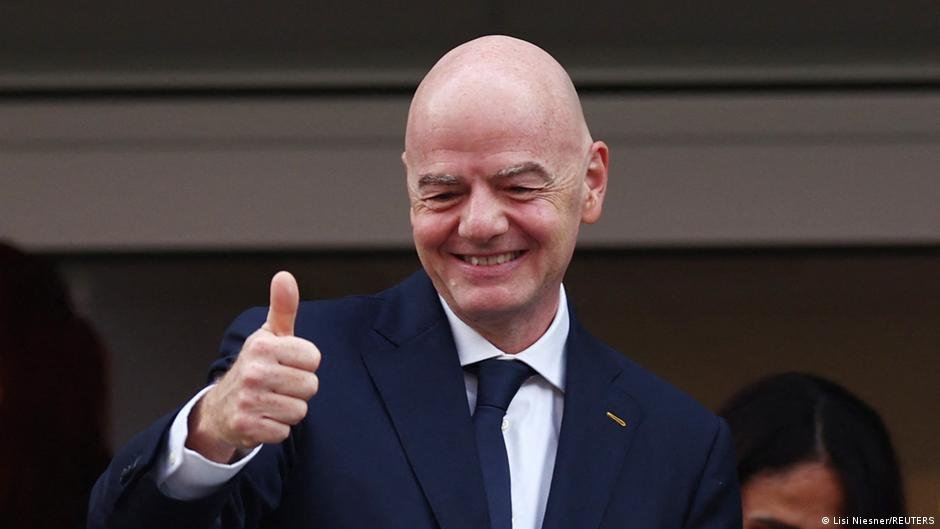
“While you divide, we unite,” Gianni Infantino wrote on social media on Monday, in a long missive aimed at his detractors. By Tuesday, he had united the football world — albeit in opposition to his latest scheme.
Shortly after reports emerged in UK newspapers The Times and the Financial Times on Tuesday, FIFA confirmed its plans to create a new subsidiary, named FIFA Forward Enterprise (FFE). This would enable it to sell a minority stake in the World Cup‘s operations to private investors for billions of dollars.
Chief among FIFA’s proposed investors is the investment vehicle, Thrive Eternal, headed by Joshua Kushner — younger brother of Jared Kushner, US President Donald Trump‘s son-in-law.
Why is FIFA’s new World Cup plan controversial?
Other than the potential conflict of interest connection to Trump, with whom Infantino has grown close, there are significant concerns about transparency, corruption and whether FIFA has the remit to make such a move unilaterally.
“The World Cup is one of the few truly global sporting events, and that comes with a responsibility beyond maximizing revenue,” Bret Myers, a professor of sports business practices at Villanova University in Pennsylvania, USA, told DW.
The US connection is important, with the model echoing the way that many US sports operate. Formula 1 too went through a similar process when it was bought by Liberty Media in 2017. Greg Maffei, a former Liberty CEO, has been a “key commercial adviser” to FIFA on the FFE plan.
“North American sports have long operated within a more commercial framework, where private ownership, franchise valuations, and investor involvement are widely accepted,” Myers added.
“Football, particularly in Europe, has a much stronger tradition of clubs and competitions being viewed as cultural institutions rather than purely commercial assets.”
More fundamentally, the concern is that this is the first step towards the World Cup, football’s biggest prize, becoming privately owned.
“A minority investment is very different from relinquishing control,” Myers said. However, it does represent a significant shift in how the World Cup is financed and managed commercially.”
World football’s global governors are a nonprofit organization but sit on cash reserves of an estimated $8 billion (€7.02 billion) after a World Cup that saw ticket prices skyrocket.
Given FIFA’s remit lies in developing football, rather than purely profiting from it, there is a sense that this is a move designed to shore up Infantino’s power and, perhaps, encroach on the turf of the continental football federations he failed to include in the planning.
How do Infantino and FIFA aim to sell the plan?
FIFA has promised to invest profits back into the game, mostly by offering all 211 member associations a flat fee of $20 million in 2027, rising to $24 million by 2035. Associations must decide whether to accept those payments by September 19 or risk them being reduced or retracted.
“The president controls this huge pot of money and uses it to reward those that are loyal to him, that support him, and punish those that are not supportive of him,” Miguel Maduro a former chairman of FIFA’s Governance, Audit and Compliance Committee, told DW.
“FIFA could do lots of good things with money. But there is no system of checks and balances and accountability to make us sure that the money is actually going to be well spent by all national football associations. Everything that that’s happened in the past makes me suspicious of how this money will end up being spent.”
What has the reaction been from the footballing world?
Almost universally negative. National federations, world leaders and fan groups have all come out against the idea, with federations particularly peeved about the lack of consultation.
But perhaps the most surprising reaction came from the Asian Football Confederation (AFC), who released a statement confirming it was “not consulted on the proposal and is disappointed” by the way in which it was released. Asia and Africa, are where Infantino’s main power base lies, as together they have 101 of the 211 national associations — with each getting a vote on the president.
Similar misgivings were expressed by a number of powerful national football associations, including Germany’s DFB.
“A line is being crossed here. There is a strong consensus among the member associations on this matter, as evidenced by several conversations I have had in recent days with Aleksander Ceferin [president of Europe’s football governors UEFA] and other colleagues,” said Hans-Joachim Watzke, a DFB vice president.
“If European football stands united in opposing these plans, it carries significant weight.”
Who might oppose FIFA’s World Cup plans?
UEFA seems in the best position to lead any revolt and has hit out at the plans, saying football is “not FIFA’s to sell.” It was a strongly worded statement of the type UEFA has released several times in recent months as its battle with FIFA plays out in public. Reports suggest UEFA will meet as soon as Wednesday to discuss their options.
Maduro backs UEFA’s stance but said he’d like the current climate to serve as an opportunity for broader reform.
“I don’t think UEFA has the same severity of problems that we find in FIFA, but I do think it also suffers from serious governance problems and that they need to be addressed,” he said.
“Simply getting rid of Mr. Infantino but leaving the entire structure and model of governance of sports will be removing a couple of bad apples but leaving the tree that produced them in place.”
How could this change football?
That the AFC and the CONCACAF (which governs North, Central America and Caribbean football) have criticized the way the latest plans were released, may have strengthened UEFA’s hand in any thoughts of breakaway or boycott.
It may also lead to the continental federations uniting to find someone to oppose Infantino in next year’s presidential election or in threats of boycotting next year’s Women’s World Cup.
But Maduro thinks such talk is often designed to appease the public before intentions are quietly shelved.
“What we’ve seen so far for the most part is that these statements, where they distance themselves from these kinds of initiatives of FIFA, are made under the pressure of public opinions. But then they actually never follow through.”
Maduro went on to say that UEFA’s increasingly strident opposition to FIFA is, at least in part, a reaction to an increased threat to its own highly lucrative Champions League. Should the proposed changes go through, Maduro expects World Cups to be more frequent and a further expansion of FIFA’s recently expanded Club World Cup.
“They will want to transform that into the big international football competition of clubs instead of the Champions League. That’s what they will try to do because it will be in their commercial interest,” he said.
Edited by: Chuck Penfold
About The Author