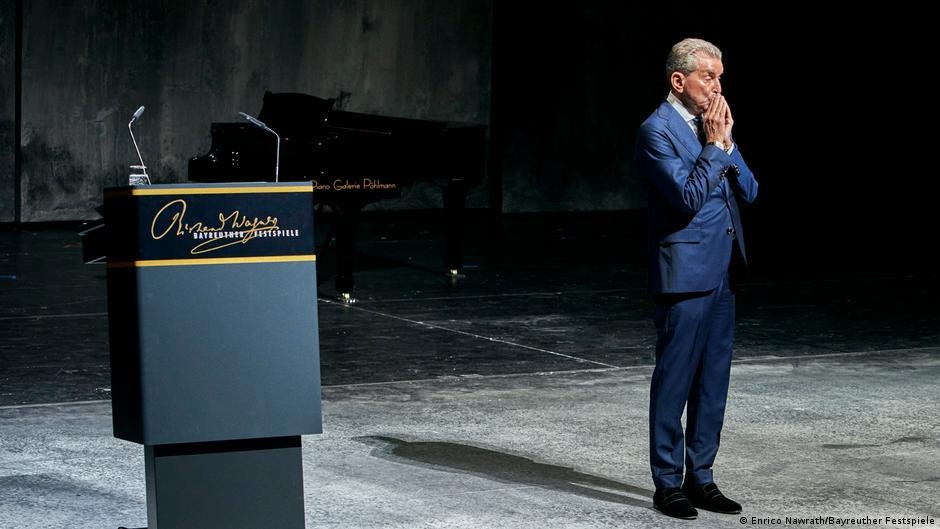
“I would like to state explicitly that Katharina Wagner is changing the culture of remembrance in Bayreuth.” With these words, spoken from the stage of the Bayreuth Festival, German-Jewish author Michel Friedman encapsulated the central message of the festival’s two-day opening celebration.
Friedman spoke during a commemorative event titled “Silenced Voices,” dedicated to Jewish artists who worked at the Bayreuth Festival and were later murdered or oppressed under the Nazi regime. Despite initial organizational turbulence, his talk became one of the key events of the opening celebrations on July 26, alongside the concert on the eve of the festival and the premiere of a new production of the opera “Rienzi.“
Friedman also visited the exhibition with Bayreuth Festival director Katharina Wagner and several members of the local Jewish community. In the park surrounding the Bayreuth Festival grounds, directly beside the bust of Richard Wagner, a series of gray memorial steles stands as a powerful reminder of the Jewish artists whose lives were lost. A cantor from the Jewish community recited a prayer for the victims, and their names were read aloud.
‘Democracy is in danger’
Friedman’s speech in the Festspielhaus, which lasted more than an hour, encompassed far more than the omissions and blind spots of Germany’s culture of remembrance. For the 70-year-old, whose family was almost entirely murdered during the Holocaust, the focus was on something more fundamental — the mechanisms that foster hatred and injustice, and the passivity of society that allows them to flourish. His message was about the present as much as the past.
Friedman criticized what he called a “bored, decadent democracy” and urged everyone present and everyone listening — as well as those outside the hall who remain “silent and grumbling”— to become active witnesses to their own time, before it is too late once again.
“My country, Germany, is a community. This community is defined by diversity, and diversity has once again become a concept that is under heavy attack. Yet this community and this diversity are the only future we have,” he said.
Bayreuth festival’s long history
Few places in Germany bring together history, culture and politics as strikingly as Bayreuth. The opening of this year’s festival demonstrated that once again. To mark the festival’s 150th anniversary, the red carpet was rolled out and graced by many of Germany’s celebrities and politicians, including Chancellor Friedrich Merz, former chancellor Angela Merkel, as well as many international guests.
Inside the Festspielhaus, visitors were greeted by Bayreuth figures from the past century and a half, represented in a large mural by Hungarian street artist Adam Heat that dominates the auditorium.
At the center is King Ludwig II of Bavaria presenting Richard Wagner with a grail overflowing with money — a vivid metaphor for the founding of the festival. Surrounding him is an illustrious cast of Bayreuth figures from the past 150 years — members of the Wagner family, who have guided the festival for generations; conductors ranging from Wilhelm Furtwängler and Arturo Toscanini to Oksana Lyniv and Nathalie Stutzmann. Also depicted is Wagner admirer and longtime Bayreuth guest Adolf Hitler, portrayed in elegant attire and holding a small glass.
Nike Wagner, the composer’s great-granddaughter, summed up the message behind the work in her festival address: As visitors to the festival’s grand hall, we become part of “Wagner’s artistic ritual. Whoever takes a seat here now, sits with all those who have sat here before.”
Katharina Wagner warns against the far-right
Katharina Wagner, Richard Wagner’s descendant and the festival’s artistic director spoke candidly about her family’s Nazi ties. “Given my family’s close and, in some cases, deeply personal ties to the Nazi regime, and given the role of the festival as a cultural showcase of the Third Reich, but also bearing in mind that our German democracy today is once again threatened by forces seeking to make antisemitism, racism, chauvinism, and nationalism part of the foundations of the state, there is no better place than this Festspielhaus to say: No.”
In his speech, German Chancellor Friedrich Merz explained why, for him personally, Wagner’s legacy and music represent the contradictions of German intellectual history:
“Richard Wagner’s person and work are exemplary of both the greatness and the darker depths of Germany’s artistic and historical legacy. They represent the uniquely German combination of the most admirable and the most questionable aspects of our past. When we engage with Wagner, we have the opportunity to see and hear so much of ourselves across the centuries in a single body of work.”
And nowhere, Merz said, is this opportunity felt more profoundly than in Bayreuth.
With such direct statements during the anniversary event, the Bayreuth Festival has opened a new chapter in its culture of remembrance. In doing so, the festival seeks to make a broader social statement and take a firm stand against antisemitism.
This article was translated from German and edited by Teresa O’Connell.
About The Author