Spanish Prime Minister Pedro Sanchez traveled to Algeriaon July 20, 2026, for talks with Algerian President Abdelmadjid Tebboune and Prime Minister Sifi Ghrieb.
The meeting’s aim was to resolve a diplomatic row that erupted between both countries in 2022 after Spain sided with Morocco’s autonomy proposal to resolve the Western Sahara conflict — much to Algeria’s dismay.
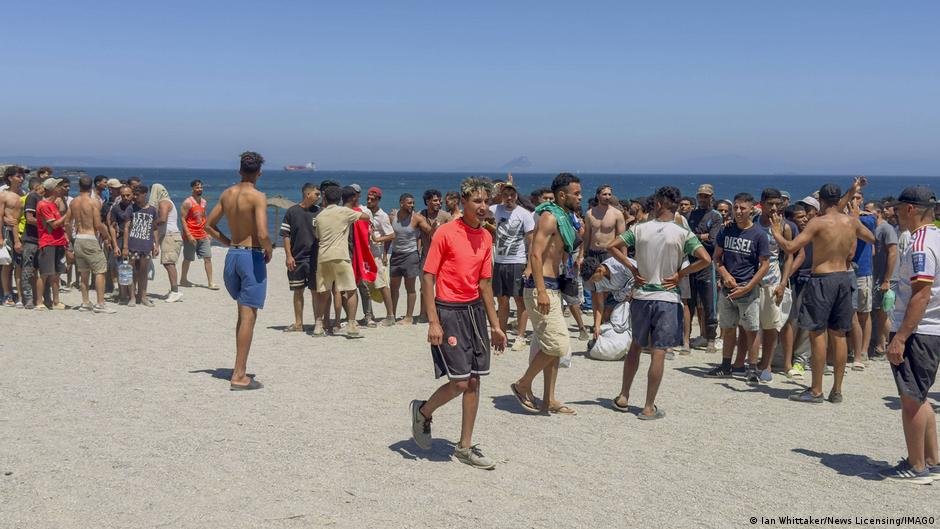
It is a matter of debate whether Spain’s rapprochement with Algeria outraged Moroccoso much that it deliberately allowed tens of thousands of migrants to storm the Spanish exclave of Ceuta, even though both countries have improved their relations enormously in recent years. Spanish daily El Pais has certainly entertained the possibility of Moroccan meddling.
“Ceuta tensions coincided with Pedro Sanchez’s trip to Algeria, a regional rival of the [Moroccan] Alawite Kingdom,” an opinion piece in the Spanish paper notes. The article later states that “any attempt to use immigration as a bargaining chip is unacceptable.”
Moroccan interior ministry spokesperson Rachid El Khalfi has rejected such accusations, saying the incident resulted from “the malicious exploitation of the digital space,” as well as “misleading information” and misinterpretations of a Spanish Supreme Court ruling.
Experts interviewed by DW also rule out the possibility that Morocco deliberately instigated the border breach.
Algeria and Morocco’s deep-rooted rivalry
The recent Ceuta incident and subsequent accusations point to the deep-seated rivalry between Algeria and Morocco. At its heart lies the conflict over Western Sahara, which began when Spain withdrew from the territory in 1975.
Morocco considers the region an indispensable part of its own national territory, seeking international recognition for its integration.
Algeria, in contrast, supports Western Sahara’s independence. Specifically, Algeria backs the region’s Polisario Front which fights for the Sahrawi people’s right to self-determination.
The Western Sahara conflict has long since become a symbol of a deeper rivalry between Algeria and Morocco over influence in the Maghreb region, according to a paper by the Research Unit on International Security and Cooperation (UNISCI), an independent Madrid-based research group. The dispute connects to both countries’ domestic politics in the sense that Morocco regards the Western Sahara issue as a matter of territorial integrity, whereas Algeria favors self-determination as it sees itself as an anti-colonial state. This constellation means reaching a compromise in the Western Sahara conflict is becoming increasingly difficult. Indeed, the “Western Sahara conflict has evolved into a struggle for regional hegemony in the Maghreb,” says UNISCI.
These tensions have hindered North Africa’s economic integration for decades, according to UNISCI experts. Institutions such as the Arab Maghreb Union have been largely paralyzed, with regional economic and security projects making little progress. This diminishes the region’s economic momentum and international standing, UNISCI analysts say.
Relations with Israel
The Algeria-Morocco rivalry took on added significance in 2020 when Morocco normalized relations with Israel, after Israel recognized Morocco’s claims to Western Sahara.
Algeria began viewing Israel’s increasingly close ties with Morocco as a threat to its own security, according to an analysis by the International Crisis Group (ICG) think tank. Algeria’s concern centers less on diplomatic normalization with Israel per se and more on the prospect of long-term military and intelligence cooperation, which could shift the regional balance of power to Algeria’s detriment, the ICG finds.
ICG analysts describe the relationship between Algeria and Morocco as a classic security dilemma, with both states viewing own their military and foreign policy actions as defensive moves, yet perceiving the other’s actions as a threat. This gives rise to a growing arms buildup and deepening mistrust, even though neither government has an interest in open war. It is precisely this logic, ICG scholars write, that makes the conflict so dangerous, as even minor incidents or miscalculations can trigger an escalation.
Relations with Europe
Their rivalry is no longer limited to the Western Sahara conflict. Indeed, the European Council on Foreign Relations (ECFR) writes that Morocco and Algeria’s strained relationship has evolved into a broader competition for international partners and political influence that includes ties with the European Union. Both nations are striving to underscore their strategic importance to the bloc by leveraging their respective foreign policy strengths, says the ECFR.
While Morocco is positioning itself as a key partner in the areas of migration, counterterrorism and economic cooperation, Algeria is emphasizing its role as an energy supplier and security influence in the Maghreb and Sahel region.
This article was originally published in German.