How bad is the Rhine water level?
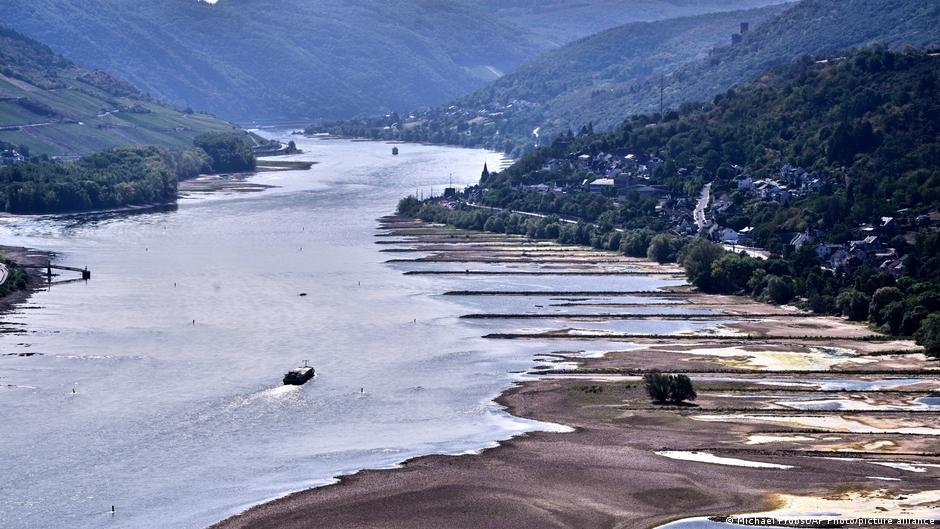
Water levels on the Rhine River — a small but critical artery for goods vital to Germany’s industry — remain critically low as a result of weeks of drought.
At one of the river’s shallowest stretches, Kaub — between Mainz and Koblenz — the water level stood at around 16 centimeters at Monday lunchtime, according to the Federal Waterways and Shipping Administration (WSV).
Although the real navigable channel is roughly a meter deeper, 40 centimeters is regarded as the lowest for standard commercial vessels at Kaub.
Ship operators use the reading at Kaub to decide how much cargo their barges can safely carry and whether a passage is feasible at all.
According to local media, in recent weeks, carriers have significantly cut their cargoes along the Rhine — in many cases to as little as one-fifth of normal capacity.
The problem isn’t just limited to the Middle Rhine, the 130-kilometer (80-mile) stretch between Mainz and Bonn that is the narrowest and shallowest section of the river.
Areas around Cologne, Düsseldorf, Duisburg-Ruhrort and Emmerich are also at historic lows.
Jens Schwanen, the head of the BDB association of inland shipping, told the Rheinische Post newspaper on Monday that the Rhine may become impassable at Kaub before the end of the week.
This would effectively split the river in two for commercial traffic.
What effect will the drought have on the German economy?
The drought could not come at a worse time for Germany’s economy, which is already grappling with weak growth, high energy costs and fading industrial competitiveness.
Germany still relies on its long rivers and waterways to transport some 5% of goods around the country, most of them bulk materials, including iron ore, coal, sand and petroleum products.
Out of 3.28 billion tons of goods transported in 2024, 173 million tons were carried by inland water, including the Rhine, according to BDB.
Eurostat, the European Union’s statistics agency, calculated in 2023 that the Rhine corridor — from the Port of Rotterdam in the Netherlands to the German-Swiss border — accounts for around 40% of freight by ton-kilometers.
After two previous droughts, the Kiel Institute for the World Economy calculated in 2023 that for every 30 days of low water on the Rhine, Germany’s industrial production declines by about 1%.
In an economy that has barely grown for the past two years, even a temporary 1% hit to industrial output is highly damaging.
The German Economic Institute (IW) now predicts a 0.4% drop in gross domestic product, effectively wiping out this year’s economic growth, which was expected at 0.5%.
“A prolonged disruption of navigability on the Rhine could completely stifle the tiny seed of growth we have,” warned IW economist Thilo Schäfer in an interview with Bild newspaper last week.
Other experts have warned of losses of €1-2 billion in the third quarter alone, with the steel, chemicals and energy sectors hit especially hard.
What happens if the River Rhine is effectively split in two?
The BDB’s Schwanen warned that “Due to the lack of rainfall, a single-digit reading is forecast for the first time this week at the Kaub gauge.”
“In principle, this means the Rhine is no longer navigable along its entire length and is therefore effectively divided in two,” he told the Rheinische Post.
This would result in two separate areas. On the one hand, shipping traffic would continue between the North Sea ports of Amsterdam, Rotterdam, and Antwerp and the Cologne region via the Rhine and the Western German canal system.
Further south, shipping would operate on the tributaries of the Neckar, Moselle, and Main, as well as the Main-Danube Canal, which is regarded as a key global link on the route to and from Southeast Europe.
Between the two sections, shipping companies would then try to move as much cargo onto trucks and freight rail services.
However, Germany’s roads cannot absorb the typical 50 to 150 truckloads that a single large barge can handle without severe congestion and substantially higher costs.
Baden-Württemberg said Monday it would join four other German states in easing restrictions on truck movements on Sundays to help ease congestion.
Following urgent talks last Thursday, Transport Minister Steffen Bilger announced several other measures to shore up Germany’s supply chain.
These include cutting red tape for heavy loads shifted to the road network, stopping unnecessary roadworks and better coordination with DB Cargo, the rail freight arm of Deutsche Bahn.
Are regular droughts a new reality for Europe’s waterways?
Extremely low water on the Rhine and other major European rivers used to be rare events.
Yet, many scientists believe climate change is making them now more frequent, longer and more severe.
According to the EU’s Copernicus Climate Change Service, western Europe has just experienced its warmest June and July on record, with exceptionally low rainfall driving much lower than average water levels on the Rhine, Danube and Seine.
The current crisis marks the third major low‑water episode in eight years, after major droughts in 2018 and 2022.
The Rhine has traditionally been supported during dry summer months by meltwater from Alpine snow and glaciers. As those glaciers retreat and snow cover declines, this natural buffer is weakening.
Germany’s Federal Institute of Hydrology (BfG) projected in 2023 that severe low-water events like 2018 could strike every five to 10 years by mid-century.
To view this video please enable JavaScript, and consider upgrading to a web browser that supports HTML5 video
Edited by: Kristie Pladson
About The Author