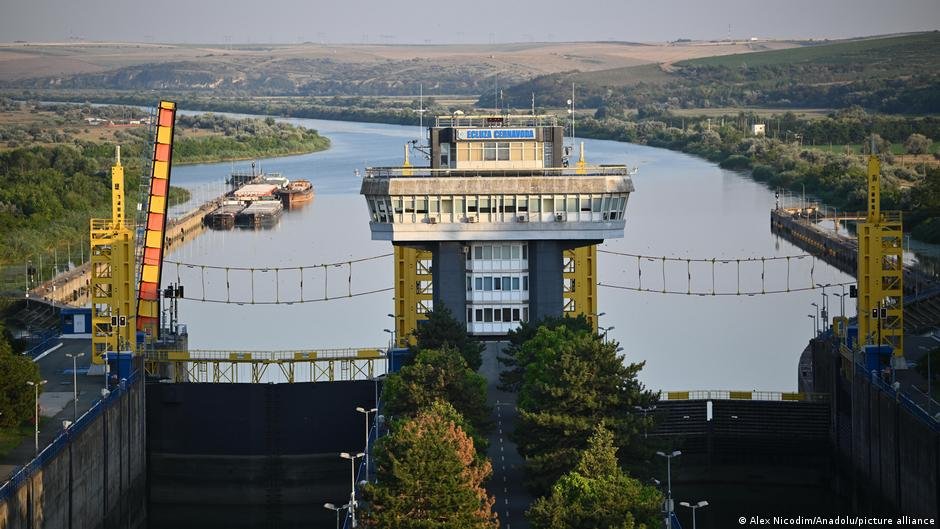
Romania shut down its lone nuclear power plant on Thursday, a rare move amid the drought that has caused record lows on the Danube River and other major waterways in Europe.
The Danube is the sole source of cooling water for the Cernavoda plant, which usually generates around one-fifth of Romania’s electricity.
The power station has only been shut down once before, in 2023, again as a result of drought and a hot summer.
Meanwhile, Hungary was scrambling to dam the Danube, as it tries to keep its Paks nuclear power plant at least running at the minimal levels that it has maintained in recent days, which are far below capacity.
What did the operator and authorities in Romania say about the shutdown?
Romania’s Nuclearelectrica company had already shut one of the two reactors at Cernavoda last month.
On Thursday, it said it needed to shut the second “because of the significant and ongoing drop in the water level of the Danube River.”
The company tried earlier this month, with help from the Navy, to improve the plant’s chances of staying operational.
Most memorably, it blew up a rocky outcrop exposed by the low water levels and strategically deposited the rocks on the riverbed in a bid to direct more water to Cernavoda.
But ultimately, continued dry weather and sinking water levels prompted the total shutdown.
“We do not foresee a restart within the next 10 days,” the plant director, Romeo Urjan, told the AFP news agency.
Romania’s Energy Ministry said it was procuring alternative power sources, including from wind power but also from energy imports, to try to ensure adequate supplies. Still it appealed to the public to consume responsibly.
It warned that as a last resort, large industrial users would have to face restrictions in the evening hours to save electricity. Carmakers Ford and Dacia had already committed to pausing production until August 19 to save power.
What is Hungary doing to try to prevent a similar shutdown of the Paks plant?
Prime Minister Peter Magyar on Thursday visited Hungary’s only nuclear power plant, the Paks facility that is also cooled by the Danube.
“We have begun construction of the low weir that will permanently contribute to raising the Danube’s water level,” Magyar told reporters at the site, roughly 100 kilometers (about 60 miles) south of Budapest.
Only one of Paks’ four reactors is currently operational amid the drought.
Nine days ago, the plant was at risk of a complete shutdown, but the government was able to abort those plans at the last moment as the Danube’s levels ended up being a few millimeters higher than forecast.
Under normal circumstances, the plant is responsible for around half of Hungary’s electricity generation, and about one-third of its consumption.
Before the completion of the weir, authorities plan to deliberately sink two 80-meter-long barges — placed end-to-end and perpendicular to the river’s flow — to create an initial damming effect and raise the water level somewhat.
Magyar said that Hungarian soldiers were working round the clock on the construction, and that it should be completed in the next four weeks. He said the project should elevate water levels in front of the Paks plant cooling system by more than a meter.
The project might not be finished long before the summer starts to fade and the rains return, but the low water levels also provide a rare opportunity to undertake such construction projects relatively cheaply and easily.
Edited by: Karl Sexton
If you rely on our team for trusted reporting, please take a moment to select us as your Preferred Source on Google, so you’ll always see our verified news first.