Criminals have once again targeted a small regional museum to steal priceless artworks on public display, this time in Messina, Sicily.
Local authorities say robbers bypassed alarm and security systems at the Regional Museum of Messina (MuMe), Italy, around 10:00 p.m. (2000 GMT) on Saturday evening as the city celebrated the high point of its “Ferragosto” summer holiday, the Catholic Feast of the Assumption of the Blessed Virgin Mary.
Thieves were able to make off with several panels painted by Renaissance artist Antonello da Messina, the most important artist ever born on the island of Sicily.
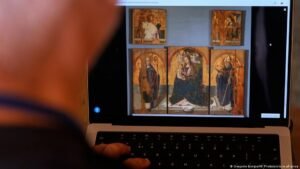
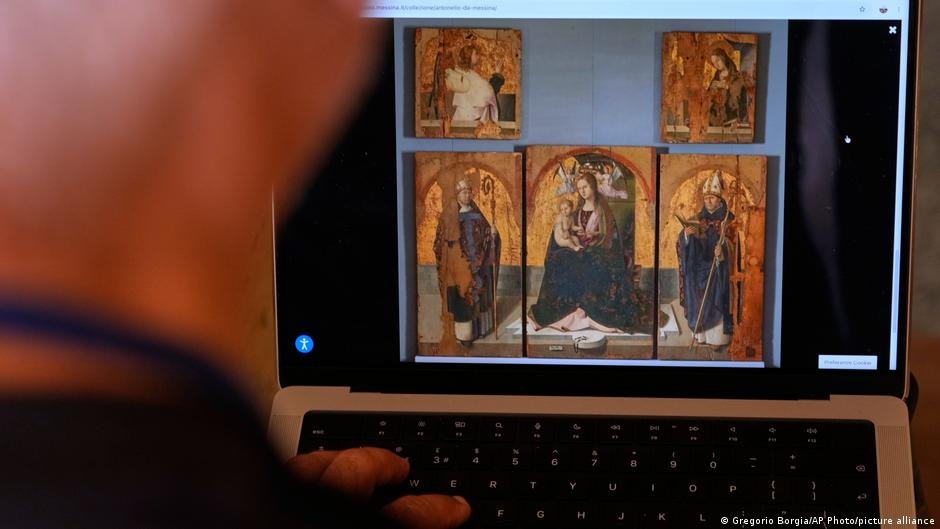
Three of the five surviving panels from Antonello’s 1473 “San Gregorio Polyptych” were taken in the robbery as well as a smaller, double-sided panel locked in an armored display case.
“We are devastated by what happened. They were some of Antonello da Messina’s most important and best-known works. It is a tremendous loss for the museum, the city, the community and the art world,” MuMe Director Marisa Mercurio told Italy’s ANSA news agency.
Messina Mayor Federico Basile called the theft “deeply reprehensible,” saying it was “even more painful” for having taken place as the city celebrated the Assumption of the Virgin.
The museum remained closed Sunday as investigators searched for evidence.
Works of ‘enormous cultural, artistic and symbolic importance’
“It is an extremely serious and significant loss,” said Mercurio, “They have stolen works of enormous cultural, artistic and symbolic importance, not only for Messina but for Sicily as a whole. All we can do now is hope they are recovered as soon as possible.”
Though the sum financial loss has not been made public — initial estimates range from €70-€80 million ($81-$92 million) — Antonello’s market value increased considerably in March of this year when the Italian state laid out $14.9 million (€13 million) for the purchase of another panel that he painted around 1460.
A moving two-sided panel in oil with an “Ecce Homo” portrayal of Christ (recto) and “Saint Jerome in the Desert” (verso), the purchase and news that the painting would soon return to Italy was greeted with enthusiasm.
Messina was among the cities hoping to display the newly returned work.
Antonello was born around 1430 and trained first in Naples before studying Provencal and Flemish painting and ultimately returning to Messina in 1457, where he would work until his death in 1474.
Seen as a key figure in what was an early example of technology transfer, Antonello is largely credited with bringing revolutionary new Flemish oil painting techniques to southern Europe while at the same time spreading knowledge of Italian perspective drawing among his colleagues north of the Alps.
The return of Antonello’s painting to his hometown, went the argument, would have huge symbolic value for a city that lost most of its cultural heritage, including what remained of Antonello’s life and work, on December 28, 1908 — when an earthquake flattened Messina and killed nearly 60% of its population in a matter of seconds.
What paintings were stolen in Sicily?
The paintings stolen on Saturday belonged to an altarpiece installed at Messina’s Monastero San Gregorio until it was destroyed in the 1908 quake.
Referred to as the “San Gregorio Polyptych” in its post-quake state, it consisted of six tempera paintings on wooden panels.
The five pieces in the museum portrayed the “Annunciation of the Virgin” in two upper panels, and the larger “Madonna of the Rosary Enthroned” flanked by full-length portraits of Saints Gregory and Benedict below.
The works were the only by Antonello never to have left Messina.
Authorities say the thieves left two panels leaning against the exterior of the museum despite having removed them from the wall and gotten them outside.
Another work, the small, two-sided oil painting on wood taken from the armored case, bore the image of Christ on one side and a Franciscan monk with the Virgin and Child on the other.
To view this video please enable JavaScript, and consider upgrading to a web browser that supports HTML5 video
What will happen to the paintings now?
Saturday’s robbery comes just days after Italian authorities announced the recovery of three stolen artworks by Auguste Renoir, Paul Cezanne and Henri Matisse worth about €10 million.
Those works were stolen from a regional museum, too, the Magnani Rocca Foundation in Parma, on March 22.
Five people — allegedly Moldavan gangsters — have been detained in connection with the theft.
Despite having (often outdated) alarm systems, museums present soft targets for criminals.
Brazen thefts at museums around the world have highlighted this problem — most dramatically in Paris, where gangsters stole priceless historic jewels from the famous Louvre in broad daylight on October 19, 2025.
Experts say the fact that stolen artworks are often instantly recognizable makes them impossible to sell via reputable channels. Instead, such objects are used as collateral among crime bosses.
In Germany, members of Berlin’s infamous Remmo crime family were convicted and put in prison in connection with the 2019 theft of historic jewels from the Green Vault at Dresden’s Royal Palace.
Most of the jewels from the heist were recovered, albeit damaged, but the cost to taxpayers was enormous. The jewels from the Louvre heist have yet to be recovered.
Sicily’s most famous art theft happened more than half a century ago, when unknown perpetrators broke into the church of the Oratorio di San Lorenzo in Palermo to cut Michelangelo Merisi da Caravaggio’s “Nativity with Saint Francis and Saint Lawrence” from its frame and spirit it away in the dead of night, never to be seen again, after having hung there for more than three centuries.
To view this video please enable JavaScript, and consider upgrading to a web browser that supports HTML5 video
Edited by: Kieran Burke
If you rely on our team for trusted reporting, please take a moment to select us as your Preferred Source on Google, so you’ll always see our verified news first.
About The Author