Russian attacks on civilian ships have effectively brought the ports in the greater region of Odesa to a standstill. Until recently, they handled about 90% of Ukraine’s agricultural exports.
The Ukrainian government has been working on finding alternative routes via rail, road and other waterways. It is also currently in negotiations about an export corridor that would go via Moldova.
But many experts have pointed out that these temporary alternatives cannot replace the ports, and warn that the current blockade of the Black Sea is an even greater threat to the Ukrainian economy than that posed by Russia’s full-scale invasion of 2022.
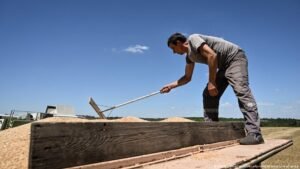
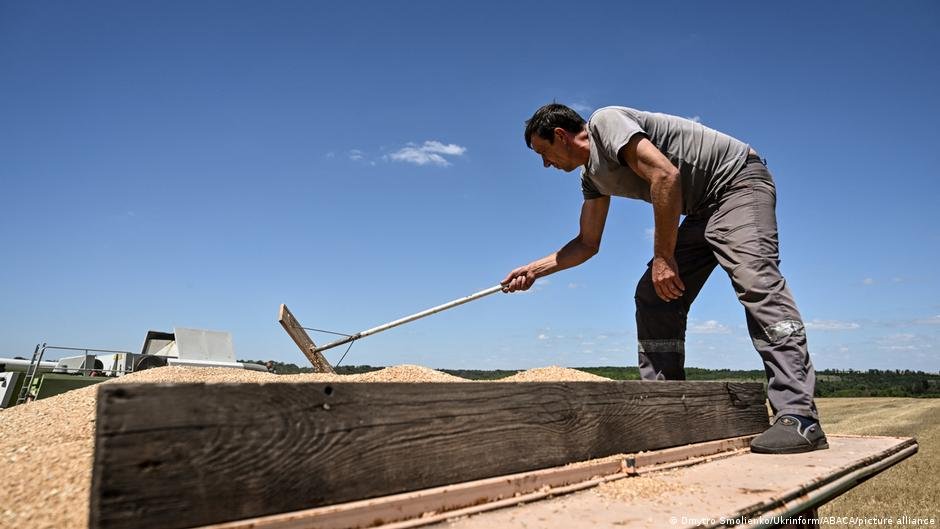
The strained security situation in the Black Sea is already having a palpable effect on Ukraine’s domestic market. According to Denys Marchuk, the deputy chairman of the All-Ukrainian Agrarian Council, Ukrainian farmers have already harvested more than 28 million tons of grains and pulses.
But a large part of this harvest cannot be sold, which has led to a shortage of the cash needed to complete the harvest and to plant winter crops. Planting usually begins at the end of August in Ukraine’s southern regions.
“Right now, we can barely sell our harvest. Instead, we’re storing what we have harvested — that’s if we find storage space. At the same time, we are wondering what to do because we need money, especially so we can plant in fall,” Marchuk told DW.
He predicted that the situation would continue to worsen in the coming weeks and months when grain and oilseed crops, which are usually harvested later, compounded the crisis.
Farmers plan to leave corn in the fields
The corn harvest alone could reach about 33 million metric tons this year. Yet in the coming months, there could be a shortage of storage capacity totaling up to 10 million tons. Regions on the front, where most silos have been destroyed amid the ongoing war, are particularly affected.
“You often hear that farmers want to leave their corn in the fields to be harvested in spring. It still needs to be dried, which needs a lot of electricity that is very expensive. They don’t have the money,” said Marchuk. “There aren’t enough places where they can sell it, nor are the prices reasonable, so for them it makes more sense to leave it in the fields as that’s cheaper.”
Domestic prices falling
Maksym Hopka, an analyst at the Ukrainian Agribusiness Club, estimates that Ukraine’s agricultural output totaled about 3.7 million metric tons in July, of which about 2.7 million metric tons comprised grain. That was a decline of about a quarter in comparison to the previous month. He expected an additional fall of over 50% in August.
Hopka added that domestic prices were falling, with the price of food-grade wheat declining by 30 to 35%. This meant increasingly difficult economic conditions for production, he explained.
Prices have fallen so sharply because farmers cannot export all of their harvest, and can no longer cover even their production costs.
Some farms are already operating at a loss. According to the Ukrainian Ministry of Agrarian Policy and Food, annual losses from unsold agricultural produce could amount to approximately $20.5 billion (approx. €18 billion).
Ukrainian government vows to provide support
The Ukrainian government has insisted it will do everything in its power to find new ways to export Ukrainian agricultural produce by rail or road through neighboring countries or through ports on the Danube.
However, extreme heat and drought have severely reduced the Danube’s transport capacity and are also hampering Ukrainian exports. There are also problems with rail and road transport. European railways are already operating at full capacity during harvest season, and transporting large quantities of grain by road is expensive.
For Agriculture Minister Taras Vysotsky, the top priority remains restoring safe shipping routes to the ports in the Odesa region with the help of Ukraine’s military and those of its partners. He told DW that there was no comparable medium-term alternative and that rail connections and dry ports could only serve as temporary measures until the Black Sea ports reopened.
Less help from EU than in 2022
Oleg Nivievskyi from the Kyiv School of Economics said Ukraine today had fewer ways of offsetting losses in maritime trade than it did at the beginning of the full-scale invasion. In 2022, the European Union provided support to Ukraine by establishing “solidarity lanes,” and import duties and quotas were temporarily suspended to ease trade.
To view this video please enable JavaScript, and consider upgrading to a web browser that supports HTML5 video
Nivievskyi pointed out that the conditions were different now. “If we look at trade with the EU, we have gone from a free system to the pre-war trade regime with customs restrictions and quotas,” he said.
He added that there were also significant shortcomings in the infrastructure, with the Ukrainian railway currently running 30% fewer trains than before 2022. Russia’s constant attacks on rail infrastructure have hampered operations and necessitated regular repairs. Transport via road is also limited due to shortage of truck drivers, not least because many had been mobilized to fight in the war.
Export strategies need rethink
Nivievskyi said the current crisis could help to encourage the government to rethink Ukraine’s export policies. He said the country should have developed a long-term strategy right from the beginning of the Russian invasion in order to ensure that its exports could reach global markets.
He explained it wasn’t only a question of finding temporary alternatives to the ports of Odesa; the government needed to put in place logistics to ensure that the blockade of one route did not paralyze the entire sector.
Hopka has calculated that Ukraine’s exports of agricultural produce will drop by about 9 million metric tons between August and October, and that losses could amount to about $1.9 billion.
In response to pressure from farmers, the government has already extended a loan program to farmers and has also applied for €220 million in aid from the European Commission. The idea is to help small and medium-sized agricultural businesses in particular to cover their payments.
This article was originally written in Ukrainian.
To view this video please enable JavaScript, and consider upgrading to a web browser that supports HTML5 video
About The Author