Facing rising cases of heatstroke and losses, farmers in Japan are changing their routines and adapting to the effects of climate change.
Image: Issei Kato/REUTERS
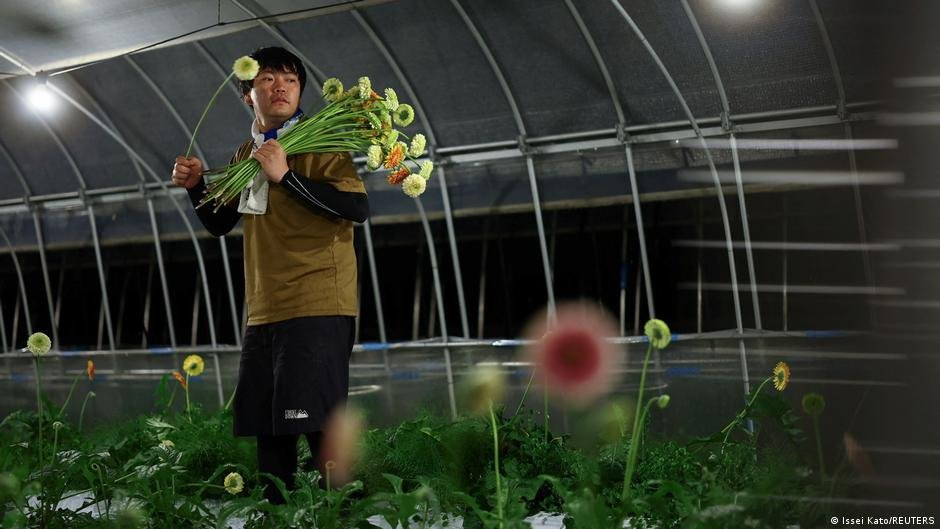
Long after sunset, Motoaki Iijima’s greenhouse north of Tokyo glows like a lantern. Under artificial light, the 36-year-old harvests pink and orange gerbera flowers. During the day, his work has become life-threatening. Increasingly severe heat waves have turned a farmer who once worked daylight hours into a night owl.
Image: Issei Kato/REUTERS
If the temperature rises above 35 degrees Celsius outside, it can get hotter than 40 C (over 100 Fahrenheit) inside the greenhouses. Three years ago, a temporary worker suffered heatstroke while picking sunflowers. Since then, the farmer has been working at night. “We’ve gradually become nocturnal. It’s about protecting our bodies, and ultimately, our lives,” he told the Reuters news agency.
Image: Issei Kato/REUTERS
Even before the morning has truly begun, four workers are already out in the field harvesting asters while the temperature is still bearable. Their workday has shifted several hours earlier. “We’ve got to race against the clock,” said 68-year-old Miyoko Asada, a veteran worker who arrives at the farm shortly after sunrise. As soon as the sun rises higher in the sky, the risks multiply.
Image: Issei Kato/REUTERS
The climate crisis is hitting Japan’s agricultural sector hard. About 70% of farmers are at least 65 years old and therefore vulnerable to heat stress. In 2024, 59 agricultural workers died as a result of extreme heat — more than twice as many as in 2021. Every record-breaking summer poses a health risk to this aging industry.
Image: Issei Kato/REUTERS
According to Lancet Countdown, a research collaboration tracking the health impacts of climate change, Japan’s agricultural sector alone lost approximately 926 million working hours in 2024 due to heat exposure. Across all industries, the economic loss amounted to $46 billion (€39 billion) — about 1% of Japan’s GDP.
Image: Issei Kato/REUTERS
Even 48-year-old Tetsuya Usuba’s chicken farm now follows a new routine. At 2:30 a.m., the lights turn on automatically, so his 4,400 laying hens can eat before the daytime heat takes away their appetite. He has installed additional fans, cools the metal roof with water and adds citric acid in the drinking water to help the birds.
Image: Issei Kato/REUTERS
Six summers ago, Usuba lost more than 500 of his laying hens within three days due to heat stress. Even today, the image of the dead birds haunts him. Despite all the protective measures, another 130 chickens recently died when temperatures rose above 35 degrees Celsius. “Summer has become a new threat to producers like us, something as scary as an outbreak of avian influenza,” said Usuba.
Image: Issei Kato/REUTERS
At 33 degrees Celsius, many chickens stand with their beaks open, panting. The consequences of climate change are immediately visible, with farm animals and farmers increasingly reaching their limits.
Image: Issei Kato/REUTERS
New workplace regulations introduced in 2025 now require employers to report heatstroke cases and develop emergency plans. At the same time, drones, robots and other technologies are expected to reduce physical labor in the sun. Yet on many farms, adapting to the heat remains a manual task and a daily race against rising temperatures.
Image: Issei Kato/REUTERS9 images1 | 99 imageshttps://p.dw.com/p/5J5XY
About The Author