Rockets on the beach and volcano parks: China is seeing a new kind of tourism emerging from its space ambitions and dreams of flying to Mars.
Image: Maxim Shemetov/REUTERS
On August 10, thousands of people crowded the beach on Hainan Island. Flashing smartphones were pointed toward the sky as people waited for a launch. Shortly after 8 p.m., the rocket lifted off from the Wenchang Space Launch Site. Its flames lit up the night and cheers erupted. The launch was not only a technical milestone but also a tourist attraction.
Image: Maxim Shemetov/REUTERS
But the unexpected happened: The unmanned Long March 7A rocket suddenly turned into a fireball in the sky. Chinese state media confirm the incident hours later. Many spectators on the beach apparently didn’t realize what happened at first. Instead of fear, there was excitement. As the sky over Hainan lit up, the crowd shouted “Wow!”
Image: Maxim Shemetov/REUTERS
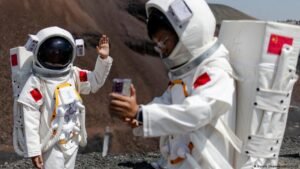
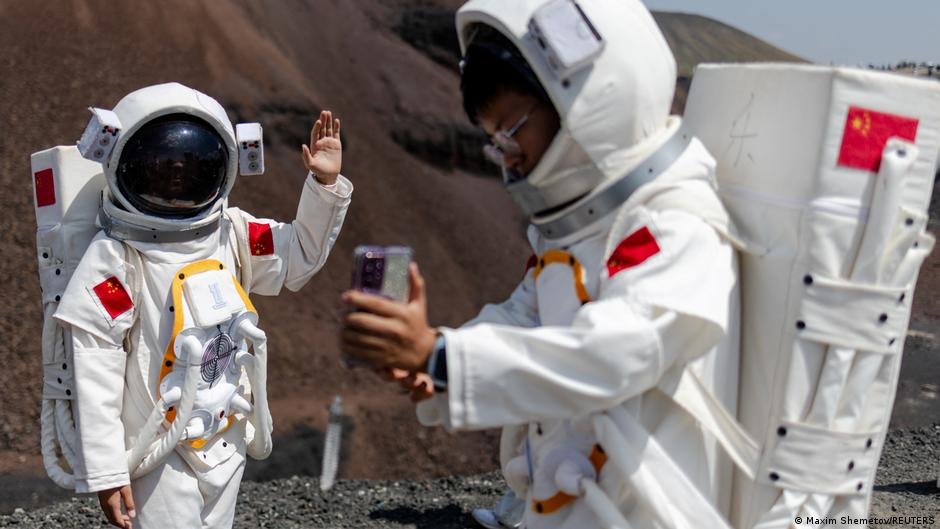
A trip to space sounds too dangerous? No problem! China has impressively realistic recreations of Martian landscapes. At Wulanhada Volcano Park in Inner Mongolia, black volcanic formations evoke the feel of an alien planet. Visitors rent white or pink spacesuits and pose for photos in the barren landscape.
Image: Maxim Shemetov/REUTERS
The costume rental shop is part of the experience. Right on the way to the Wulanhada Volcano Geopark, visitors can stop by to pick up an alien-themed outfit. The idea for the costume rental shop came about after photos of students in astronaut suits in front of the volcanoes went viral. The owner, a former shepherdess, has been renting spacesuits to visitors since 2022.
Image: Maxim Shemetov/REUTERS
Visitors explore a replica of the “Tiangong” space station. Behind the excitement lies an ambitious space program. Since its first rocket launch in 1960, China has made great strides: The first manned spaceflight followed in 2003, the first spacewalk in 2008, and the completion of the space station in 2022. Beijing plans a manned moon landing by 2030. Missions to Mars are also in the works.
Image: Maxim Shemetov/REUTERS
Tourist Fu Jinhua from Guangdong didn’t travel alone: his parrot, Yangzai, came along to the launch on August 10. “I thought I’d let it soak up the atmosphere and watch the rocket too,” Fu says. What used to be a strictly controlled event has now become a family outing — complete with animal companions.
Image: Maxim Shemetov/REUTERS
Fu believes that space travel could soon become as commonplace as flying or taking the train. “Maybe in 10 or 20 years, we’ll have our own version of Elon Musk, and we might even be able to move to Mars — who knows?” he says. “I truly believe the future is not just a dream.”
Image: Maxim Shemetov/REUTERS
Chinese art is also reaching for the stars. In Songzhuang, Beijing’s artists’ quarter, a huge sculpture of a sleeping female astronaut rises among the plants. Titled Resonance, it was created by Yang Wanting. The character Chen Zilan, based on the artist’s novel, is imagined to travel through the universe for the next 100 years. “Everyone is curious about space,” says Yang.
Image: Maxim Shemetov/REUTERS
You can even get astronaut-shaped icecream, as Reuters photographer Maxim Shemetov demonstrated. It’s available at the Wulanhada Volcano Geopark, along with the full-scale model of a space shuttle you can see in the background here. In a souvenir shop, space passports are displayed as mementos. Space has become a collective experience involving tourism, art, and branding in China.
Image: Maxim Shemetov/REUTERS
At Shougang Park in western Beijing, space exploration takes a playful turn. Amid the structures of a former steel mill stands “Space Molly,” a giant figure wearing an astronaut helmet created by toy maker Pop Mart. Visitors’ interest shows how rockets and astronauts have become more than symbols of state research. They are now woven into consumer life and modern pop culture in China.
Image: Maxim Shemetov/REUTERS
Visitor Yang still remembers China’s first manned spaceflight in 2003. Her grandfather called her to the TV as Yang Liwei launched into space. “It felt like all other activities were canceled,” she says. “I think the things we remember — and the impressions certain events leave on us — ultimately come back to people.” Watching the spaceflight shaped her view of progress.
Image: Maxim Shemetov/REUTERS
For tourist Fu, the crowds on the beach illustrated just how much China has changed. “Previous generations could never have imagined sitting here, enjoying the sea breeze and watching the launch of our own rocket,” he said. Space exploration has evolved from a secret government project into an experience. And the next dream is Mars.
Image: Maxim Shemetov/REUTERS12 images1 | 1212 imageshttps://p.dw.com/p/5J9tj
About The Author