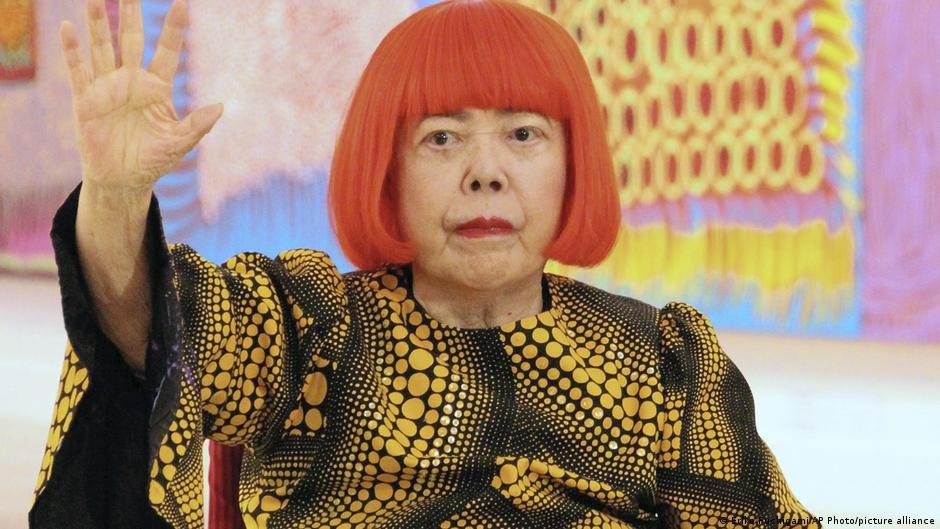
The iconic Japanese artist has died at age 97. She channeled her mental health challenges into artworks that are among the most photographed in the world.
Image: Eriko Fuchigami/AP Photo/picture alliance
As a child in Matsumoto, Japan, Kusama started experiencing vivid hallucinations. She described seeing fields, walls and objects covered with endless dots and patterns. Her art was her way of sharing how she perceived the world.
Image: Miho Takahashi/AP Photo/picture alliance
Shown here, a part of “My Eternal Soul” — a series of more than 800 paintings Kusama began in 2009. The artist was open about her mental health challenges: “The only method I have found that relieves my illness is to keep creating art,” she said. She checked herself into a Tokyo psychiatric hospital in 1977 and chose to live there permanently, going to her nearby studio each morning.
Image: Martin Meissner/AP Photo/picture alliance
In her immersive and hypnotic “Infinity Mirror Rooms,” she combined mirrors and lights to create endless, magical spaces. They have been dubbed “art for the Instagram age,” as visitors, enveloped in a seemingly endless cosmos of light, create their own iconic pictures — contributing to the Japanese artist’s popularity.
Image: Julian Stratenschulte/dpa/picture alliance
A large mirrored sphere hangs at the center of a hexagonal chamber lined with mirrors and LED lights flashing across the space: “Beauty Described by a Spherical Heart” is the name of this 2024 “Infinity Mirrored Room.” Kusama spent her entire life exploring the concepts of infinity, wonder and the dissolution of boundaries between the individual and the world in her art.
Image: Justin Ng/Avalon/Photoshot/picture alliance
Visitors become part of her artworks exploring the possibility of transcendence: Featuring Kusama’s signature yellow-and-black polka dots, mirrors and a large inflatable structure, this ambitious 2025 installation is titled “The Hope of the Polka Dots Buried in Infinity Will Eternally Cover the Universe.”
Image: Rolf Vennenbernd/dpa/picture alliance
Phallic forms emerged in the early 1960s in her works. “Phalli’s Field” (1965) is Yayoi Kusama’s first installation in her “Infinity Mirror Room” series. The groundbreaking work consists of a mirrored room filled with hundreds of soft, hand-sewn fabric elements resembling phalluses, covered with the artist’s characteristic polka dots.
Image: Alex Cruz/dpa/picture alliance
Before turning to mirrors, Kusama had already created a series of sculptures called “Accumulations,” in which she covered everyday objects — chairs, sofas, boats — with stuffed fabric protrusions. But she found reproducing objects by hand exhausting; the mirrors allowed her to achieve the infinite repetition effect that obsessed her.
Image: Telmo Pinto/SOPA Images/Sipa USA/picture alliance
“A Bouquet of Love I Saw in the Universe” was a monumental installation Kusama created for her 2021 Berlin exhibition. While her artistic work generally promoted universal themes of love, she faced backlash for racist remarks in earlier writings that resurfaced in recent years. In response, Kusama issued a public apology expressing her “deep regret” for the offensive language.
Image: Adam Berry/Getty Images
Kusama first presented “Narcissus Garden” as an unauthorized performance at the Venice Biennale in 1966, installing 1,500 shiny ball-shaped plastic globes outside the Italian Pavilion. She stood among the balls in a gold kimono next to a sign that read, “Your Narcissism for Sale,” and sold the spheres to passersby for $2 each — a work mocking the commercialization of art and celebrity culture.
Image: Winfried Rothermel/picture alliance
Pumpkins were among Yayoi Kusama’s most beloved and enduring motifs. She started sketching them as a child on her family’s seed farm. She saw pumpkins as comforting, humorous and deeply human in character, saying they offered her a sense of emotional stability. Her giant pumpkin sculptures are iconic.
Image: Justin Ng/Avalon/Photoshot/picture alliance
Her childhood hallucinations have inspired playful spaces that visitors of all ages enjoy experiencing. Her installations are among the most photographed artworks in the world. “She continued to paint until her final days, never setting aside her brush, and continued exploration of forever love and eternal soul,” said her studio in a statement following the announcement of her death.
Image: Daniel Ceng Shou-Yi/ZUMA/picture alliance11 images1 | 1111 imageshttps://p.dw.com/p/5JTRu