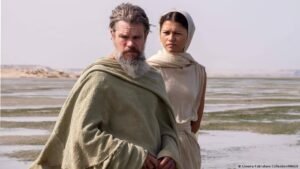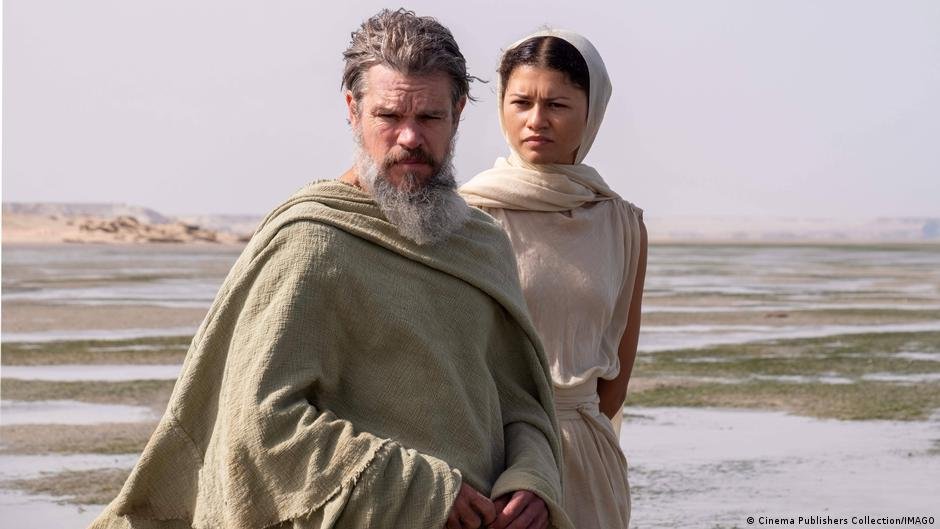
Christopher Nolan’s latest blockbuster has drawn tens of millions of viewers into a world of stormy seas and cities on fire.
Minus the monsters, that world is based in reality. “The Odyssey” — a post-Trojan War survival story — is set during the Bronze Age collapse of civilization.
A new study links that collapse to a severe climate shift. And the authors warn of “implications for the future.”
Scientists have long known about a mysterious and severe drought that struck more than 3,000 years ago, overlapping with the disintegration of kingdoms and states across the Mediterranean.
To view this video please enable JavaScript, and consider upgrading to a web browser that supports HTML5 video
Research published in July has shed light on the potential cause of that drought: a slow drying trend and a quicker natural cycle of dry weather stacked on top of each other.
By the late Bronze Age, the West African monsoon system had been shrinking for thousands of years, turning a green Sahara into desert. Less rain over Africa meant less over the Mediterranean. That trend amplified when the region hit a dry spell caused by natural climate cycles from the Atlantic, which saw the region swing between decades-long wet and dry periods.
Katherine Power, the Stockholm University scientist who led the study, said the environment at the time could explain the mass migration and conflicts of the Odyssey era.
For decades, scholars have speculated on the reason for the large-scale movement during this time — which is also referred to as the period of the so-called Sea Peoples.
Archaeologists have argued that climate shifts could help explain the migration and political collapse at the end of the Bronze Age. The new findings add puzzle pieces.
“We don’t know necessarily why those people moved,” Power said. “But if we can say, ‘Hey, the climate was getting worse and worse to survive,’ that could be a potential reason.”
‘A perfect storm of calamities’
And that, she said, is relevant to today. Europe’s major rivers are at record lows, and drought is creating conditions for devastating wildfires as well as fueling historic crop loss. That includes France’s lowest maize harvest in 50 years.
The same cycles of wetting and drying from the Atlantic are still at play, but they’re now happening in the context of a world that’s heating as a result of humans burning oil, gas and coal.
“I think it is even more alarming and even more of a threat,” Power said.
But does what happened then give insights into what might happen now?
Eric H. Cline, an archaeologist at George Washington University who wrote a book on the roots of the Bronze Age crisis, said drought and disease were part of the “perfect storm of calamities” that led to societal downfall. He sees parallels to today.
In an email to DW, he said “we should be very concerned” about climate change as a stressor for the collapse of civilization. “That fear is not too dramatic at all,” he said.
Cline added that on his most optimistic days, he believes “we will come to our senses and sidestep that possibility at some point.”
To view this video please enable JavaScript, and consider upgrading to a web browser that supports HTML5 video
Was there a trigger moment for the collapse?
Power’s research sought to explore what patterns might lie behind isolated Bronze Age drought events.
They started by examining plant spores, ice cores, cave stones and other natural records that pointed to drought. Then, she and co-author Stockholm paleoclimate scientist Qiong Zhang turned to modeling to get a broader picture.
Their model looked at the whole planet, overlaid with a grid, each cell covering an area with an atmospheric resolution of roughly 125 kilometers (78 miles). A supercomputer then calculated the conditions in each of these cells, for every month, across thousands of years. That let the scientists look at the entire Mediterranean.
“We’re not now stuck with just one core or one cave,” Power said. “We can see farther afield and build a whole picture.”
What they found was not a single event that dramatically and suddenly changed the climate. Instead, shorter cycles of wetting and drying lined up with a longer warming trend.
“When we are looking for connections between climate changes and civilization changes, we often are looking for that big, huge, abrupt, catastrophic event,” Power said. She added that it is “slow, gradual changes that push a society over a threshold.”
She said it could have been a steady fall in water supply that led to a slow decline in crops, which prompted people to migrate, triggering conflict.
“It doesn’t take very much to push a society over the threshold that they’re comfortable with,” Power said. “What if you add something more to the mix? Maybe then that pushes you a bit farther, and you can’t quite recover from that.”
Edited by: Tamsin Walker
About The Author