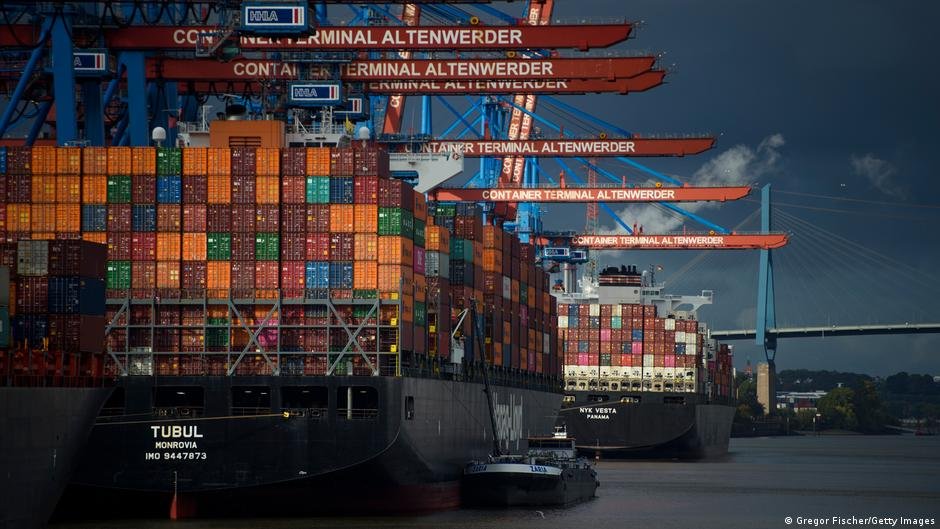
The German economy is showing tentative signs of recovery after a prolonged period of gloom. Europe’s largest economy is on track for its strongest GDP growth since 2022, while business sentiment is finally trending upwards again after a lengthy spell in the doldrums.
The country’s official statistics office reported last week that the economy grew by 0.3% in the second quarter of 2026, beating estimates and building on robust figures for the previous two quarters.
Several others have revised their forecasts upwards. The Ifo Institute, Kiel Institute for the World Economy and the Leibniz Institute for Economic Research are all now predicting growth of 1.3% or more for 2026.
Meanwhile, the Ifo business climate index — a key barometer of the country’s corporate mood — returned its highest reading in a year for August.
“It’s more than a flash in the pan,” Clemens Fuest, president of the Ifo Institute, told DW. “It could be a recovery.”
“The momentum is positive and the economy has shown a better-than-feared level of resilience,” said Carsten Brzeski, ING’s global head of macro research.
However, he cautioned against too much cheer, saying some of the economy’s fundamental problems remain. “In order to really transform this into a longer-term recovery story, we still need more,” he said.
Where has the good news come from?
The positive figures come as negative headlines related to Germany’s economy continue to stack up.
Volkswagen, one of the country’s most iconic companies, is in the midst of a bitter downsizing — reflecting a wider restructuring across the country in the face of competition from China and other global headwinds.
This summer, record low water levels on key German waterways such as the Rhine and Danube significantly disrupted trade and economic activity while the war in Iran continues to drive energy prices upwards.
Yet part of the reason for the upturn relates to how the German economy has handled some of those challenges, notably the closure of the Strait of Hormuz as a result of the Iran war.
Germany’s exports and industrial base have powered GDP growth, with new orders increasing for the third month in a row, leading to the strongest production growth since early 2022. The VDMA, which represents the German mechanical and plant engineering sector, reported a 2% increase in foreign orders for July year-on-year.
Brzeski told DW that many German manufacturing firms, especially in energy-intensive sectors such as chemicals, have benefited from the closure of the Strait of Hormuz. They have increased orders and taken some market share from Asian suppliers who were more severely dependent on Middle Eastern oil.
“There was a bit of a rechanneling of industrial orders away from Asia to Europe and Germany,” he said.
The German Federal Ministry for Economic Affairs and Climate Action itself identified this factor in its August statement, saying Asian rivals “were more affected by price increases and supply bottlenecks.”
It said that the multiple shocks of recent years have led German companies to diversify supply chains.
“Many companies have altered their transport logistics in recent years, are maintaining larger stocks, and are using a variety of transport routes in order to make their supply chains more resilient,” it added.
Can the German government take some credit?
Analysts also think Chancellor Friedrich Merz’s government deserves some credit for the turnaround, despite it hitting historic levels of unpopularity in 2026.
“It’s driven by government demand and debt-financed spending, particularly in defense,” said Fuest.
To view this video please enable JavaScript, and consider upgrading to a web browser that supports HTML5 video
The government’s economic plans are built around a €500 billion ($580 billion) infrastructure investment drive, a massive increase in defense spending and a major reform proposal aimed at boosting competitiveness.
It has also introduced some energy price relief measures and a €10 billion tax relief plan for lower-income households. “Companies are more optimistic and a big part has to be the stimulus,” said Brzeski. “It is gradually reaching the economy.”
Germany’s structural problems remain
Despite the positive data, many of the issues which have dogged the German economy in recent years remain.
The recent uptick is driven by export demand, with practically no increase in domestic demand. According to the Federal Statistical Office, public and private consumption spending was flat, while investment declined.
“Even though everyone is happy that we have some positive news, we need to watch out and not fall into the trap of thinking that now ‘everything is fine,’” said Brzeski, noting that the factors undermining German competitiveness persist.
“Chinese competition is still there,” he said. “The long loss in international competitiveness in the automotive industry and other industries is still here,” he added, stressing that these structural challenges would be difficult to alter or reverse.
Tentative optimism among Germany’s businesses
Yet the positive sentiment remains. Indicators for the third quarter of 2026 suggest significant optimism among business leaders about the future, while overall German growth is now on track for a 1.2% increase for 2026. That puts it ahead of other European countries such as France, the UK and the Netherlands.
In the wake of the war in Ukraine, Germany’s economy fell into a sustained slump from which it has struggled to emerge since 2022. While other economies showed signs of recovery, Germany remained in the doldrums.
For some analysts, the recent positive data reflects a sense that things had reached a natural “bottoming out” and that a return to growth was inevitable.
“It could hardly have gotten much worse,” said Brzeski. “We’re bouncing back from low levels. This is not wirtschaftswunder [“economic miracle”] 3.0, we have to keep that in mind.”
He also thinks part of the optimism is related to corporate Germany finally accepting some harsh truths about how it had fallen behind in key areas such as innovation and digitalization, and belatedly trying to improve.
“They realize they simply have to embrace technological change, AI and so on, and have to start investing,” he said. “They are no longer waiting for what’s happening in Berlin in terms of reform packages; it’s a question of survival.”
For Fuest, the data suggests Germany’s “industrial core” remains intact. He said three-quarters of German manufacturing companies are still expanding, but warns that the recovery will be short-lived unless bigger change follows.
“It is urgent to allow for structural change and to find new areas where German companies have competitive advantages,” he said.
Edited by: Rob Mudge
To view this video please enable JavaScript, and consider upgrading to a web browser that supports HTML5 video