


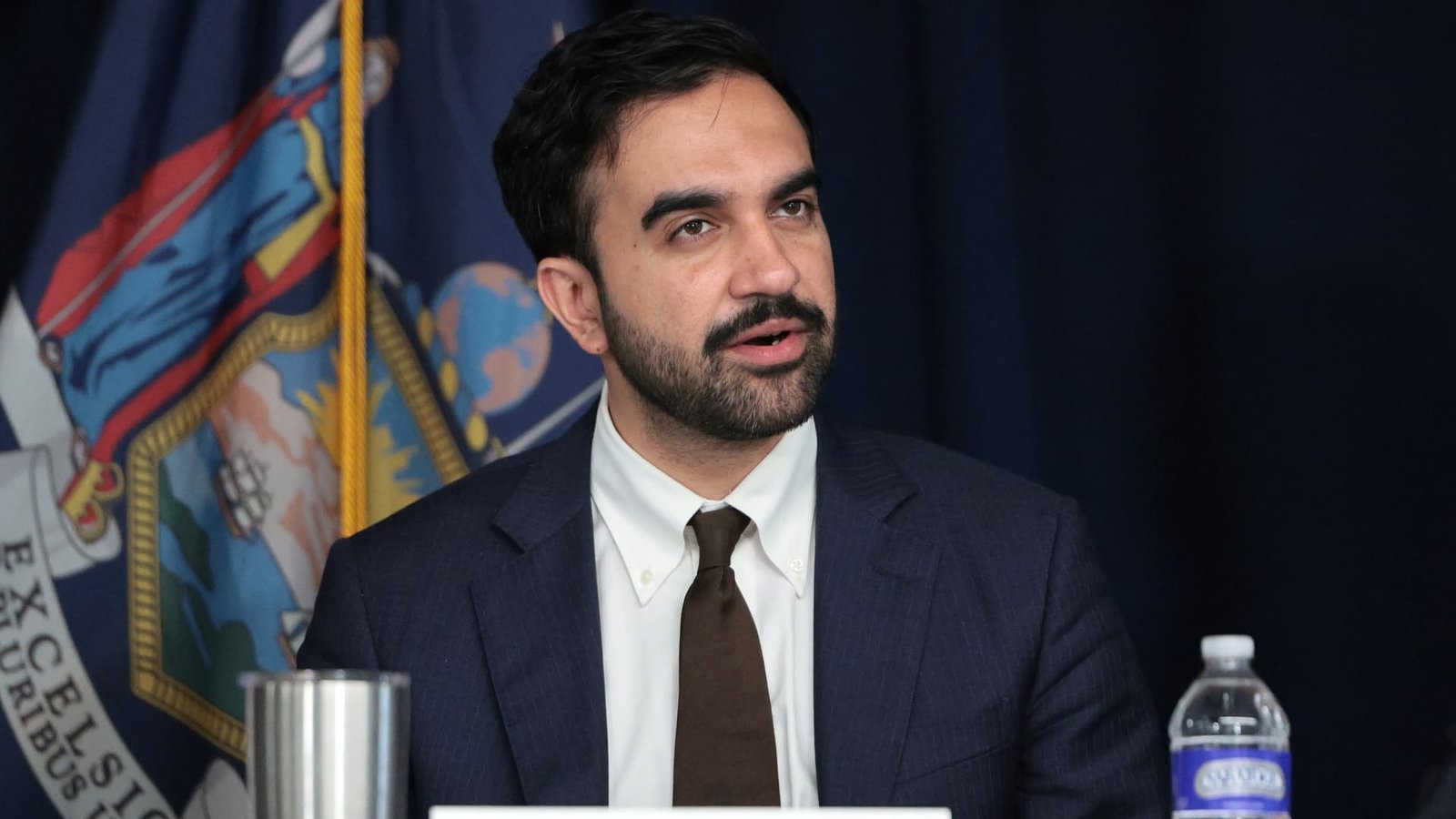
Skip NavigationNew York City Mayor Zohran Mamdani speaks during the annual New York State Financial Control Board meeting on August 12, 2026 in New York City. Michael M. Santiago | Getty Images
The country’s largest school district now has some of the strictest guidelines around younger students using artificial intelligence tools in school — at least, temporarily. Some education experts say it’s a step in the right direction toward schools using AI effectively to benefit children.
New York City’s schools will ban elementary and middle school students from using generative AI tools during the upcoming school year, Mayor Zohran Mamdani announced on Wednesday. The one-year moratorium, which will affect more than 600,000 students, will allow city education officials time for “studying the impacts of this technology,” Mamdani said in a statement.
The announcement comes amid a swirling debate around the role AI should play in how students across the country learn, and how parents and educators can best set kids up for future success. Some parent-led groups have raised concerns about the potential for AI tools to enable students to cheat more easily, or become overly reliant on the technology at the expense of creative thinking skills. Proponents of AI in the classroom say the technology is becoming prevalent in modern society, and students would benefit from learning how to effectively and responsibly use it sooner rather than later.
New York’s new guidelines already have detractors on both sides of the debate. Some critics say the city is denying students valuable learning tools and the ability to develop AI literacy. Others say the city’s new policies don’t go far enough in banning AI tools: Students will reportedly still be allowed to use “centrally approved instructional programs,” according to The New York Times, and high schools are largely unincluded.
For the middle ground of parents who want their kids to learn how to use AI responsibly without over-relying on it, New York’s new policies initially make some sense, says Bree Dusseault, the principal and managing director at the Center on Reinventing Public Education, a research organization affiliated with Arizona State University that studies AI adoption in school districts across the country.
A temporary and limited pause “represents the kind of clear, but flexible, policy approach that is necessary in this kind of fast-evolving moment,” Dusseault says. Its ultimate success will hinge on what city officials turn up in studying the impact of educational AI tools over the next year, she notes. The officials’ findings could, at least in theory, also help parents across the country who want to strike the right balance of AI education at home with their kids, she adds.
Other school districts across the country are likely watching, too. The city is often a bellwether in that sense: After New York and Los Angeles blocked access to ChatGPT in schools in 2023, a series of other cities followed suit. Notably, New York eventually reversed that decision. Nearly 40% of schools in the U.S. ban the use of AI tools in classrooms, with many ultimately leaving that decision up to individual teachers, according to October 2025 research from College Board.
A potential ‘home run’
New York’s new policies will apply to “all software that uses student-facing generative AI,” according to the city’s press release. Students are also banned from using individual screened devices until the third grade, and students from age 2 through high school are barred from using companion chatbots, which simulate emotional connections and friendship. Teachers will be able to use AI tools for creating lesson plans and completing administrative tasks, but not for grading assignments.
The moratorium is balanced against strategic investments by the city in AI literacy classes for high school students, and multiple pilot programs to test AI educational tools with a limited number of high schoolers in supervised environments, notes Dusseault.
The policies can be effective, even a “home run,” if the city spends the next year testing and identifying AI educational tools with high data privacy standards that help students learn and think critically, as opposed to those that simply hold students’ attention, says Dr. Nicole Barnes, the American Psychological Association’s executive lead psychologist for education.
Educational technology products built on generative AI often make unsupported claims of improving young students’ learning and critical thinking skills, according to an APA report co-authored by Barnes that published on Thursday. Features that hold a child’s attention and increase engagement are frequently mistaken for fostering genuine learning, the report found.
Effective tools should have proven track records of helping students “retain and apply knowledge” and maintaining human interactions with teachers and peers, which the APA’s research has found is essential to supporting effective learning, Barnes says. She’s also a proponent of teaching parents and family members about AI literacy so they can understand the technology’s benefits and drawbacks, and how kids can best use them safely and effectively. Kids don’t need “unrestricted AI access” to learn AI literacy, she says.
Her recommendation for parents and teachers: Start educating children as early as possible, including teaching them that “AI can be wrong” and critical thinking skills are still best performed by humans. Monitor the tools they use, if they use any at all, and how they interact with them to make sure they’re retaining information, rather than simply being entertained by the technology, she suggests.
In the meantime, Barnes credits New York for “having the courage to slow down and ask the tough questions and engage in the tough work,” she says. “Part of which is demanding proof that we’re actually getting the benefits from AI that [are] being touted.”
 VIDEO03:41Why Gen Z is sports betting instead of investingMoney







