Thousands are being lured to the Philippines with false promises of jobs, only to be forced into working as online scammers. Workers freed in police raids are then stuck in internment camps waiting to be repatriated.
Image: Aaron Favila/AP Photo/picture alliance
“Yes my love” — “Okay sweetheart”: In an interview with The Associated Press news agency, a former scam worker shows messages he exchanged with his victims. Wind — a pseudonym — is both a perpetrator, and victim. A relative lured him to the Philippines from his village in the south of China. But instead of the office job he was promised, Wind was forced to defraud people.
Image: Aaron Favila/AP Photo/picture alliance
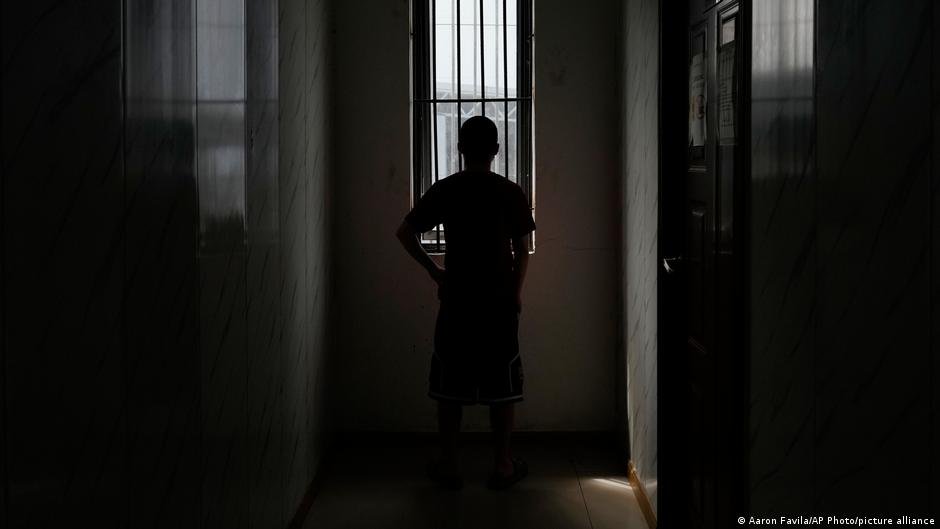
Wind became a forced laborer, made to work up to 16 hours a day perpetrating complex online scams. If he failed to meet expectations, he was beaten and sold on to other criminals for several thousand dollars. He was eventually rescued by the Philippine police. Ever since, Wind has been stuck in this makeshift detention center, waiting to be allowed to return to China.
Image: Aaron Favila/AP Photo/picture alliance
In recent years, huge numbers of large-scale cyberfraud networks have sprung up all over Southeast Asia, from the Philippines to Cambodia. The Philippine government of President Ferdinand Marcos Jr. has been taking firm action against the criminals for some time now through the Presidential Anti-Organized Crime Commission, which set up this detention center to house rescued scam workers.
Image: Aaron Favila/AP Photo/picture alliance
The Pasay internment camp was set up in a former scam compound; the Philippine government turned the six-story building into a makeshift detention center. Some former forced laborers are being held here in the same building where they were made to work for the cybercriminals.
Image: Aaron Favila/AP Photo/picture alliance
An empty swimming pool glows blue in the grounds of the infamous Bafou scam compound in Bamban, about an hour and a half from the Philippine capital, Manila. Hundreds of forced laborers were held captive in this huge complex of 36 buildings, which was disguised as an online casino. The police stormed the scam compound in 2024, freeing Wind along with 400 other forced workers.
Image: Aaron Favila/AP Photo/picture alliance
SIM cards and computer parts lie scattered on the floor in the Bafou compound. The then mayor of Bamban was also involved in the scheme. Alice Guo concealed the criminal activity, and used the network to launder millions of dollars. In November 2025, she was sentenced to life imprisonment for human trafficking.
Image: Aaron Favila/AP Photo/picture alliance
This Vietnamese man has made an improvised dumbbell out of water bottles and a stick. The former forced workers are stuck in the internment camp for weeks, months, sometimes even years, until their repatriation is arranged. Four to six people are crammed onto wooden bunk beds in a single room, while others sleep on mattresses on the floor.
Image: Aaron Favila/AP Photo/picture alliance
Many of the people held here say they were physically abused as forced workers. A baton and handcuffs can be seen in the “torture chamber” of the former scam compound in Pasay. Another witness from China told AP he was abused repeatedly: “I was beaten because I didn’t want to scam,” he said.
Image: Aaron Favila/AP Photo/picture alliance
Freed workers line up outside the canteen in the internment camp. Many are originally from other countries in the region, such as Malaysia, Vietnam and China. One man is from Madagascar. The Office of the High Commissioner for Human Rights estimates that more than 300,000 people from 66 countries are being forced to work in criminal cyber networks in Southeast Asia.
Image: Aaron Favila/AP Photo/picture alliance9 images1 | 99 imageshttps://p.dw.com/p/5LdnD