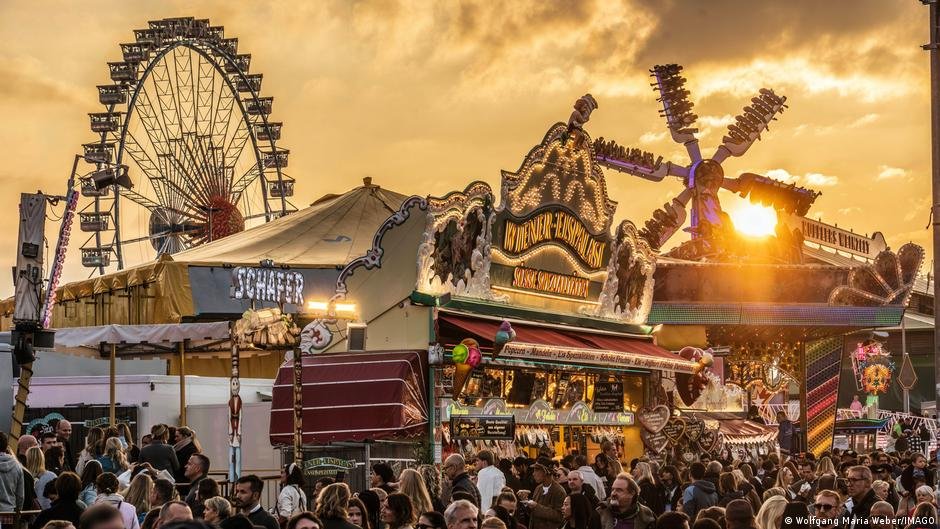
On Saturday, September 19, at noon, Oktoberfest will once again open with the ceremonial tapping of the keg, during which the mayor of Munich drives a tap into the first wooden barrel of beer and calls out “O’zapft is,” a Bavarian phrase that translates to “It’s tapped.”
His call will be followed by 12 gunshots, a signal that lets all festival tents know that they can start serving beer.
More than 6 million people are expected at the world’s largest Volksfest, which runs this year through October 4.
To view this video please enable JavaScript, and consider upgrading to a web browser that supports HTML5 video
Expanded security measures to prevent overcrowding
The festival grounds are enormous: Oktoberfest takes place on Munich’s Theresienwiese, a 34.5-hectare site roughly the size of 48 soccer fields.
But crowds can swell, especially on weekends — sometimes to dangerous levels.
Last year, officials had to temporarily close the entrances.
One reason is that nearly all 38 beer tents operate in two or three reservation shifts. When one group of guests leaves and the next arrives at the 14 large tents — which each accommodate several thousand people — huge numbers of visitors end up trying to enter and exit at the same time.
That’s how, on one Saturday afternoon at last year’s Oktoberfest, the crowds became so dense that movement temporarily came to a standstill. The crush caused some visitors to panic.
To prevent that from happening again, the city of Munich has overhauled its security plan for this year’s festival.
Twenty-six new cameras, in addition to 56 police cameras, will monitor the grounds, while an AI system will analyze visitor flows and issue alerts if areas become overcrowded.
A newly established coordination center is also intended to improve communication between security agencies and event organizers.
Organizers and police have drawn up a plan to defend against drones over the grounds, though no details have been disclosed.
In addition, 600 police officers will be deployed on site.
Oktoberfest is famous worldwide, but most visitors are local
Oktoberfest may be known around the world as an international tourist attraction, but most of its visitors don’t travel very far to get there.
A study commissioned by the city of Munich last year found that the festival remains overwhelmingly regional.
In 2025, 41% of visitors came from Munich, another 25% from the surrounding area and 9% from elsewhere in the region. In all, three-quarters of Oktoberfest’s roughly 6.5 million visitors came from Bavaria. Another 4% came from elsewhere in Germany.
About 21% of visitors — roughly 1.35 million people — traveled from abroad. Americans made up the largest group of international visitors, accounting for just under 20% of the total, or more than 270,000 people. Italians were next, at just over 13%.
Beer prices rise again
Cannabis is banned throughout the festival grounds.
Alcohol, on the other hand, is available in whatever quantities visitors are willing — and able — to pay for. A Mass, the traditional 1-liter mug of beer served at Oktoberfest, costs between €14.80 and €15.90 ($17-$18.25) this year, only slightly more than last year.
A liter of table water comes in at a hefty €11, although the grounds also have several free drinking water fountains.
Visitors planning to enjoy one of Oktoberfest’s many rides would be wise to stay relatively sober. Tickets cost anywhere from just under €5 to €14.
Germany’s traditional fairground culture was officially added to the UNESCO Intangible Cultural Heritage list in 2026, and that tradition remains very much alive at the 191st Oktoberfest. According to organizers, about 90% of the festival’s more than 130 fairground operators can trace their roots back to the 19th century.
The festival remains decidedly traditional when it comes to payment, too: Many vendors still accept cash only. Visitors caught without any can withdraw money from ATMs on the grounds.
Dirndl or lederhosen for Oktoberfest?
Then there’s the question of what to wear.
Bavarians who take pride in doing things properly generally show up in local traditional dress.
The dirndl is the traditional dress worn by women and girls, which consists of close-fitting bodice with a low neckline, a blouse worn under the bodice, a wide high-waisted skirt and an apron.
Men wear lederhosen, the traditional leather shorts or knee-length breeches with suspenders.
For those who are not Bavarian, lederhosen and dirndls are certainly an option, but they’re by no means required. Munich’s event marketing department, Simply Munich, advises first-time visitors to consider renting traditional garb rather than buying it.
Be aware that locals find cheap imitations of traditional dress off-putting, as Simply Munich points out: “If you want to avoid wry looks, steer clear of Seppl hats, ‘leather pants’ made of cloth and garish mini plastic dirndls. With jeans and a checkered shirt, you’ll definitely be more suitably dressed.”
This article was originally written in German.