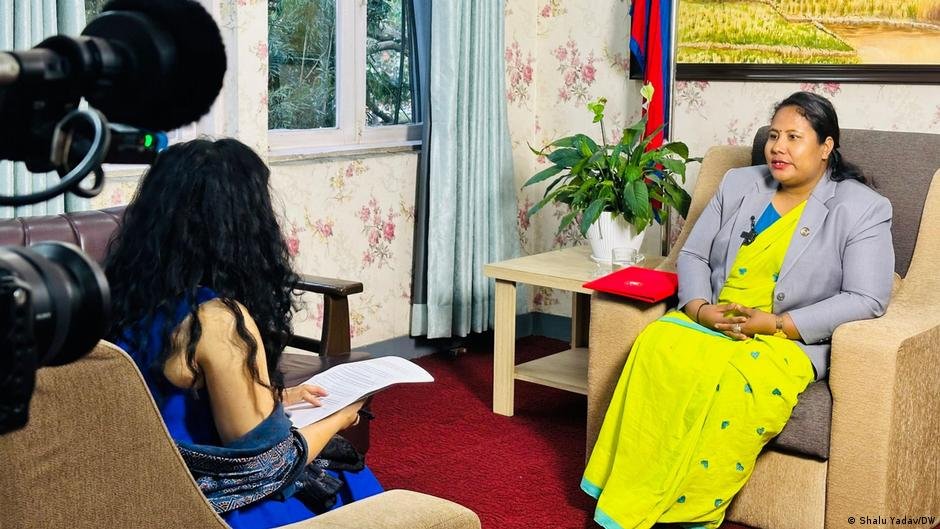
Nepal is seeking $20 million (just under €17.5 million) from the international Loss and Damage Fund, the UN-backed mechanism designed to support countries suffering irreversible climate-related losses, Environment Minister Geeta Chaudhary said in an exclusive DW interview.
The move comes after floods and landslides killed more than 1,400 people in August and left thousands missing.
“We have already issued the official letter for the fund for the loss and damage,” Chaudhary told DW. “Most of the countries have sent us a positive response.”
The flash flooding caused widespread destruction across large swathes of Nepal, damaging homes, agricultural land and infrastructure. Rescue and recovery efforts are still ongoing in several areas, while authorities continue to assess the full scale of the losses.
In the Himalayan nation, the tragedy has become a powerful symbol of what developing countries describe as the unfair climate burden of contributing little to global emissions while facing disproportionate consequences.
‘Sympathy alone will not work for us’
Talking to DW, Chaudhary repeatedly framed Nepal’s response through the lens of climate justice, a concept that has become increasingly prominent in global climate negotiations.
“Sympathy alone will not work for us,” she said. “We don’t need sympathy. We need justice. It’s high time. If you’re not able to give us justice, then we also don’t need the words.”
“Those countries who are emitting the most and are able to contribute the funds, they need to pay for the climatic disasters like what we are facing,” she said.
Nepal contributes roughly 0.1% of global greenhouse gas emissions. Its geography, however, makes it extremely vulnerable to climate-related risks. Rising temperatures in the Himalayas have accelerated glacial retreat and increased concerns about glacial lake outburst floods, landslides and extreme weather events across the region.
To view this video please enable JavaScript, and consider upgrading to a web browser that supports HTML5 video
In the wake of the most recent disaster, the government has intensified calls for more adaptation financing, direct access to climate funds and stronger international commitments to fight consequences of climate change.
‘The world is watching’
Chaudhary pointed to melting glaciers, warming temperatures and changes in mountain environments as factors behind the deadly floods.
“Our evidence is showing that this catastrophic event is because of climate change,” Chaudhary said.
While many scientists agree that climate change increases the likelihood and severity of such events, establishing a causal relationship between a specific disaster and global warming typically requires detailed attribution studies.
Researchers are more likely to point to a combination of factors, including glacier and permafrost degradation, extreme weather conditions and geological vulnerabilities.
The Nepali government, however, insists that the connection is clear.
“We are the real example and the world is watching us,” Chaudhary told DW.
Building support ahead of COP31
The minister’s comments come as Nepal seeks to build momentum for COP31, the UN’s annual climate conference set to be held in Turkey this November.
When asked about her government’s plans for the conference, Chaudhary said “Nepal will no longer negotiate on vague promises or slow-moving traditional and development aid.”
According to the minister, Nepal intends to push for greater recognition of the specific challenges facing mountainous countries, arguing that global climate discussions often overlook the risks confronting Himalayan regions.
“Mountain issues need to be addressed,” she said. “The world needs to see us, that we are victimized countries. We are paying the price.”
Chaudhary also pointed out that Nepal received strong backing from fellow vulnerable nations at the recent gathering of Least Developed Countries (LDCs) in Timor-Leste.
“All the LDCs stood with us,” she said. “They are very concerned.”
The government plans to bring climate concerns to the UN General Assembly, highlighting the recent disaster and calling for concrete support from the international community.
Nepal to improve its early warning systems
The scale of the disaster has also prompted scrutiny inside Nepal, particularly of the country’s warning systems and its disaster response.
Residents in some affected areas have complained that warnings came too late or did not adequately reflect the scale of the danger.
To view this video please enable JavaScript, and consider upgrading to a web browser that supports HTML5 video
Chaudhary defended the government’s response but conceded that existing systems were overwhelmed by the sheer scale of the event.
“We had sent them messages and information,” she said. “But the situation was beyond imagination.”
She acknowledged that Nepal’s early warning systems must improve and said authorities are now reviewing and strengthening existing monitoring mechanisms.
“Our hydrology and meteorology departments are working on that,” she said.
The floods also highlighted the importance of cooperation between Nepal and its neighbors, particularly China, in monitoring river systems and glacial hazards that cut through national borders.
“We are working closely,” Chaudhary said, adding that technical teams from both countries are sharing information and examining future risks.
Himalayan catastrophe as a warning for the world
For Chaudhary, the disaster is not only a national tragedy but a warning about the future.
“Our snow is melting, our lakes are in danger,” the minister said.
She warned that, unless global warming is limited in line with the Paris climate agreement of 2015, vulnerable countries could face increasingly severe disasters.
Asked whether the world is acting fast enough, the minister responded: “I don’t think so.”
To view this video please enable JavaScript, and consider upgrading to a web browser that supports HTML5 video