


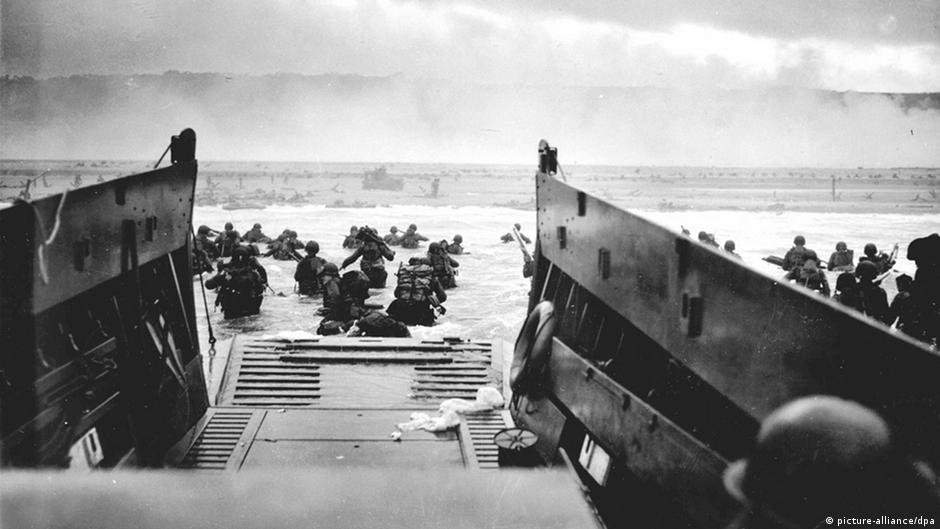
On June 6, 1944, Allied troops landed at Normandy and opened a second front against the Nazis. It was the beginning of the end of World War II, and one of the most mythically charged moments in 20th century history.
Image: picture-alliance/dpa
The Normandy invasion is known historically as D-Day, but it remains unclear what exactly the “D” means. Whether it’s simply a signifier for “Day,” or it means “Decision,” one thing is for certain. It was the beginning of one of the most significant battles in military history.
Image: Imago
The five sectors of the 80-kilometer (50-mile) stretch of Normandy coast where the landings happened were all given different names: Utah, Omaha, Gold, Sword, and Juno. Apart from the US, 13 other nations were involved in the invasion. Troop contingents were provided by the Americans, British, Polish, Canadians, French, Greeks, Czechs and Australians.
Image: Imago
The commander of the Allied forces in northern Europe was General Dwight Eisenhower, who would go on to become the 34th president of the United States. A few months prior to D-Day, Eisenhower had successfully led landings in Sicily and mainland Italy.
Image: Imago
Just before the planned start of Operation Overlord on June 5, storms broke over Normandy, forcing Allied commanders to push the invasion back a day. The largest amphibious landings in military history got underway on June 6. The weather was not ideal, but allies feared Germans would learn of their plans if the delay continued.
Image: public domain
Around 156,000 soldiers reached land on D-Day. On five different locations on the beach, they stormed the “Atlantic Wall,” where German Wehrmacht soldiers were perched in fortifications that had been built in anticipation of an assault. The allied troops were forced to run unprotected, first through water and then onto the beach, all the while under German fire.
Image: AP
Before the D-Day Invasion began, paratroopers had touched ground early on June 6 in a bid to secure key positions behind the Atlantic Wall. The troopers were camouflaged (shown here); they also used war paint and Mohawks to frighten the enemy.
Image: Imago
At first, the beaches of Normandy were bombed from the air by the Allies. After the beach had been secured, over 1,000 warships and some 4,200 landing crafts converged on the coast. Further reinforcement was provided by thousands of planes and tanks.
Image: picture-alliance/akg-images
One of the reasons why “Operation Overlord” was so successful was that the German military command simply wasn’t expecting it – at least not in Normandy. The Allies duped the Nazis into thinking they would land at Calais, near the Belgian border, and at a date later than June 6.
Image: AP
Many leading NS officers had absolutely no idea D-Day was going to happen when it did. Field Marshall Erwin Rommel, for instance, was celebrating his wife’s 50th birthday in the south of Germany when the invasion started. (Pictured above: Wehrmacht divisions at Normandy in 1940)
Image: Imago
When the invasion got underway, Adolf Hitler was sleeping in Obersalzberg. His officers didn’t dare wake him, and when they did (at 10 in the morning), the Nazi leader was in surprisingly good spirits. After being briefed, he is said to have exclaimed: “The news couldn’t be better!” Hitler was apparently pleased that the Allies were “finally in a place where we can defeat them.”
Image: picture-alliance/akg-images
Even if the Normandy landings were perhaps the decisive battle for the Allies, the final victory came at heavy price. It still took 11 months for peace to be declared in Europe, and many of the soldiers who took part in the invasion were shipped straight to the Asia Pacific shortly thereafter. The war lasted until September 2, 1945, when Japan capitulated.
Image: AP
Around 57,000 Allied soldiers lost their lives in Operation Overlord, which started on D-Day and continued until the end of August. Another 155,000 were injured and 18,000 reported missing. German losses rounded out at about 200,000. Each year on June 6, there is a ceremony of remembrance at Normandy. Heads of state and government and many veterans often make the trip to the French coast.
Image: AP
In 2004, German Chancellor Gerhard Schröder became the first German leader to take part in the ceremonies at Normandy. Chancellor Gerhard Schröder, shown embracing France’s Jacques Chirac, chose his words carefully for the event: “We will never forget the victims.” Schröder added: “It’s not the old Germany of those dark years that I am representing today.”
Image: picture-alliance/dpa13 images1 | 1313 imageshttps://p.dw.com/p/1CCHQ







