On September 23, fighting escalated dramatically in Ethiopia‘s Tigray region. Tigrayan forces seized three local airports and the conflict spread into the neighboring regions of Afar and Amhara, according to reports.
Both sides have accused the other of starting the escalation. The renewed fighting poses a major challenge to the 2022 Pretoria peace agreement that ended the previous Tigray war.
This is where Eritrea becomes crucial. Martin Plaut, a British journalist specializing in the Horn of Africa, noted that the US needs Eritrea in the struggle to secure the Red Sea against the Houthis, an Iran-backed Shiite Muslim militia.
Plaut argues that removing sanctions gives new political weight to one of Africa’s most repressive regimes.
As fighting resumes in Tigray, Eritrea could once again become a decisive military player. Plaut said the current tensions had the potential of developing into a broader regional confrontation, which, he said, “is the most serious danger.”
In his view, the administration of US President Donald Trump has already made a strategic calculation. “Trump has now mended fences with Eritrea and has lifted sanctions against Eritrea” in an effort to reduce the threat posed by the Houthis and secure the Red Sea, said Plaut.
A striking coincidence of timing
The escalation in Tigray came only days after Washington removed key Eritrean entities and individuals from its sanctions list.
On September 18, the United States allowed the national emergency underpinning its Ethiopia-related sanctions regime to expire. The Treasury Department subsequently removed a number of Eritrean individuals and entities from its sanctions list, including senior financial official Hagos Ghebrehiwet and the Red Sea Trading Corporation. The measures had originally been imposed in 2021 in connection with the Tigray war.
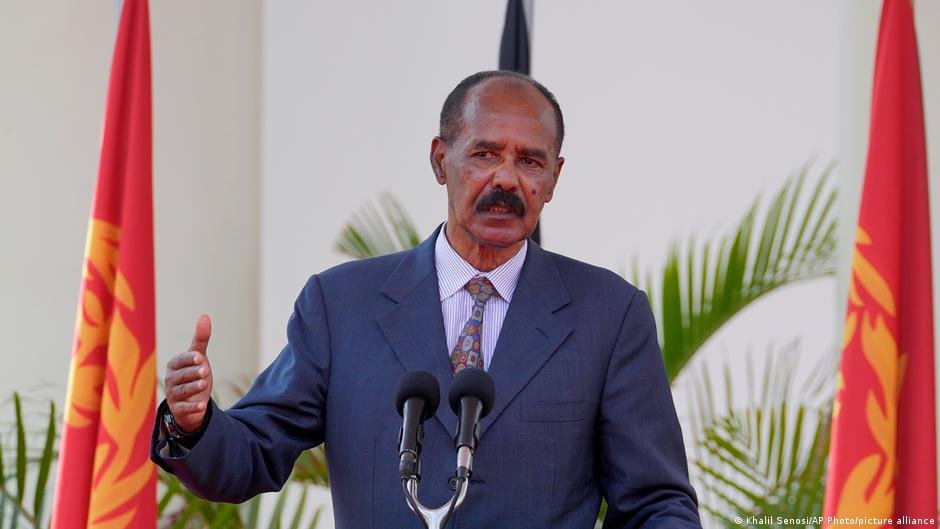
US officials have not described the move as an endorsement of Eritrea, nor has Washington publicly said that it struck a deal with Eritrean President Isaias Afwerki. But it removes a layer of pressure on a government whose strategic importance has grown as security around the Red Sea deteriorates.
For Abdurahman Sayed, director of the Horn of Africa Centre for Regional Integration and a political analyst, the wider geopolitical context is crucial.
“It is happening at a time when the war on Iran is ongoing,” he told DW. “The Strait of Hormuz has been blocked for some time, and now the Bab el-Mandeb on the Red Sea, where Eritrea is located — this may give Eritrea some advantage to establish a meaningful relationship with the US.”
Why Eritrea matters
Eritrea controls a long coastline opposite Yemen. Its southern port of Assab lies close to the Bab el-Mandeb Strait, one of the world’s most important maritime waterways.
Moses Okello, a senior researcher at the Institute for Security Studies in Addis Ababa, said the regional context has fundamentally changed since the previous Tigray war.
“In 2020, the concern was the TPLF [Tigray People’s Liberation Front] versus the Ethiopian National Defense Force [ENDF],” he told DW. “Today, the entire Middle East is up in flames, and now the tensions in the Red Sea. So this changes the strategic value of not just the Eritrean coast, but the entire Red Sea waterway.”
To view this video please enable JavaScript, and consider upgrading to a web browser that supports HTML5 video
For Washington, cooperation — or at least non-hostility — from Eritrea can therefore be strategically valuable.
But the bargain carries risks.
Eritrea is one of the world’s most authoritarian states, with no national elections since independence in 1993 and an extensive system of indefinite national service. Eritrean forces also fought alongside Ethiopian federal troops during the 2020-22 Tigray war.
And the economic impact of lifting sanctions may be more limited than the political symbolism suggests. “Lifting the sanctions may not make a huge difference on the ground,” said Sayed. “Eritrea is not a trade hub [nor does it have] a well-established trading relationship with the outside world. It’s actually a closed country.”
Ethiopia heads back toward war
The latest fighting did not emerge from nowhere.
On September 21, seven Ethiopian armed and political groups announced an alliance aimed at removing Prime Minister Abiy Ahmed’s government. The coalition includes the TPLF, the Amhara Fano National Movement and the Oromo Liberation Army. Some members were on opposing sides during the 2020-22 Tigray war.
It remains unclear how closely the alliance’s members will coordinate militarily. The alliance brings together groups with very different histories that share opposition to the federal government.
Two days later, fighting escalated in Tigray. Tigrayan forces seized airports and fighting spread into neighboring regions. The TPLF has said federal forces attacked first; Addis Ababa has said the TPLF launched the offensive.
The renewed fighting has raised questions about the durability of the 2022 Pretoria agreement.
Could Eritrea intervene?
During the previous Tigray war, Eritrean forces fought alongside Ethiopian federal troops. But relations between Afwerki and Abiy have since deteriorated sharply.
One major dispute concerns Ethiopia’s demand for reliable access to the Red Sea. Landlocked since Eritrea’s independence, Ethiopia regards maritime access as a strategic necessity. Eritrea insists on its sovereignty and has rejected any suggestion that Ethiopia could obtain access through coercion.
To view this video please enable JavaScript, and consider upgrading to a web browser that supports HTML5 video
The Ethiopian government has accused Eritrea of supporting armed groups in the new conflict. Eritrea has denied such allegations.
There is currently no public evidence that the US sanctions decision was designed to encourage Eritrean military intervention in Ethiopia. Nor is it clear that Eritrea has decided to enter the fighting.
But if the Tigray conflict intensifies, Eritrea could see a direct security interest in intervening. That would transform an Ethiopian conflict into a potentially interstate confrontation.
A regional conflict waiting to spread
The Horn of Africa is already exceptionally volatile.
Sudan remains at war. Somalia is unstable. Ethiopia and Egypt remain locked in a dispute over the Nile and the Grand Ethiopian Renaissance Dam. Saudi Arabia and the UAE are pursuing their own interests across the Red Sea and Horn of Africa. And the conflict in Yemen is directly connected to the security of the Bab el-Mandeb Strait.
Okello sees the changing Middle East as an additional reason for urgent engagement. “There is no doubt that the conflict in the Middle East now puts a new contextual layer over that primary tension and increases the urgency to engage with both Eritrea and Addis Ababa to try and address this before it becomes a conflagration which makes addressing issues in the Red Sea a lot more difficult,” he said.
A new Ethiopia-Eritrea confrontation would therefore not happen in isolation.
Plaut warned that regional alliances could interact in dangerous ways. “You have the UAE backing the RSF and you have the Saudis backing the Eritreans and the Sudanese Armed Forces,” he said. “This could all multiply and you could get one conflict leading into another.”
That does not mean a general regional war is inevitable. Most governments involved have strong reasons to prevent an uncontrollable escalation. But the number of links between the region’s conflicts is increasing.
Eritrea and shifting regional dynamics
For Eritrea’s President Afwerki, the US decision is an opportunity.
The end of the sanctions removes one source of international pressure and may give Eritrea greater diplomatic room for maneuver. More importantly, Washington’s renewed engagement with Asmara underscores the strategic value of Eritrea’s Red Sea position.
To view this video please enable JavaScript, and consider upgrading to a web browser that supports HTML5 video
The more important Eritrea becomes to US and regional security calculations, the greater the danger that strategic interests will overshadow concerns about its authoritarian system and past military interventions.
For Ethiopia, the immediate question is whether the renewed fighting can be stopped before it draws in Eritrea.
For Washington, the challenge is whether Eritrea can be engaged as a Red Sea security partner without giving the country greater freedom to destabilize its neighbors.
Eritrea has spent decades on the margins of international diplomacy, but its location on the Red Sea has long given it strategic significance.
With fighting again raging in Tigray, the Houthis threatening the Red Sea and Washington reopening its channel to Asmara, Eritrea could become one of the key players in the Horn of Africa’s next chapter.
Ekinder Firew in Addis Ababa contributed to this report.
Edited by: Keith Walker