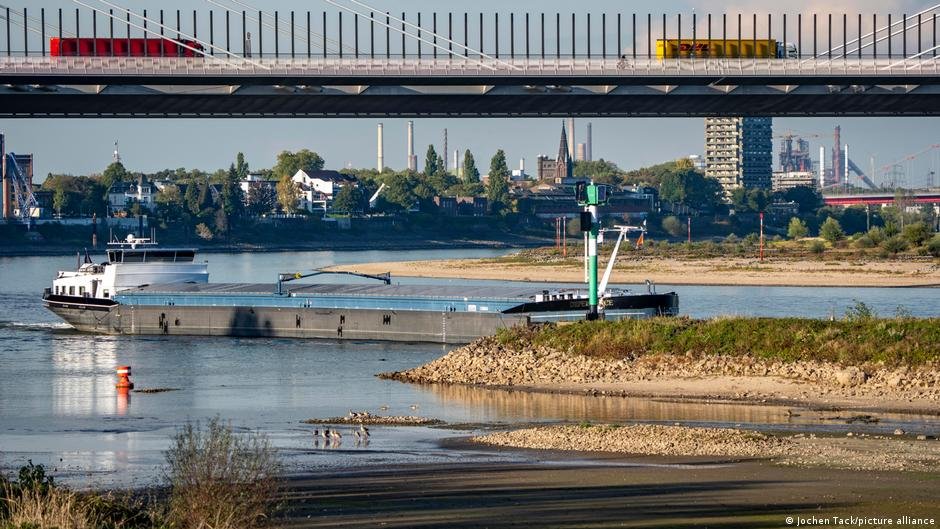
The cooler autumn months have done little to ease the severe strain on Europe’s waterways, with navigation still disrupted along some parts of the Rhine River.
Image: Jochen Tack/picture alliance
Extremely low water levels continue to take a heavy toll on rivers and lakes across much of Europe. After the warmest summer on record in Western Europe, autumn has so far brought little relief to the parched waterways. On Lake Constance, Germany’s largest inland lake, the water level is currently about 90 centimeters (35 inches) below the average for this time of year.
Image: Felix Kästle/dpa/picture alliance
A rapid recovery is not in sight, with Switzerland’s national drought platform reporting high-risk drought conditions in and around Lake Constance. One of the lake’s main tributaries, the Rhine, is carrying particularly low volumes of water. Officials say it would take a significant amount of precipitation in the fall and winter to restore water levels in Lake Constance to normal.
Image: Gian Ehrenzeller/KEYSTONE/dpa/picture alliance
According to the Baden-Württemberg State Institute for the Environment, climate change is reshaping the conditions that feed Lake Constance, with rising temperatures altering snowfall and snowmelt patterns. The agency has said extreme water levels are becoming more and more likely — at both ends of the spectrum. That can mean flooding, or critically low water levels.
Image: Markus Keller/imageBROKER/picture alliance
The Rhine River, a key inland waterway in western and central Europe, is also still struggling with record-low water levels. In response, Germany’s Environment Minister Carsten Schneider has warned that, “the times when we in Germany did not have to worry about water are definitely over.”
Image: Jochen Tack/picture alliance
The ongoing low water levels are increasingly disrupting shipping along the Rhine. Numerous ferry services have been suspended, while inland vessels, particularly in southern Germany, can operate only with reduced cargo loads. Germany’s Federal Network Agency has also warned of potential impacts on energy supply logistics.
Image: Marc John/Bonn.digital/picture alliance
A Europe-wide survey has highlighted the extent of the crisis: During the summer months, significantly less water than usual flowed through Europe’s rivers, while at the same time, the oceans surrounding Europe were unusually warm. The consequences range from irrigation problems and declining freshwater reserves to a higher strain on the energy sector.
Image: Jochen Tack/picture alliance
On the border between France and Switzerland lies Lake Brenets, fed by the Doubs River. But the once-picturesque lake is drying up, and the Doubs has shrunk to a trickle. Geological fissures, low rainfall and recurring heat waves are all contributing factors. In late September, local residents wrote a message in the grass-covered bed of the parched lake.
Image: Fabrice Coffrini/AFP7 images1 | 77 imageshttps://p.dw.com/p/5O4Ic